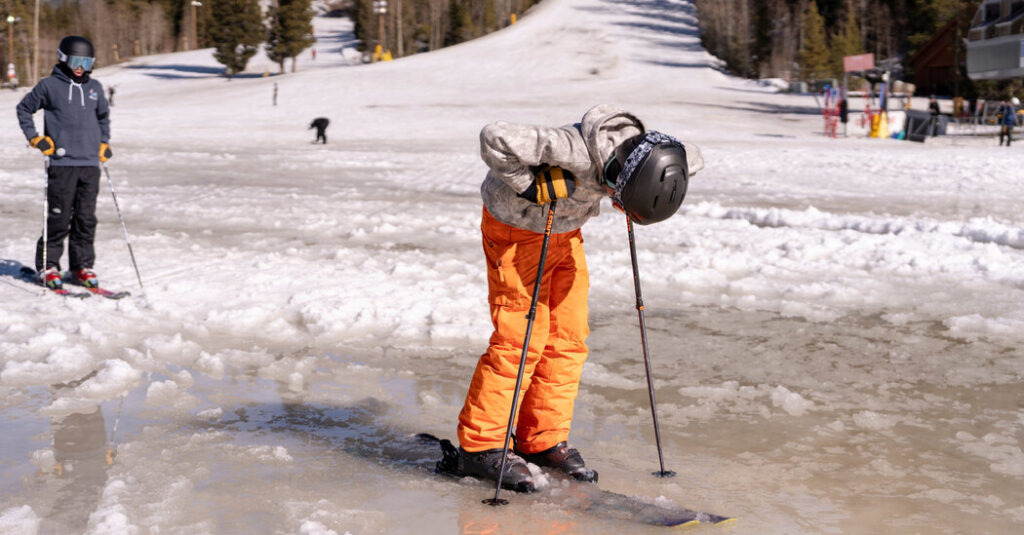
After the warmest winter on record for many states and a blistering March heat wave that left almost no snow in parts of the American West, the region is facing a summer of serious wildfire risks and a drought that could force broad water restrictions.
New measurements this month show most of the Mountain West won’t be able to rely on melting snow, the region’s largest water source, because there’s hardly any snowpack there. And while some rain is forecast in the coming weeks, any spring precipitation will likely be too little, too late, scientists said.
“It’s going to be a seriously dry summer ahead,” said Nels Bjarke, a research scientist with the Western Water Assessment at the University of Colorado, Boulder.
Scientists in many parts of the West found a snow drought this month unlike any they had seen. Almost the whole region was affected, rather than just isolated pockets, said Noah Molotch, a professor of hydrology at the University of Colorado, Boulder.
At one key snowpack measurement site in California’s Sierra Nevada, scientists last week found only traces of snow. In parts of western Colorado, mountain slopes where researchers have always measured at least 6 inches of snowpack at this time of year were virtually snowless. Across that state, snowpack was less than half of normal.
Those findings were the product of a record-warm winter for many western states. Through much of the winter, temperatures were simply too warm for it to snow, and precipitation fell as rain instead, unlike in previous low-snow years caused by a general lack of moisture, said Karla Nemeth, director of the California Department of Water Resources. Snowpack, which builds up over the winter and spring, provides a larger, steadier and less ephemeral source of water than rain.
Then, a March heat wave across the West broke monthly temperature records in more than a dozen states — and it wiped out much of the already thin layer of winter snow. Across the upper Colorado River basin, snowpack was about 52 percent of the median historical amount on March 1, already low. By April 1, it had diminished to 23 percent of the median, according to the Colorado Basin River Forecast Center, which released new measurements Monday.
That means very little fresh water will flow out of the mountains this spring and summer. Across the Colorado River basin, government scientists are predicting stream and river volumes will be among the smallest ever observed.
The amount of spring and summer runoff forecast to reach Lake Powell, the nation’s second-largest reservoir and a vital store of Colorado River water on the Utah-Arizona border, is forecast to be just 22 percent of normal, according to the river forecast center. If dry weather continues, there is a growing chance — about 30 percent as of April 1 — that water flows into the lake over the next four months will be the smallest on record, surpassing a 2002 drought that helped spur changes in how the Colorado is managed.
Across the West, water utilities have started to call for conservation, though the measures are largely voluntary so far because reservoir storage remains relatively healthy despite the low snow totals.
Denver’s water agency is seeking to cut usage by 20 percent, asking customers not to turn on automatic lawn sprinklers and other irrigation systems until at least mid-to-late May. Salt Lake City is asking residents and businesses to help cut water use by 10 million gallons per day.
In Las Vegas, normal spring watering restrictions are in place, including a 12-minute limit on lawn sprinklers. Phoenix water authorities declared a “stage 1 water alert,” which carries no requirements to reduce usage but encourages residents and businesses to be mindful of drought conditions and to conserve water when possible.
Across California, water authorities are closely watching their supplies, with snowpack at just 18 percent of normal for this time of year, said Ms. Nemeth of the state’s water department. That snow typically provides about a third of California’s water in any given year, she said, and virtually all of the state’s supply falls in the winter months.
While Denver’s reservoir storage is running only slightly below average, at about 80 percent of capacity, more usage restrictions could be ahead, Denver water officials warned.
“This is not our first drought, and we will get through this challenging time, but we need everyone to help out this summer in case drought conditions persist into next year and beyond,” Tyrone Gant, president of the Denver Board of Water Commissioners, said last month.
The conditions have already elevated fire dangers across the region, including in much of Nevada, Utah, Colorado, Arizona, Wyoming and Montana, according to U.S. Geological Survey data that captures changes in vegetation moisture levels and density as well as wind conditions. Early snowmelt and dry weather mean soils are drying out more quickly than usual, leaving vegetation more flammable. From January through March, more than 1.6 million acres burned in wildfires across the country, more than twice the average of the last decade, the National Interagency Fire Center said.
The snow situation is also exacerbating tensions over water in the West. The federal Bureau of Reclamation is writing a plan to divvy up the Colorado River’s dwindling flows — one that better reflects the decades of drought that is forecast to continue as the climate changes in the West. A century-old agreement among states that use the river’s water was last updated in 2007, and its rules aren’t keeping up with changing hydrology. It expired at the end of last year.
Kyle Roerink, executive director of the Great Basin Water Network, a Nevada-based advocacy group, said he hopes this year’s challenging conditions spark deeper conversations about how the West must adapt to a drier future.
“This might be what it takes to get us to truly adapt to 21st century realities,” Mr. Roerink said. “If we believe what the top scientists are saying, this isn’t the worst it’s going to get in the 21st century.”
Odds are also increasing that an intense episode of the global climate pattern El Niño will develop later this year, and it isn’t clear how that may affect Western water fortunes. The pattern has in the past led to warmer-than-normal conditions across the Southwest, potentially increasing drought. But is also known for sending soaking rains across the southern tier of the United States during the winter months.
In some past El Niño years, predictions of increased precipitation for the Southwest failed to materialize because day-to-day weather patterns that carry eastern Pacific moisture can vary, Mr. Bjarke said.
“It’s not a guarantee,” he said. “It’s difficult at this point to plan for that.”
Confronting the looming water challenges will take infrastructure that can better capture rain and snowmelt and can use it more efficiently, through solutions such as recycling, said Ms. Nemeth, the California water official.
“This is us experiencing the realities of warmer temperatures that come with climate change,” Ms. Nemeth said. “It’s going to challenge our historic water practices in the state.”
Scott Dance is a Times reporter who covers how climate change and extreme weather are transforming society.
The post Heat Wipes Out Western Snowpack, Raising Fears of Drought, Wildfire appeared first on New York Times.