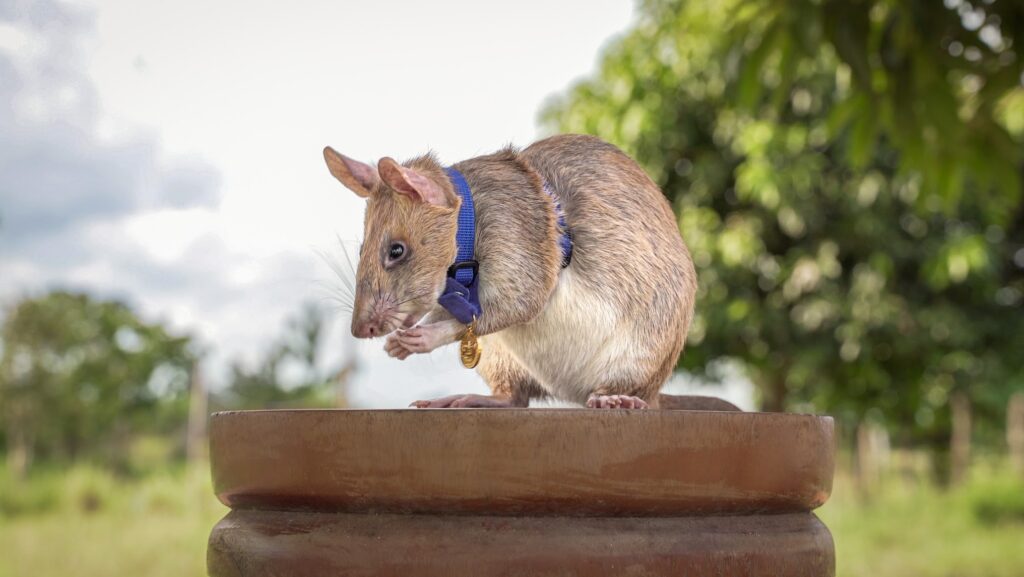
Although Magawa weighed less than three pounds, his impact was monumental. The African giant pouched rat sniffed out more than 100 land mines during his five-year career, saving countless lives.
To honor his bravery, a seven-foot statue of Magawa was unveiled on Friday in Cambodia, where he spent his time nose-down on high-stakes missions. Magawa died in 2022, but his legacy lives on.
“Magawa was one of the best rats we’ve ever had,” said Michael Raine, a program manager in Cambodia for Apopo — a Belgium-based nonprofit that trains animals to detect land mines. “Magawa was calm and focused … he was gentle and friendly with his handlers. He just had the perfect temperament.”
Born in 2013 at Apopo’s headquarters in Tanzania, Magawa was trained as a “HeroRAT,” learning to harness his strong sense of smell to detect explosives. In 2016, he was relocated to Siem Reap, Cambodia, to begin his career, quickly rising to the top among Apopo’s rats. He even has his own Wikipedia page.
Raine said Magawa could search a field the size of a tennis court within about 20 minutes — a task that would take a human several days.
“He was curious, very composed and quick at work,” Raine said. “He knew his job.”
Apopo trains rats using positive reinforcement, teaching them to identify chemical compounds in explosives, such as trinitrotoluene. When a rat detects a land mine, it scratches the surface, alerting its handler. The rat is then rewarded with a treat, typically a peanut or a slice of banana.
Rats are well-suited to this work, Raine said, mainly due to their small size and highly developed olfactory system.
“They’re so light they wouldn’t trigger a land mine,” Raine said. Plus, “they have an extremely sensitive sense of smell and they are quite intelligent.”
Cambodia has one of the world’s highest concentrations of land mines, largely stemming from the Khmer Rouge era in 1979 and the Vietnamese occupation between 1979 and 1989.
In the past 47 years, land mines in Cambodia have caused about 18,800 deaths and 45,000 injuries. Apopo started training mine-detection rats in 2015, which helped speed up the efforts to locate mines, though an estimated 6 million land mines remain in Cambodia, according to Apopo.
“Millions of mines have been cleared; however, there’s still a huge task ahead of us,” Raine said. “Cambodia’s target is to be land mine free by 2030.”
Magawa’s individual impact is remarkable, Raine said. He cleared more than 1.52 million square feet — roughly 26 football fields — and detected dozens of land mines. In 2020, Magawa became the first rat to receive the PDSA Gold Medal, which rewards animal bravery and devotion to duty.
“That recognition made him stand out,” Raine said.
Although rats don’t bond with their handlers like dogs do, Raine said, they have distinct personalities and work styles.
“The handlers know the fast ones and the slow ones,” Raine said.
When a rat identifies a mine, human handlers are then able to investigate and safely destroy it.
The rats have one day off a week, Raine said, when they get a “special feast” of bananas, peanuts and seasonal fruit. They also get daily playtime and exercise.
After retiring in 2021, Magawa spent several weeks mentoring younger rats, helping them refine their detection skills by his example.
“He stayed with Apopo and helped socialize and acclimatize other rats,” Raine said. “Rats will learn from each other through routine exposure.”
African giant pouched rats typically live between five to eight years.
“Magawa lived a good, long life,” Raine said.
The giant statue of Magawa, hand-carved from stone by local artists, was commissioned by Apopo and unveiled on the eve of International Day for Mine Awareness. In attendance were government officials, including the head of the Cambodian Mine Action and Victim Assistance Authority. Land-mine victims were also present, as well as children from a local school.
“What Magawa delivered was excellent, and it was a good way to remember him and also remind people in a nice way that there’s still a mine problem here in Cambodia,” Raine said.
Magawa already has a successor named Ronin, one of Apopo’s newest standout rats. Ronin set a world record last year by detecting 109 land mines during his four-year career.
“He’s got similar traits to Magawa: highly accurate and a strong work drive,” Raine said. “He’s the next generation … there’s still a big job to be done.”
The post Hero rat who sniffed out over 100 land mines is honored with giant statue appeared first on Washington Post.