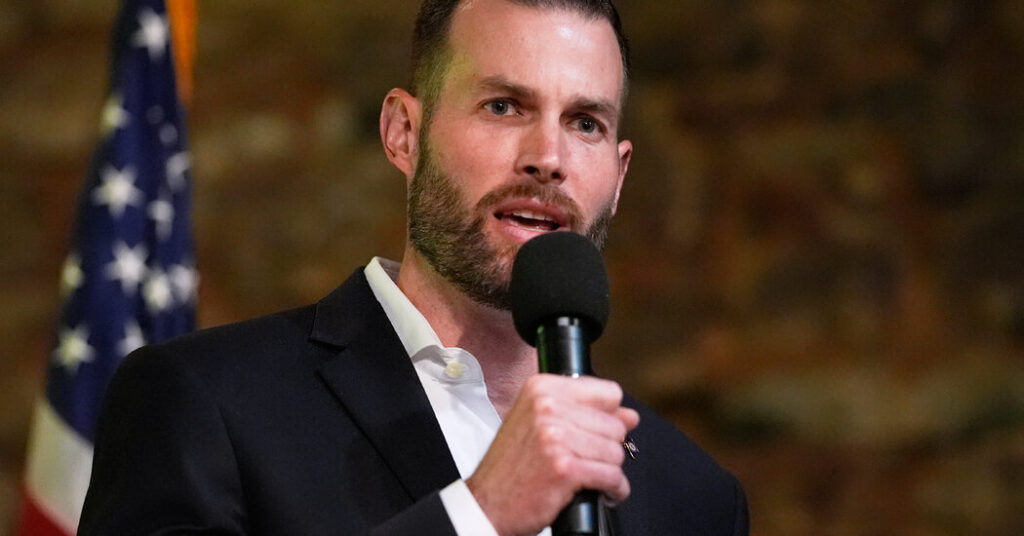
On Tuesday night, voters in a conservative and rural corner of Georgia sent a Republican, Clay Fuller, to Congress to replace Marjorie Taylor Greene. But they did so with decidedly less enthusiasm than they showed two years ago: All 10 of the district’s counties shifted by double digits toward the Democratic candidate compared with the 2024 presidential election.
And in Wisconsin, voters again handed a liberal Supreme Court candidate, Chris Taylor, a commanding victory over a conservative rival, cementing a five-to-two liberal majority on the state’s high court. Judge Taylor’s victory came by an even wider margin than the 2023 and 2025 liberal triumphs in Wisconsin Supreme Court elections that drew national attention and served as magnets for political donors.
Georgia’s special election had the largest shift toward Democrats, about 25 points, of any congressional contest since President Trump took office at the beginning of 2025. It came a year after Wisconsin’s last state Supreme Court race brought the first Democratic rebuke of Mr. Trump’s second term.
Here are three takeaways from the Tuesday night results:
A Big Shift in Georgia
Mr. Fuller won comfortably in a special election that was never much in doubt. But Republicans elsewhere will take note that a district where Mr. Trump took 68 percent of the vote in 2024 swung 25 points away from Mr. Fuller on Tuesday.
The shift is a potential harbinger for Republicans in this year’s midterm elections. Nearly two dozen House Republicans won their 2024 races by 10 points or less. The Senate map includes seats in Alaska, Iowa, Ohio and Texas that could be in play if the Democratic advantage proves to be durable through November. Georgia Democrats also saw the outcome as a boost for Senator Jon Ossoff, who is seeking re-election this fall.
Turnout, of course, is expected to be higher in November than in any special election. Torrents of money will materialize that was not present in a Georgia special election Republicans were certain to win. But Mr. Trump tried to help Mr. Fuller. He offered a full endorsement and traveled to the district for a rally in February.
Shawn Harris, the Democrat who lost to Mr. Fuller, declared victory anyway.
“If Democrats, independents and Republicans can do this in a ruby-red district, the Democrats can win anywhere,” Mr. Harris said Tuesday night after his defeat. “Nobody ever thought that we would ever be this close.”
Democrats Romp Again in a Wisconsin Court Election
The last two Wisconsin Supreme Court elections became nationalized contests that shattered fund-raising records. First $50 million, then $100 million. Mr. Trump endorsed, and Elon Musk visited to campaign.
This time, Republicans barely put up a fight — and the liberal candidate won by even more. The narrative lives on that Wisconsin off-cycle elections are a bad bet for Republicans.
After losing the 2023 and 2025 Supreme Court races by double digits, Republicans invested little money in this year’s contest. Maria Lazar, a conservative state appeals court judge, spent less than $1 million and got virtually no help from outside groups.
Wisconsin judicial elections are technically nonpartisan, but the two major parties typically back respective slates of liberal and conservative candidates.
The relative pittance spent on Judge Lazar’s campaign followed a widespread belief in the state that Democrats and liberal candidates benefit from a substantial advantage in off-year elections. The Democratic Party of Wisconsin is far better funded than its Republican counterpart, and Democratic voters are more likely to participate in low-turnout spring elections.
“Since the 2025 Supreme Court rout, Trump has only gotten more extreme and unhinged, daily life has become even less affordable, and the voters most closely tracking the news have reached volcanic levels of outrage,” said Ben Wikler, the former chairman of the state party.
A Blue Wave Lands in Crucial Waukesha County
Judge Taylor’s 20-point triumph reshaped Wisconsin’s election night map. All across the state, counties that had voted for Mr. Trump by wide margins turned blue on Tuesday.
Perhaps most worrisome for Republicans was the erosion of their votes in Waukesha County, for generations the party’s largest source of votes and a place where, as recently as 2012, Mitt Romney won 67 percent of the vote.
Judge Lazar was on track for just 54 percent — four points less even than the conservative Supreme Court candidate took a year ago when he was trounced statewide. The math in Wisconsin is simple: Given Democratic strength in Milwaukee and Madison, a Republican candidate must deliver a big margin in Waukesha and other vote-rich conservative suburbs to have any shot at winning statewide.
Democrats have been organizing in the county for years, hoping to flip some key seats in the State Legislature there this fall in their effort to win control of the State Assembly and Senate for the first time since 2010.
And in the mayoral race in the City of Waukesha, Alicia Halvensleben, a Democrat on the city’s Common Council, defeated State Representative Scott Allen, a Republican, giving Democrats a triumph in the longtime G.O.P. stronghold.
Tim Balk contributed reporting.
Reid J. Epstein is a Times reporter covering campaigns and elections from Washington.
The post Warnings for the G.O.P.: 3 Takeaways From the Elections in Georgia and Wisconsin appeared first on New York Times.