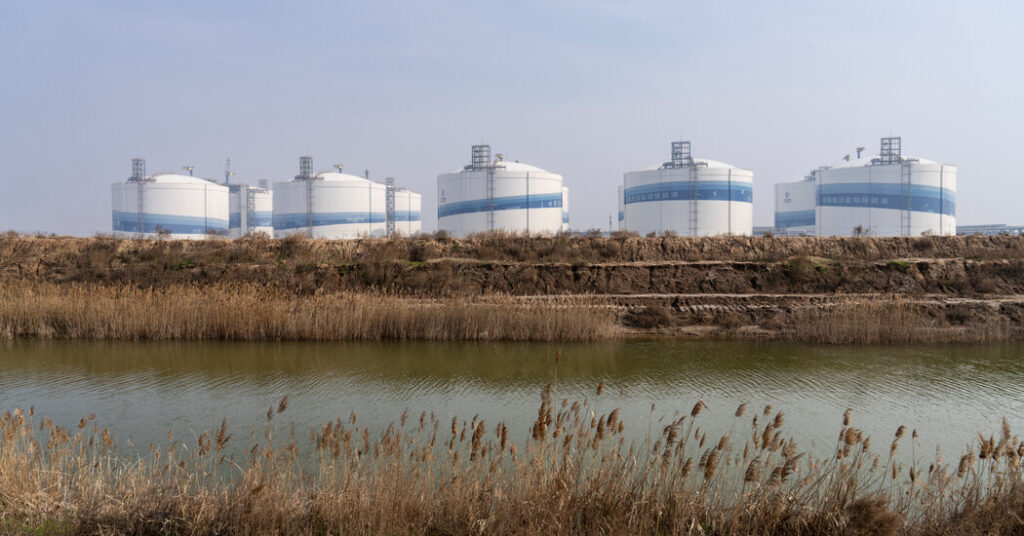
Two rows of storage tanks the height of 20-story buildings, filled with liquefied gas, help explain why China is better prepared than many countries to endure the interruption of gas supplies from the Middle East.
Each of six tanks in Yancheng, an industrial port, holds enough natural gas to meet the household needs of Beijing’s 22 million people for more than two months. Adjacent to them are four more tanks that are only slightly smaller.
The storage tanks are part of a huge effort by China over the past decade to accumulate stockpiles of all kinds of commodities, from pork and rice to rare-earth metals and coal, in case of a disruption of overseas supplies. But the natural gas stockpiles — the world’s largest above ground are in Yancheng, with more giant storage tanks in southern China — are conspicuously important now. They have helped China cushion the supply shock caused by the war in the Middle East even as its Asian neighbors, including India, Pakistan and Vietnam, are running low on natural gas.
On Tuesday evening, the United States and Iran reached a cease-fire deal that would open the strait and allow tankers and other freighters carrying oil, gas and other commodities to proceed through the Strait of Hormuz. The strait has been effectively closed since the first U.S.-Israeli strikes on Iran five and a half weeks ago.
No matter when regular traffic resumes, Qatar, a country on the Persian Gulf and one of the world’s top exporters of liquefied natural gas, has said it may take years to repair its gas facilities.
China is the world’s largest importer of natural gas and the largest consumer of fertilizer, much of which is made from natural gas. China also has the biggest chemicals industry, much of which requires natural gas as well.
The country has other supply options besides the storage tanks, which hold liquefied natural gas brought in by sea. It has constructed pipelines to gas fields in Central Asia and Russia. China has developed coal-based processes that can replace natural gas in making some kinds of chemicals. And China has more than doubled its domestic production of natural gas in the past decade through fracking and other technologies.
While the United States now leads the world in oil and natural gas production by a wide margin, China is the fourth-largest producer of natural gas, trailing only the United States, Russia and Iran. China is the fifth-largest oil producer, behind the United States, Saudi Arabia, Russia and Canada.
Chinese government data shows that natural gas imports through the Strait of Hormuz represented only 6.9 percent of the country’s overall gas consumption last year.
Beijing’s top leaders have long been preoccupied with their country’s vulnerability to pressure from the American or Indian Navy on their seaborne supply of oil and natural gas from the Middle East. The country’s programs to develop solar and wind power and electric cars as alternatives to oil all moved into high gear 20 years ago.
“They’ve been thinking about this for a long time,” said Geoffrey Garrett, the dean of the Marshall School of Business at the University of Southern California.
China’s expansion of strategic stockpiles of fossil fuels is more recent, an effort pushed by its top leader, Xi Jinping. He has uttered dark warnings about the challenges facing the globe and the need for China to depend on commodities and technologies found within its borders.
In a speech in 2022, he called for China to “enhance coal, oil and gas storage capacity, promote the large-scale application of advanced energy storage technologies, and improve the capacity for self-sufficient energy supply.”
There are gaps in China’s stockpiles. Chinese officials have discussed the creation of a national reserve for helium, which is crucial to the manufacturing of semiconductors. China imports large quantities of helium from the Persian Gulf, and there has been no sign that China started a stockpile of the commodity before Iran closed the strait.
China’s natural gas reserves, together with imports from places that are not affected by fighting in the Mideast, like Australia, Turkmenistan and Russia, are ample for home heating and cooking. Households, including residential electricity use, represent less than 15 percent of China’s natural gas consumption. China is also finishing its second consecutive warm winter, and residential gas demand has dropped steeply with the end of the heating season last month.
The country generates only 4 percent of its electricity from natural gas, and can easily replace that with coal and, to some extent, renewable energy. Within days of the start of the U.S.-Israeli war on Iran, Premier Li Qiang, China’s second-highest official, called for the country to “create a safe, reliable, green, low-carbon, resilient, intelligent and flexible new power grid,” according to People’s Daily, the official newspaper of China’s Communist Party.
Natural gas is particularly difficult to store. The easiest approach is to keep it underground by pumping it into salt caverns or into previously exhausted underground natural gas fields near big cities. But China has few of these caverns and fields relative to its enormous population.
That has prompted it to pursue a technologically audacious strategy: storing enormous quantities of supercooled gas as a liquid in aboveground storage tanks. The state-owned China National Offshore Oil Corporation disclosed in December that it had built 18 of its largest size of storage tanks for liquefied natural gas — more than twice as many as the rest of the world combined.
South Korea is constructing seven equally large L.N.G. tanks about 75 miles south of Seoul, to be completed in stages by the end of 2029. Japan has also begun building slightly smaller storage tanks.
Each of China’s superlarge tanks, including the six at Yancheng, has a volume of 9.5 million cubic feet. By comparison, the arena at Madison Square Garden in New York City has a volume of 6.2 million cubic feet.
The row of enormous storage tanks in Yancheng holds liquefied natural gas at a temperature of minus 260 degrees Fahrenheit, or minus 162 degrees Celsius. When the gas is allowed to warm gradually to room temperature through a system of pipes, it expands 600-fold. The tanks in Yancheng are connected to a long pier into the Yellow Sea to unload L.N.G. from ships.
Papers published in Chinese engineering journals reveal the design breakthroughs involved in holding enormous quantities of supercooled natural gas, which can be explosive if ignited or warmed too quickly.
Each storage tank has an outer concrete frame to provide rigidity. Inside the concrete walls is a second layer of flexible plates made from a special steel alloy with a lot of manganese and nickel. Sophisticated robots weld the plates.
China has one more tool to make sure it has enough natural gas: making less fertilizer for export. Analysts say that since the start of the war in Iran, China has already halted most of its overseas fertilizer sales.
While farmers in the United States, India and elsewhere have expressed concern about fertilizer shortages this spring, residents of villages near the Yancheng L.N.G. storage tanks said they had plenty. At a nearby store, tall stacks of fertilizer were displayed for sale.
The fertilizer store’s salesman, who gave his family name, Liu, said China’s authorities had made sure that fertilizer was abundantly available and that prices did not rise too sharply.
“I stocked up quite a bit of fertilizer in advance — after all, there’s a war going on in the Middle East,” he added.
Ruoxin Zhang contributed research.
Keith Bradsher is the Beijing bureau chief for The Times. He previously served as bureau chief in Shanghai, Hong Kong and Detroit and as a Washington correspondent. He lived and reported in mainland China through the pandemic.
The post How China Built Its Vast Natural Gas Stockpile appeared first on New York Times.