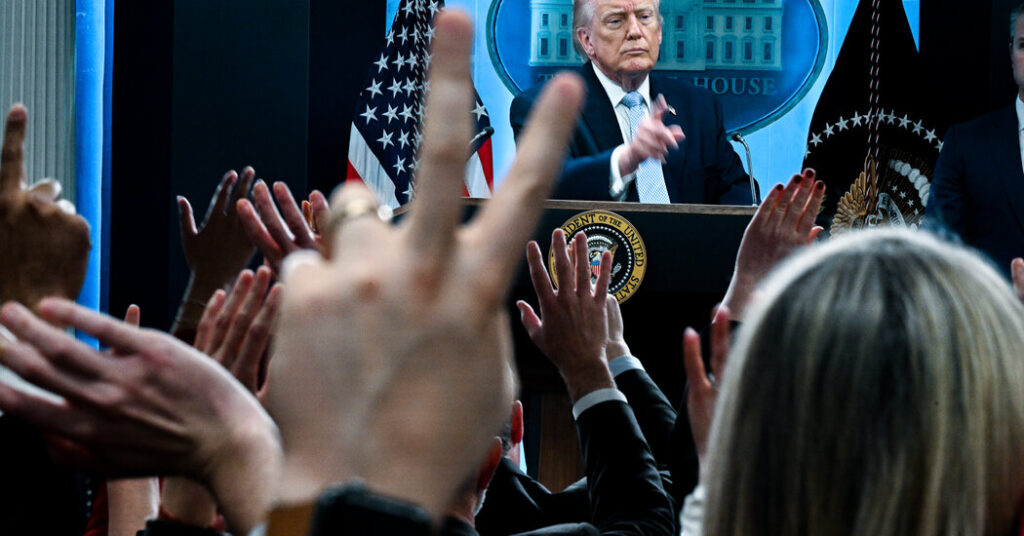
At 8:06 a.m. on Tuesday, President Trump delivered an apocalyptic threat to Iran, declaring that unless his demand to open the Strait of Hormuz was fulfilled by nightfall, “a whole civilization will die tonight, never to be brought back again.”
Ten hours and 26 minutes later, at 6:32 p.m. Eastern time, he lifted the threat, for now. He said an intervention by the Pakistani government had led to a two-week cease-fire in a war that has wracked the world economy and showed off American technological dominance and unexpected Iranian resilience.
Mr. Trump’s tactic of escalating his rhetoric to astronomical levels certainly helped him find an offramp he had been seeking for weeks. That success alone may fuel his belief that the tactics he learned in the New York real estate world — ignore old conventions, make maximalist demands — works in geopolitics as well.
Without question, it was a down-to-the-wire tactical victory, one that should, at least temporarily, get oil, fertilizer and helium flowing again through the Strait of Hormuz, and calm markets that feared a global energy shock would lead to a global recession.
But it resolved none of the fundamental issues that led to the war.
It leaves a theocratic government, backed by the vicious Islamic Revolutionary Guard Corps, in charge of a cowed population that has been pummeled by missiles and bombs, and finds itself still under the thumb of a familiar regime, even if under new management. It leaves Iran’s nuclear stockpile in place, including the 970 pounds of near-bomb-grade material that was, in theory, the casus belli of this war.
It left Gulf allies reeling, with the discovery that the glass skyscrapers of Dubai and the desalination plants that make wealthy enclaves in Kuwait livable can be taken out by Iranian missiles and drones. Gas prices have soared, and are about to test Mr. Trump’s promise that they will fall again to old levels as soon as the fighting stops.
And it has left Mr. Trump’s political base fractured, with onetime supporters now accusing the president and his loyalists, starting with Vice President JD Vance, with violating their promise not to get America tied up in unwinnable wars in the Middle East.
It all happened at a moment when Iran has demonstrated that it can absorb 13,000 targeted strikes and still conduct an impressive asymmetric war, choking off oil supplies and sending its cyber army to attack American infrastructure.
Now Mr. Trump faces the challenge not only of reaching a more permanent settlement but proving to the United States and the world that this conflict was worth flighting in the first place. And to do so, he will have to demonstrate that he has removed Iran’s death-grip on the 21-mile channel that makes up the strait, and its chances of ever building a nuclear weapon.
On that point there was an ominous-sounding element buried in the Iranian description of the deal. Shipping would proceed, the Iranian foreign minister, Abbas Araghchi, wrote, but under the control of “Iran’s Armed Forces,” who would determine who passes, and when.
“Iran remains in the control of the Strait, which was not the case before the war,” said Richard Fontaine, the chief executive of the Center for a New American Security, a Washington think tank. “I find it hard to believe that the United States and the world could accept a situation in which Iran remains in control of a key energy checkpoint indefinitely. That would be a materially worse outcome than existed before the war.”
So might a final agreement. Four weeks ago Mr. Trump was demanding Iran’s “unconditional surrender,’’ saying he would determine when the country had been completely defeated. On Tuesday evening his tone was different. He agreed to base the next two weeks of talks on a 10-point plan Iran submitted to the Pakistanis. Mr. Trump called it “a workable basis on which to negotiate.”
“Have you looked at Iran’s plan?” asked Mr. Fontaine. “It reads like a Tehran wish list from before the war, calling for a global recognition of Iran’s right to enrich uranium, the removal of all American forces from the region and a lifting of economic sanctions. And it calls for the payment of reparations to Iran for damage caused in the war.”
Of course, that is just the starting point for the negotiation. But the gap between the Iranian view of a final peace agreement and the American view is so wide that imagining a settlement in two years, much less two weeks, requires some diplomatic jujitsu. It took two-and-a-half years for the Obama administration to negotiate the 2015 nuclear accord, which Mr. Trump dispensed with in 2018, and that was in peacetime. This negotiation will be held under the sword of a possible resumption of hostilities.
Presidents have been negotiating with Iran, sanctioning Iran and sabotaging Iran for 20 years. Now Mr. Trump faces the challenge of showing that warring with Iran achieves better results. It will not be easy.
If he fails to get the 970 pounds of 60-percent enriched uranium out of the country, along with far larger quantities of lower-enriched nuclear fuel, he will have accomplished less in the billion-dollar-a-day war than Mr. Obama accomplished 11 years ago. In that agreement, Iran shipped 97 percent of its nuclear stockpile out of the country.
If he fails to win agreement that Iran will limit the size of its battered arsenal of missiles, or the distance they can travel, he will have fallen short on one of his top objectives.
And if his talks with a government led by the new Supreme Leader, Mojtaba Khamenei, who is believed to be recovering from injuries in the bombing that killed his father, Ayatollah Ali Khamenei, end up cementing the new government’s authority, he risks selling out the Iranian people.
It was only a little more than five weeks ago that Mr. Trump was urging the Iranian people to rise up and overthrow their government. Now he is doing business with that government. On Tuesday he repeated his claim that the new Supreme Leader is part of a generation of “different, smarter, and less radicalized” leaders. American intelligence agencies have their doubts.
“Maybe this will work out,” said Mr. Fontaine, a former aide to the late Senator John McCain. “But there is a chance that this ends with the U.S. and the world in a worse situation than when it started.”
Farnaz Fassihi and Anton Troianovski contributed reporting.
David E. Sanger covers the Trump administration and a range of national security issues. He has been a Times journalist for more than four decades and has written four books on foreign policy and national security challenges.
The post Trump Finds His Offramp With Iran. But the Causes of War Remain Unresolved. appeared first on New York Times.