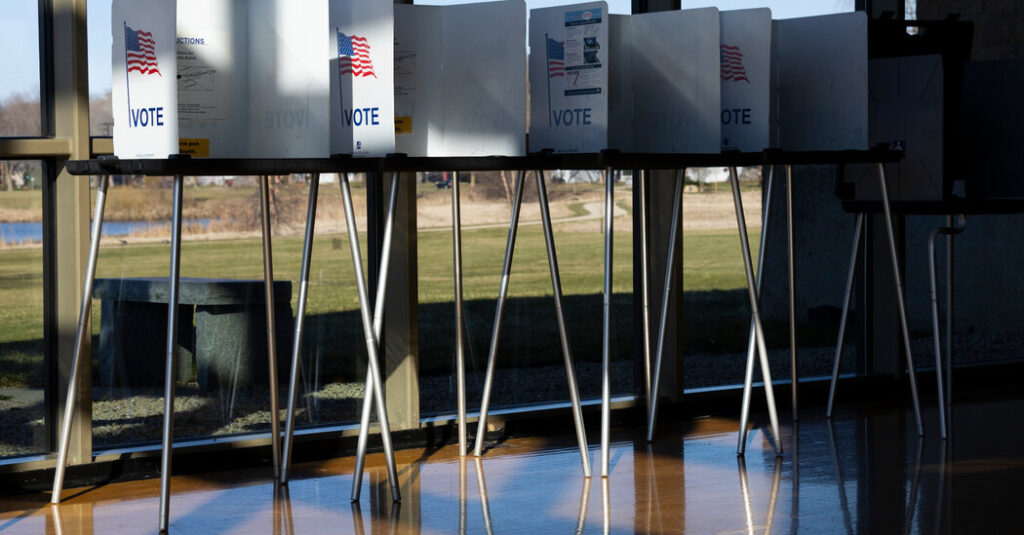
After a few years of intense focus on Wisconsin Supreme Court elections, the race to replace the retiring Justice Rebecca Bradley, a conservative, has attracted far less national attention and far less money — putting the contest comparatively under the radar even within the state.
The election has been tracked by just two publicly released polls, both from Marquette University Law School. Each showed Chris Taylor, a liberal, leading Maria Lazar, a conservative. But one of the Marquette polls, conducted just under three weeks before Election Day, showed 53 percent of registered voters in Wisconsin were still undecided about who they would vote for, including 46 percent of likely voters. Just 12 percent of the state’s registered voters said they had heard a lot about the race, and 57 percent said they had heard a little.
Compare that to 2025, when a Marquette poll fielded about a month before the election showed that 39 percent of registered voters had heard a lot about the race, and 45 percent had heard a little. And while Marquette did not ask about vote choice in the 2025 survey, numerous polls fielded in the final month of that election showed a very tight race, all with fewer than 20 percent of likely voters left undecided.
Spending tells a similar story. The 2023 election, which occurred in the aftermath of the Dobbs decision by the United States Supreme Court and centered on abortion rights, saw more than $50 million in spending, making it the most expensive judicial election in history at the time. The 2025 election shattered that record, with more than $100 million — $25 million from Elon Musk alone — spent on a race that doubled as a test of President Trump’s political standing just a few months after he returned to office.
This year, by contrast, the two candidates have raised less than $8 million combined, with more than $6 million of that being raised by Judge Taylor.
While liberals will retain control of the court regardless of the outcome tonight, the stakes on both sides could be sizable. Another win by liberals would build a 5-2 edge, which would most likely keep them in power through the end of the decade.
Even though voters had told pollsters they’d heard less about this race than prior contests, they still viewed it a consequential: 87 percent of registered voters in last month’s Marquette poll said the election was either very (51 percent) or somewhat (36 percent) important to them. That was only slightly lower than the 92 percent who said the same ahead of the 2025 race.
Caroline Soler is a Times researcher focused on collecting and analyzing polling and election data.
The post Polls in Wisconsin Reflect a More Muted Supreme Court Race appeared first on New York Times.