The most moving image to emerge from the Artemis II mission has not been a snapshot of the moon or the Earth. The camera was instead pointed at the astronauts themselves, squeezed inside their tiny capsule. Christina Koch sat in the foreground, strapped into her chair. Only parts of the other three were visible. Jeremy Hansen, the Canadian, was talking to ground control but also to an international livestream audience.
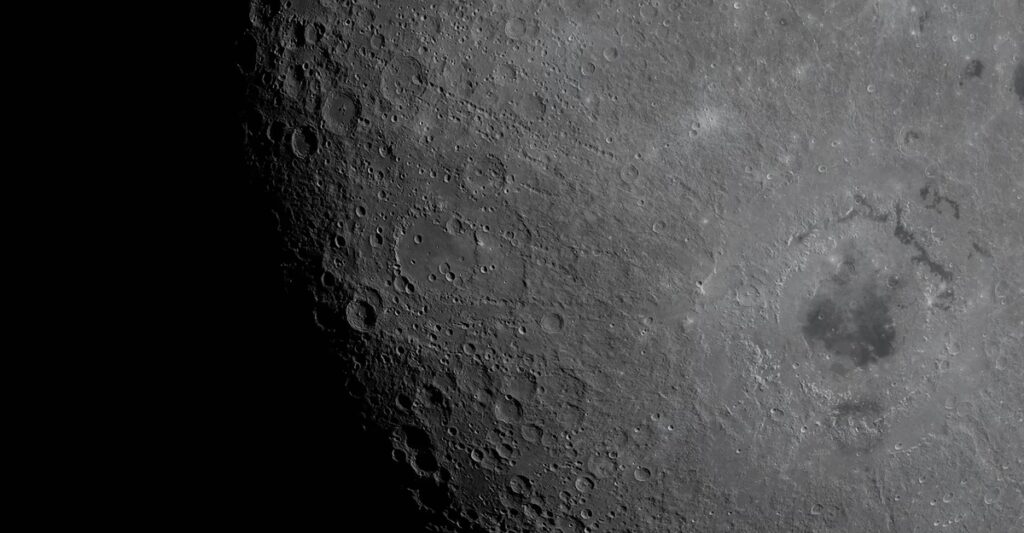
Hansen said that the crew had spent part of yesterday morning looking out the window at the moon. The astronauts had seen an abundance of craters, including a few scars likely incurred about 4 billion years ago, when, during their shared childhood, the Earth and its satellite were both bombarded by asteroids. Many of the lunar dimples and round basins already have official names, but not all of them. Hansen said that the crew would like to propose a couple of new ones.
Naming is a poetic act, and it can go wrong. Before Richard Nixon’s 1972 announcement of a new spacecraft that would carry Americans to orbit more regularly, Peter Flanigan, his assistant, made the case that it ought to have an exciting name. Someone had suggested Pegasus. Naming the program for a winged horse—a working animal that could fly to and fro—made sense, and it was a callback to the classical Greek grandeur of Gemini and Apollo. Flanigan liked “Space Clipper” and “Starlighter,” but he warned against “the Space Shuttle,” Nixon’s eventual choice, because to him, that name connoted “second-class travel.” By emphasizing the routine nature of the cosmic jaunts that the new spacecraft would enable, it risked reminding people of their dreary commute. It robbed the shuttle’s destination—the celestial realm!—of mystique.
For this mission that has just flown around the moon, and those that will succeed it, NASA picked a much more inspired name, better even than the one given to the agency’s previous moon program, more than half a century ago. “Apollo” was never quite right. It is the name of a sun god, an avatar of reason, order, and harmony. Artemis is a proper moon deity. As a wild forest huntress, she embodies the dreamier lunar qualities, the nighttime longing and magic.
On Monday, while flying around the moon, the crew tried to live up to this elevated standard of naming. During the livestream, Hansen said that the crew hoped that a crater on the moon’s far side might share the name of their spacecraft, Integrity. You can understand why they might have been feeling gratitude for the little vessel at that moment. In carrying them farther from Earth than any humans had ever traveled, it had bested the Santa María, the H.M.S. Endeavour, and every single one of the Apollo crew modules. For days, its thin walls had been the only thing separating their soft animal bodies from the lethal vacuum of space.
Hansen said that the second crater was especially meaningful to the crew. It was located close to the boundary line between the moon’s near and far sides, and can be seen from Earth for part of the year. Hansen proposed that it be named for a departed loved one from their “astronaut family.” To his right was Reid Wiseman, the mission’s commander, who in 2020 lost his wife, Carroll, to a five-year battle with cancer. The couple’s two daughters were teenagers at the time, and since then, he has raised them on his own. “We would like to call it Carroll,” Hansen said of the crater. His voice cracked as he spelled it out. C-A-R-R-O-L-L. The astronauts wiped away tears, and all four of them floated up to the top of the capsule, in a group hug—an image of human tenderness, beamed down to a planet that badly needed one.
Wiseman is now on his way home to his daughters. The crew blasted off from the Atlantic coast, but on Friday, they will splash down in the Pacific. They’ll don entry suits and point Integrity’s heat shield at Earth’s fast-approaching atmosphere. The friction and burn will surround them in a placenta of superheated plasma. When it nears 3,000 degrees Fahrenheit, the astronauts will lose contact with ground control. Parachutes will shoot out of the spacecraft to slow it down and stabilize it. According to NASA, the fabric will have been packed tight, to the density of oak wood. The capsule will splash down off the coast of San Diego, and orange airbags will inflate to flip it upright. Divers from the U.S. Navy will approach in choppers and quickly set up a platform. Someone will slide open the capsule’s door, and the astronauts will come out and huff down sweet lungfuls of sea air.
The post The Most Beautiful Moment of the Artemis II Mission appeared first on The Atlantic.