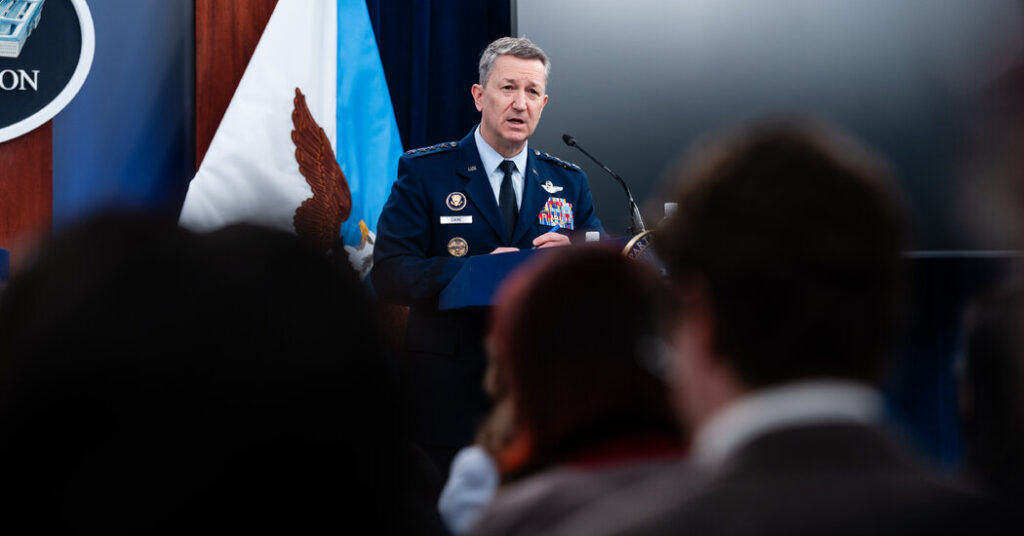
It took the chairman of the Joint Chiefs of Staff two attempts to answer a question last week about whether President Trump’s threat to blow up Iran’s power infrastructure, oil wells and desalination plants would constitute a war crime.
“Is there a way to do either of those things without, like, seriously jeopardizing or seriously harming civilians?” a reporter asked at a Pentagon news conference.
“We’re always thinking about those considerations and develop options to be able to mitigate those risks pursuant to the normal practices that we do in the military,” Gen. Dan Caine replied.
About ten minutes later, General Caine conceded that he had not really answered the question, and tried again. He described the military he leads as the “most professional force in the world,” and spoke again about the “numerous processes and systems” the military relies on in war. He vowed that the force would “always strike lawful targets.”
His muddled response, delivered in what has become his typical affectless monotone, reflected his difficult position as Mr. Trump escalates his threats not just against Iran’s leadership and its military, but the basic infrastructure that keeps its people alive.
Civilian sites with military uses are considered legitimate targets, but the kinds of strikes Mr. Trump has threatened over the last two weeks would in most cases be considered a war crime under international law. Mr. Trump reiterated those warnings on Tuesday morning, vowing to destroy Iran if its leaders did not open the Strait of Hormuz by 8 p.m. in Washington.
“A whole civilization will die tonight, never to be brought back again,” he wrote in a social media post. “I don’t want that to happen, but it probably will.”
As the chairman of the Joint Chiefs of Staff, General Caine is not in the chain of command, which runs from Mr. Trump to Defense Secretary Pete Hegseth and Adm. Brad Cooper, the leader of U.S. Central Command. He does not have the power to move forces around the battlefield.
But as the principal military adviser to the president and the military’s highest ranking and most visible officer, he has powerful obligations to the troops he leads. He is charged with defending the military’s professional, nonpartisan ethos and safeguarding the honor of the more than two million active duty, National Guard and reserve troops who serve under him.
“He absolutely has responsibilities to the institution,” said Kori Schake, a senior fellow at the American Enterprise Institute who has written extensively about civil military relations. “Military leaders also have constituents, and they’re the Americans we’re putting in harm’s way.”
These days, General Caine is in an especially precarious spot. The president’s first-term defense secretaries — Jim Mattis and Mark T. Esper — often resisted or ignored orders from Mr. Trump that they viewed as ill-advised or illegal, drawing the president’s ire. Both were fired.
By contrast, Mr. Hegseth has complained repeatedly about “stupid rules of engagement” that tie the U.S. military’s hands, and has questioned whether the United States should follow the Geneva Conventions and other international law governing war.
“What if we treated the enemy the way they treated us?” Mr. Hegseth asked in “The War on Warriors,” his 2024 book. “Would that not be an incentive for the other side to reconsider their barbarism?”
General Caine has kept a low public profile in his first year as chairman, and has earned the trust of Mr. Trump. The former Air Force F-16 fighter pilot and Pentagon liaison to the C.I.A. is often described as the military’s Trump whisperer — its main interlocutor with the president on operational matters.
On Monday, Mr. Trump paused during a stream of escalating threats to repeat his oft-told and somewhat apocryphal story of his initial 2018 meeting with General Caine in Iraq.
“He was able to take out ISIS in four weeks, instead of the four-year projection that was given to me by other, much lesser generals,” Mr. Trump recalled. “I said, ‘You know, if I ever do this again, that’s going to be the head of my Joint Chiefs of Staff.’”
In White House meetings leading up to the Iran war, General Caine has underscored that the conflict would be much more difficult than other recent operations, such as the strikes on Iran’s nuclear sites last year and the capture of President Nicolás Maduro of Venezuela in January, military officials said. But he did not weigh in on the larger policy question of whether Mr. Trump should launch the war.
General Caine, in his quiet way, has at times seemed to push back on some of Mr. Hegseth’s moves to reshape the force by firing senior officers, such as Gen. Randy George, the Army chief of staff who was dismissed last week.
Shortly after General George was removed without explanation, General Caine’s office released a statement praising the Army officer “for his decades of steadfast service to our nation.”
“General George and his family have consistently answered the nation’s call with honor and dedication,” the statement read. “We are profoundly thankful to General George and his wife, Patty, for their many years of sacrifice and devotion.”
Some observers in the Pentagon saw the message as a quiet statement of disapproval with the way the Army chief had been treated. “It has to be excruciating for the military leaders to have their civilian superiors willfully destroying the values that make the institution,” Ms. Schake said.
When it comes to speaking out on operational matters — even in private — General Caine must walk a fine line. He has his own uniformed military legal adviser who can warn him about the legality of U.S. military conduct in Iran. Adm. Cooper, who oversees forces in the Middle East, also has dozens of miliary lawyers who can help him assess risk and the legality of strikes.
General Caine is also responsible for helping Mr. Trump understand how strikes on power plants, bridges and civilian infrastructure could be viewed by allies in Europe and Asia, as well as adversaries.
The U.S. military’s record regarding the laws of war is far from spotless. But for decades, it has been the mainstream view within the military that American troops, who are generally the best trained and equipped in the world, accrue an advantage by adhering to the Geneva Conventions and other international laws. Allies would be more willing to work with U.S. troops, who would be more likely to retain the support of the American people if their actions were seen as legal and moral.
Mr. Trump’s threats of widespread destruction in Iran are certain to raise doubts among military leaders about whether the president and senior officials in his administration share their view. General Caine’ responsibilities also differ from those of other senior leaders in the White House, and even the Pentagon.
“The chairman is not just a military adviser,” said retired Rear Adm. John F. Kirby, a former top aide to Pentagon civilian and military leaders. “He’s the personification of the U.S. military, the human representative of everyone who wears the uniform and their families.”
But even in that role, there are limits to General Caine’s power and influence.
The chairman cannot function as “the single person protecting the republic,” said Peter D. Feaver, a national security aide under President George W. Bush during the wars in Iraq and Afghanistan.
“He can be and should be an important, sober, nonpartisan voice,” Mr. Feaver said. But his arguments will carry the day only if they are reinforced by others in the administration or by the president’s powerful allies in Congress.
“Expecting the chairman to ‘save us’ is just another form of the peculiarly American debility that says: ‘This problem is too great for us to handle; let’s ask the military to handle it,’” Mr. Feaver said.
Greg Jaffe covers the Pentagon and the U.S. military for The Times.
The post Trump’s Threats of War Crimes Intensify Pressure on General Caine appeared first on New York Times.