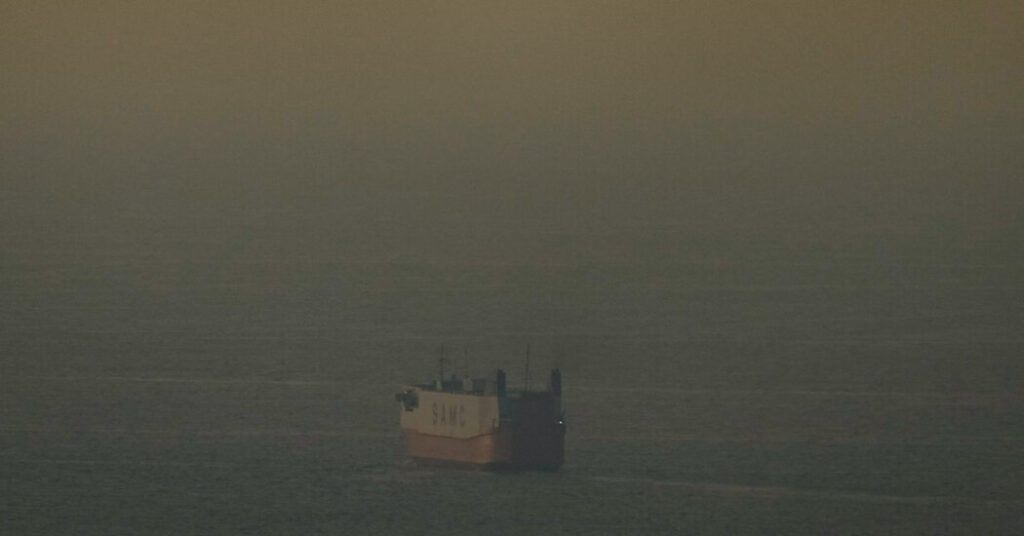
Most of the countries in the world have agreed to an international treaty, the United Nations Convention on the Law of the Sea, that bans interfering with ships passing through the Strait of Hormuz. But neither the United States nor Iran has ratified the treaty. And now, both are saying they want to impose tolls on ships passing through the strait.
That would be illegal under the Law of the Sea, as the pact is widely known. The actions represent a significant challenge to a United Nations-brokered treaty that sets out a wide range of rules for behavior in waters that no single nation owns or controls. On Monday, Donald Trump told reporters at a news conference that he would like the United States to impose a toll in the Strait of Hormuz, a vital shipping channel that Iran has been blocking since the start of the war. He was responding to the fact that Iran has been establishing tolls of its own on the waterway, and recently indicated that it intends to do so after peace is reestablished. Previously, U.S. officials have called these actions illegal.
About a fifth of the world’s oil typically passes through the Strait of Hormuz. Attacks on ships there, allegedly by Iran, have caused traffic to plummet and have sent oil prices soaring around the world.
“All international law, unfortunately, is fragile,” and depends on mutual respect between nations, said Saleem Ali, a policy expert and chair of the University of Delaware’s geography department.
International laws don’t carry the same consequences for violators that domestic ones do. The Law of the Sea establishes a process for international disputes, but only for countries that have ratified the treaty. In effect, it requires nations to agree to cooperate, which makes enforcement difficult.
President Trump recently told The New York Times that he does not need international law, only his own morality.
The Law of the Sea functions as a treaty that 171 nations and the European Union have ratified. It sets national borders in the ocean, creates rules for industries like fishing, and establishes the safe passage of ships through international waters beyond the jurisdiction of an individual country. It also establishes certain waterways, like the Strait of Hormuz, as a freely passable to international shipping and bars interference like tolls.
Ever since the current law finally came into force in 1994, it has worked, if imperfectly. That’s because the handful of nations that didn’t ratify the law have generally followed its norms for decades, including the United States and Iran, a practice that reinforced the law as an international status quo, Dr. Ali said.
Any future tolling arrangement would likely bump up the price of oil and gas, affecting nations that rely on shipments from this region the most, said Clayton Siegle, a senior fellow for energy security at the Center for Strategic and International Studies.
But that hypothetical price increase would most likely be small compared to the spike the world is seeing now, he said.
If Iran were to keep charging tolls in peacetime, as it has said it intends to do, that could set a precedent that tempts other nations bordering critical waterways around the world to follow suit, said Donald Rothwell, a professor at the Australia National University School of Law who specializes in international ocean law.
Separately from the situation in the Strait of Hormuz, for the past year the Trump administration has indicated its intention to disregard the Law of the Sea in another way. The administration has said that it plans to issue permits that would allow companies to mine the seabed for valuable minerals and resources in international waters, a practice that the Law of the Sea was also designed to regulate. When the United Nations created the law, it delegated the task of overseeing the seabed mining industry to an independent organization, which has spent a decade debating a yet-unfinished industry rulebook. Until last year, the United States had participated in those discussions, even though it hadn’t ratified the Law of the Sea.
The risk, according to Dr. Rothwell, is that other countries that have ambitions to start seabed mining, like Japan, may also be tempted to follow the U.S. lead and possibly exit the treaty.
It’s not uncommon for countries that have ratified the Law of the Sea to challenge various parts of it, said Scott Savitz, a professor at the Rand School of Public Policy. China, for instance, has claimed parts of the South China Sea as national territory.
Sachi Kitajima Mulkey covers climate and the environment for The Times.
The post How Tolls in the Strait of Hormuz Would Undercut International Law appeared first on New York Times.