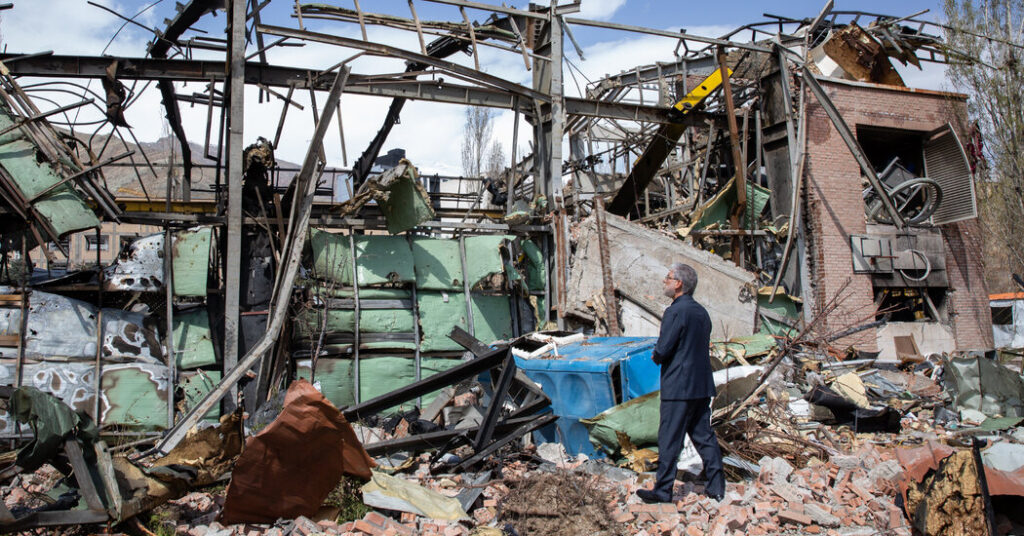
In recent days President Trump has repeatedly promised to destroy Iran’s power plants and civilian infrastructure if the Strait of Hormuz remains closed to global shipping.
Mr. Trump’s threats are a cornerstone of his version of diplomacy.
But his recent comments, human rights experts say, cross a line by suggesting that the United States is willing to violate U.S. and international law meant to protect civilians to attain its goals.
On Tuesday morning, Mr. Trump took it a step further. “A whole civilization will die tonight, never to be brought back again,” the American president wrote on social media.
Mr. Trump and his defense secretary, Pete Hegseth, have made it a point to protect and pardon U.S. troops for their actions in combat; some of them had been accused of war crimes.
The United States’ military is not alone in being accused of illegal conduct. Russia’s full-scale invasion of Ukraine as well as Israel’s destruction of Gaza and now its invasion of southern Lebanon, have all contributed to a litany of allegations of human rights violations. In Iran, the United States already faces questions over scores of deaths in what was most likely an American bombing of a school in Iran.
Despite the violence against civilians, the Geneva Conventions, adopted in 1949, remain an important pillar in modern warfare. Changes to the United States’ own laws and rules of war, updated after the failed wars in Iraq and Afghanistan, also reveal how the U.S. military has struggled to define and protect civilians in its wars of choice.
Is it legal to target civilians?
It is unlawful for the U.S. military to target civilians.
“A civilian target, by definition, is not a lawful target,” said Sarah Yager, the Washington director at Human Rights Watch. “Under international humanitarian law, what the U.S. military calls law of armed conflict, parties must always distinguish between civilian and combatants and between civilian objects and military objectives.”
The Geneva Conventions require militaries to distinguish between civilians and combatants and to take precautions to protect noncombatants, including by ensuring that the attacks are proportional.
The U.S. military’s own law of war manual states that “the protection of civilians against the harmful effects of hostilities is one of the main purposes of the law of war.” The manual goes on to outline the duties the U.S. military has by not directly attacking civilians and minimizing harm to the civilian population.
What are the gray areas?
What seems like straightforward terminology outlined in the Geneva Conventions or U.S. law can have varying interpretations.
Ground troops, commanders and states may even define “civilian” differently. One example comes from the wars in Iraq and Afghanistan; the United States used the presence of “military-aged males” as a contributing factor in justifying lethal force because a person looked like they might be a combatant, regardless if they were armed.
In Iran, with power plants as possible targets, scrutiny is rising over another military term, “dual-use objects” — infrastructure that can be used for both civilian and military purposes.
Power grids are civilian objects by default but can become lawful targets if they make an effective contribution to military action and offer definite military advantage, experts say.
“Power plants sit at the heart of civilian life, which is why the legal bar to attack them is so high,” Ms. Yager said. “The civilian harm from blackouts, water disruption and collapsing health care must be weighed. In Iran, bombing power plants and bridges would be devastating, and the U.S. military would have no way of saying they didn’t know that.”
Where Mr. Trump’s threats on social media become especially dangerous is for those executing the war, experts say. The suggestion of wide-scale attacks on infrastructure without protections for civilians could allow commanders to issue unlawful commands under the auspices of executive approval.
Why do such laws exist?
As today’s conflicts are flooded with new technology, especially cheap drones and artificial intelligence, most everything can be easily targeted on the battlefield and beyond.
But international law like the Geneva Conventions came from the destructiveness of modern weapons, and the war that touched every part of society during the mid-20th century.
“It’s important to remember that the Geneva Conventions and international law around war was written by generals and militaries who had the blood of millions on their hands,” said Brian Castner, a crisis researcher at Amnesty International, a human rights organization. “They gave themselves great latitude to fight wars, and very few things are prohibited. But targeting civilians or using them as human shields are two of those things.”
Thomas Gibbons-Neff is a national correspondent for The Times, covering gun culture and policy.
The post What Defines a Civilian Target in War? appeared first on New York Times.