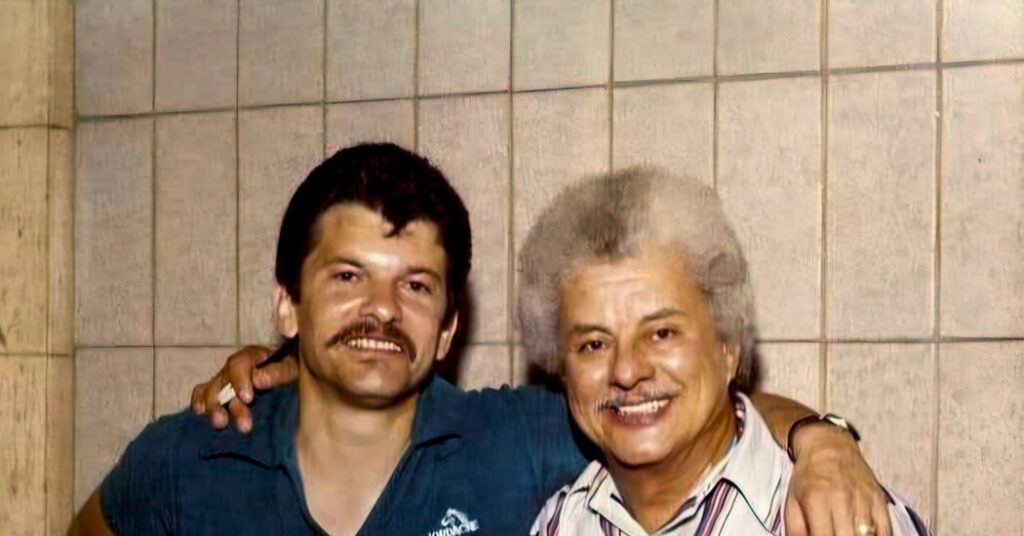
Joe Conzo Sr., who was the best friend, manager, publicist and personal historian of Tito Puente, the musician known as the Mambo King, and who tended to Mr. Puente’s posthumous legacy as a way of preserving the shared New York Latino culture of their youth, died on Wednesday in Valhalla, N.Y., in Westchester County. He was 83.
His death, in a hospital, was caused by congestive heart failure, his son, Joe Conzo Jr., said. The elder Mr. Conzo lived in Warwick, N.Y., in Orange County.
After Mr. Puente died in 2000 at 77, The New York Times called him “as much a symbol of New York City as the Empire State Building or the Statue of Liberty.” Many Puerto Ricans considered him their Frank Sinatra.
He rose to fame after World War II, when people across America were doing the cha-cha-cha. That dance was part of the mambo craze, whose national headquarters was the Palladium Ballroom, a nightclub at Broadway and West 53rd Street in Manhattan.
Amid fierce competition between the acts at the venue, no bandleader won the affection of audiences so much as the diminutive, joyous Mr. Puente, who played a drum set that included timbales, cymbals and a mounted cowbell.
It was in the late 1950s that Mr. Conzo, then a teenager and “a frustrated conga player,” as he put it, first saw Mr. Puente perform at the Palladium.
The connection was quick, almost familial. Born 19 years apart, Mr. Conzo and Mr. Puente both came from El Barrio, as Spanish Harlem was known. Mr. Conzo’s sister had gone to school with Mr. Puente’s son, and Mr. Conzo grew up friendly with Mr. Puente’s second wife.
“I became a groupie,” Mr. Conzo told Newsday in 2000.
Mr. Puente had his biggest hit in 1962, with “Oye Como Va.” (Several years later, the rock group Santana would record the cover that made the song a standard.) By then, tastes were changing: The cha-cha-cha was going the way of the Charleston and jitterbug. The Palladium closed in 1966, a few years after losing its liquor license.
Mr. Puente became a musical journeyman. He played 200 to 300 shows a year, including jubilant summer block parties in the Bronx, and eventually recorded more than 100 albums.
Mr. Conzo’s many duties included waiting in the morning for Mr. Puente to finish a circuit of nightclub shows so that he could serve the maestro breakfast. Mr. Puente did not bother keeping track of his busy schedule of gigs. He would simply ask Mr. Conzo, “What time today?” Mr. Conzo would pick him up in the car and handle the rest.
In 1992, Mr. Puente went straight from his late-night sets to a morning performance on “Live With Regis & Kathie Lee.” Tired and disorganized, he forgot his drumsticks. Mr. Conzo quickly materialized, having fashioned a couple of sticks from a wooden clothes hanger.
Though journalists often simply described Mr. Conzo as Mr. Puente’s manager, his role was far more expansive; Mr. Conzo preferred the term “confidant.” He told Newsday in 1992 that he was also Mr. Puente’s bodyguard.
“He’s from the street,” Mr. Conzo explained.
The South Florida Sun Sentinel once heard a “Bronx hit-man accent” in Mr. Conzo’s gravel voice. His tough-guy reputation helped him earn a place as a consultant on two movies about Latino New York. For “The Mambo Kings” (1992), Mr. Conzo explained how to give a 1950s gunfight period authenticity; he appeared in the film firing a .22. For “Carlito’s Way” (1993), he advised Al Pacino about playing the title character, a stoic, reluctant gangster.
Joseph Louis Conzo was born on Sept. 13, 1942, in El Barrio. As he told oral history interviewers at Fordham University in the Bronx, Mr. Puente was his first, and only, male role model. His father, Louis Conzo, was a bus driver who left the family during Joe’s early boyhood. His mother, Olga Cabezas, was a secretary for ophthalmologists. Joe grew up in the Longwood section of the Bronx.
At 17, he joined the National Guard, and soon found himself in the U.S. Army. While still a soldier, he married Lorraine Montenegro, his first wife. He was then sent to Korea, where he developed a heroin addiction. (In the oral history, he said that Mr. Puente had helped him quit drugs.) Inspired by Ms. Montenegro’s mother, a community activist in the Bronx, Mr. Conzo became a social worker with the city government, a career he pursued in the midst of his all-purpose service for Mr. Puente.
When Mr. Puente died, Newsday wrote, “Joe Conzo, more than anyone else, will keep the music, the message and the memory fresh.”
Mr. Conzo drew on a collection of thousands of live Puente recordings to produce new releases of his music. At Hostos Community College in the Bronx, he taught a continuing education course on Latin music; helped organize memorial events focused on Mr. Puente’s legacy; and donated his holdings of memorabilia to an archive called the Tito Puente Legacy Project, which he ran. In 2012, he published a memoir, “Mambo Diablo: My Journey With Tito Puente,” written with David A. Pérez.
“If not for Joe’s efforts, the masters of this music would be forgotten,” Mike Amadeo, a songwriter and New York record seller, told The Times in 2008.
Mr. Conzo married and divorced six times. In addition to Joe Jr., from his first marriage — a photographer whom The Times described in 2005 as “the man who took hip-hop’s baby pictures” — he is survived by another son from that marriage, Eric; a stepson with his former wife Linda Lopez, Vincent Bobianco; two sisters, Emma Conzo LaSalle and Joanne Bermudez; six grandchildren; and four great-grandchildren.
Tito Puente Jr., one of Mr. Puente’s sons, is a bandleader and percussionist who performs his father’s music. “Joe Conzo was the biggest influence and catalyst for me to do that,” he said in an interview.
In fact, the younger Mr. Puente added, on New Year’s Day this year, Mr. Conzo called and gave him the idea for his current tour, based on a foundational Tito Puente album from 1956.
“Hey, junior,” Mr. Conzo said. “This year’s the 70th anniversary of ‘Cuban Carnival.’ You’ve got to celebrate that album.”
Last month, Mr. Puente called Mr. Conzo to ask him about the record’s personnel. Mr. Conzo may not have always remembered his most recent meal, Mr. Puente said, but he retained his comprehensive knowledge of Puentiana.
He reeled off a full breakdown of who Tito Sr. had played with back in 1956 — off the top of his head.
Alex Traub is a reporter for The Times who writes obituaries.
The post Joe Conzo Sr., Guardian of Tito Puente’s Legacy, Dies at 83 appeared first on New York Times.