President Donald Trump has said Iranians welcome expanded U.S. attacks even as he threatens to destroy key infrastructure and bomb their country “back to the stone ages” if Tehran doesn’t reopen the Strait of Hormuz by a Tuesday deadline.
“All I can tell you is they want freedom. They have lived in a world that you know nothing about. It’s a violent, horrible world where if you protest, you are shot,” Trump said at a news conference Monday. “They want us to keep bombing.”
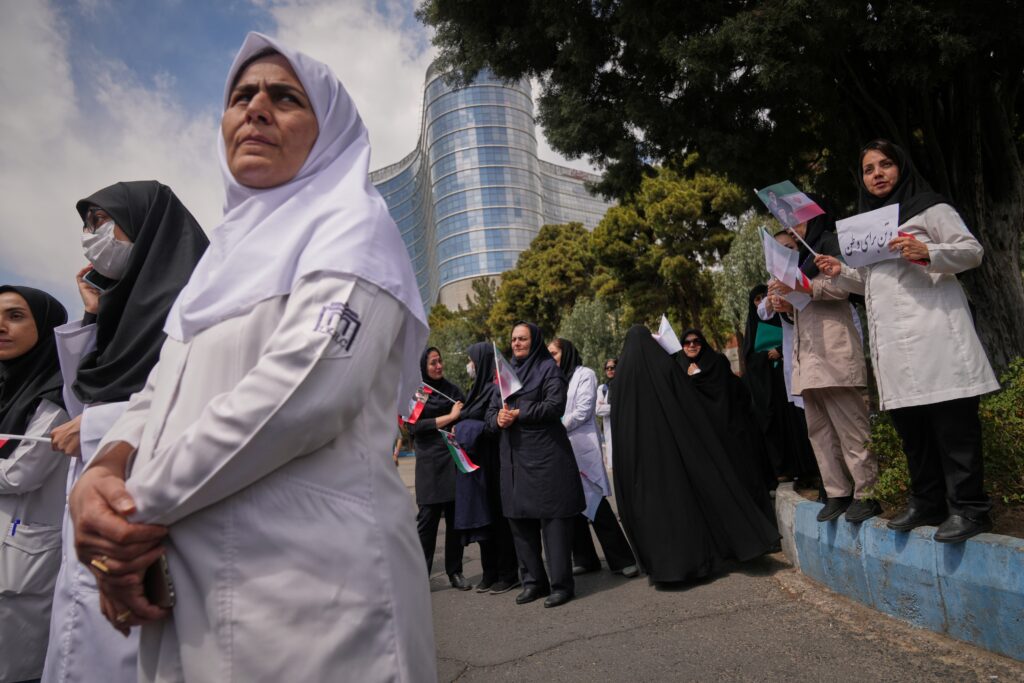
People in Iran say the reality is more complex. Many fear that if the war escalates further, it could wreak long-term havoc on the country’s economy, leaving civilians to pay the price.
A 27-year-old teacher from Tehran said he almost felt positive about the war when it began, with U.S.-Israeli attacks that killed the country’s supreme leader, Ayatollah Ali Khamenei. But as strikes began shifting to economic and industrial targets, “the reaction shifted completely,” he said, speaking from Qom, having fled the capital. “I felt deeply upset and so did those around me.”
Like others in Iran interviewed for this article, he spoke via voice memos shared on a messaging app, on the condition of anonymity for fear of reprisal.
“It was no longer just about the regime,” the teacher said. “These are directly tied to people’s lives and to the country’s economic future. This destruction creates a much deeper sense of insecurity.”
Nearly 1,500 civilians have been killed since Feb. 28, according to a report released late last month by a consortium of human rights groups, which provided the most comprehensive estimate yet of the war’s growing civilian toll. Strikes on infrastructure that could serve both civilian and military needs were among the major factors contributing to the loss of civilian life, the report found.
“The key point is that infrastructure ultimately constitutes a national asset — one that belongs to the people, not the regime,” a 37-year-old factory manager from Tehran said.
“Even if we have serious grievances with the government, we cannot — under any circumstances — condone the destruction of infrastructure,” the factory manager said. Such attacks are “effectively directed at the population itself.”
Communicating with people in Iran remains extremely difficult under a near-total, government-imposed internet blackout. Those who have managed to stay connected do so with VPNs that allow them to bypass government restrictions and through Starlink internet terminals that connect via satellite and are strictly outlawed in Iran.
Trump has twice delayed attacks on Iranian infrastructure, saying he wanted to allow more time for talks. Trump initially threatened to destroy Iranian power plants last month and since then, Iran and the United States have exchanged messages and positions, according to officials briefed on the mediation efforts, but do not appear to be nearing a deal.
Last week, the United States struck a suspension bridge outside Tehran, a move Trump said he ordered after Iran’s leaders signaled reluctance to engage in negotiations.
Other U.S. and Israeli airstrikes have hit Iranian factories, universities and medical facilities, including a pharmaceutical production plant and a medical research institute. Iranian state media has reported attacks on a cement factory in southern Iran and two of the country’s largest steel plants: Khuzestan Steel Company in the southwest and Mobarakeh Steel Company in Isfahan in central Iran.
“Striking civilian structures, including unfinished bridges, will not compel Iranians to surrender,” Iranian Foreign Minister Abbas Araghchi posted on social media last week after airstrikes on a suspension bridge west of Tehran caused part of the structure to collapse, killing eight people, according to local authorities.
“It only conveys the defeat and moral collapse of an enemy in disarray. Every bridge and building will be built back stronger,” Araghchi added. “What will never recover: damage to America’s standing.”
The United States and Israel have launched more than 15,000 airstrikes on Iran since the war began, attacks that forced some Iranians to flee.
“These strikes had an effect in the opposite way” from what was intended, a 50-year-old businessman from the city of Sanandaj, in a Kurdish region of western Iran, told The Washington Post in an interview last month, just after crossing the border into Turkey. “Even the ones who wanted a regime change now say they didn’t want this to happen like this.”
Others at the border crossing described cities that largely continue to function and said even the attacks targeting military sites often injured civilians who happened to be nearby.
“Tehran is a complex city where military and residential buildings are right next to each other,” said a man in his 40s who had just crossed. He said he was an Iranian-Swedish dual citizen. “That’s why civilian buildings get damaged when a missile targets a military building. So people get injured and go to hospital.”
As the United States built up forces around Iran earlier this year, some Iranians told The Post they welcomed a possible attack against the Iranian government. Popular expressions of anti-government sentiment have gained intermittent momentum for years. Earlier this year, nationwide protests drew a ferocious government crackdown, which killed thousands of people.
Some in Iran saw the start of U.S. and Israeli attacks in late February as another chance for a new government. A 32-year-old importer from Tehran said that after years watching Iran’s leadership mismanage the country, the war’s physical destruction did not bother him.
“For me and many young people, there is a sense that these resources were never truly accessible to us, or that their benefits never reached us,” the importer said.
He said many of his friends and family appear willing to endure greater hardship if it means a chance for lasting change.
“Some believe that everything should be torn down and rebuilt, even if the cost is high,” he said.
A 45-year-old actor from Tehran said when the war began, “there was a brief wave of elation,” after he learned that Khamenei had been killed on the first day of the conflict. He said the shock from hearing of Khamenei’s death was so great he felt like that moment would mark an ending of some kind.
“But no one expected the situation to drag on like this, to become so prolonged and exhausting,” he said. “That initial feeling quickly gave way to fatigue — a deep, collective exhaustion.”
Fearful that conditions in the capital could quickly deteriorate, the actor fled to a city north of Tehran for the first few weeks of the war, but after hearing reports of heavy damage near his home, he decided to return to see for himself.
“They said the destruction was extensive, but I didn’t truly understand what ‘extensive’ meant until I returned,” he said. “When I came back to Tehran, I didn’t recognize the city.”
The number of destroyed buildings was beyond what he had imagined, and even in places where there wasn’t as much physical destruction, he said he felt a profound shift in the city’s energy.
“We are tired,” he said, “and we truly do not believe that anything good will come out of this foreign attack.”
George reported from Washington, Abasian from Paris and Yüksekkaş from the Kapikoy border crossing in Turkey.
The post Iranian civilians voice fear and fatigue as U.S. escalates conflict appeared first on Washington Post.