Like so many landmarks New York once admired, the Grand Central Palace disappeared decades ago, though it had once been worthy of postcards — 13 stories of neoclassical splendor filling a block north of Grand Central Terminal. Built for a boom in American trade fairs, it opened in 1911 as “the largest and handsomest show building in the world,” one report said, hosting vast expos on aviation, construction and dogs.
And in April 1917, it hosted another fair quite unlike all its others: a trade show of art, the First Annual Exhibition of the Society of Independent Artists. Its 2,400 works by 1,300 makers included a memorial to the Titanic, a cutesypie sundial and Picasso’s most abstracted cubism.
But what might actually have mattered most is what has barely been remembered: that it was installed according to the strange ideas of a certain Marcel Duchamp, chairman of its “hanging committee.” He was America’s most famous modern artist. His Cubist “Nude Descending a Staircase” had caused a scandal when it traveled to New York four years before. And he’s just about as famous, today, as the godfather of some of the most challenging, most cerebral art of the 20th century, and beyond.
But it may have been his quite peculiar installation of the Independent, in the Palace, that we need to think most deeply about, 115 years after that building opened. It should help us understand another sprawling show, being hosted in a landmark that survives just a half-dozen blocks north of where the Palace stood.
On Sunday, the Museum of Modern Art opens “Marcel Duchamp,” a survey of the French-born maverick. He took commonplace objects — a snow shovel, a bottle rack, a bicycle wheel — and displayed them as artworks he called “readymades,” eventually weaving a conceptual thread into postwar art.
Even today’s art lovers are likely to find him “complicated and interesting and fascinating and difficult,” said Matthew Affron, who curated the show with MoMA’s Ann Temkin and Michelle Kuo. (The survey travels to Affron’s home base, the Philadelphia Museum of Art, after New York.)
This is Duchamp’s first retrospective in the United States since one at MoMA in 1973, five years after his death at 81. It includes more than 300 items, including paintings, readymades and films, covering seven decades of art making.
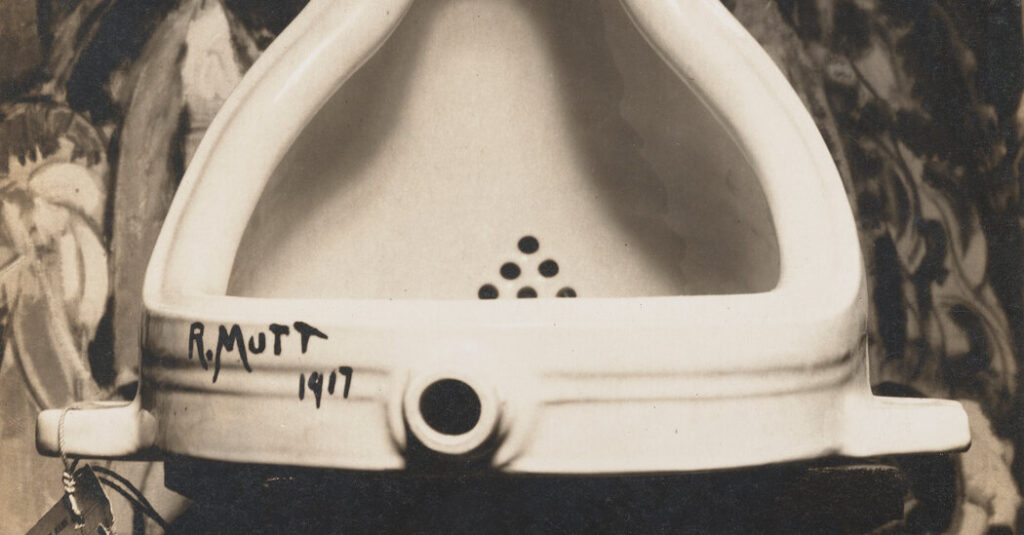
Duchamp’s best-known and arguably most important work is the store-bought urinal he and some friends submitted to the Independent exhibition as a sculpture, called “Fountain,” with the pseudonym “R. Mutt” scrawled on its front. The gesture went mostly unnoticed, and the sculpture itself vanished before it could make much of an impact. But as Duchamp’s fame grew, he responded with four remakes of “Fountain,” all of which are in the new survey.
“Fountain” was voted the most influential of all modern artworks by a poll of 21st-century artists and experts. Many of them, including me, have seen it as “anti-art.” But new research into the Grand Central Palace has made me feel that the sculpture pays homage to every Western artwork that came before it, helping us see what had even made them count as art.
IN NOVEMBER 1916, FIVE MONTHS BEFORE Duchamp bought his urinal from a Manhattan plumbing supplier, the Palace had welcomed the National Hotel Men’s Exposition, which displayed everything from a milk agitator to the finest in brussels sprouts — and also, as the world’s Duchamp scholars never seem to have noticed, a model bathroom with the latest in porcelain fixtures. “Many interested hotel men stopped by to hear why a built-in tub was the most satisfactory type for hotels, why all fittings should be concealed, and why hotel water closets should have flush valves,” a review said.
It’s a fair guess someone else was stopping by the Palace that November: Duchamp. He’d have needed to check it out as the venue for his upcoming art show, where he was planning to display his own bathroom fixture.
But when the show opened, it was his unorthodox way of installing the submissions — alphabetically by the 1,300 makers’ names — that got all the press attention. The urinal earned only a few column inches.
Robert Henri, dean of New York’s Ashcan School, panned the show as “a disastrous hodgepodge” and withdrew his own work from it.
You’d think Henri was upset that anyone who paid $6 was allowed to submit any work at all for display. That he didn’t mind, praising it as an “open forum such as a free country should have.”
What broke his heart was Duchamp’s alphabetical organization, which meant that A-named artists were gathered in one spot, Bs in another, and so on, with only spelling to link neighboring works rather than any properly artistic criteria. “Should order and relationship not be sought in the presentation of pictures?” Henri groaned. “We would not care for a musical program where Beethoven’s Seventh Symphony would be followed by a fox-trot, nor would it be possible to enjoy eating in sequence mustard, ice-cream, pickles and pastry.”
This chaotic organizing principle was standard practice at the Grand Central Palace fairs that previous fall. The Hotel Men’s expo had given an open embrace to anything that might possibly interest a hotelier, while an Electrical Exposition welcomed an “automatic oven” and a census-card counter. The reviewer of an earlier Palace show, of automobiles, complained that its jumble of cars and trucks lacked any “effort at classification.”
With its alphabetical gambit, Duchamp’s show would have appeared to visitors as a grab-bag of objects. The only common thread was their submission to something called an “art show,” just as machines, vegetables and toilets had only come together at the Palace under their “hotel goods” umbrella.
I THINK DUCHAMP GOT AT SOMETHING vital about Western culture over the previous 400 years: that an object didn’t count as “art” because of its beauty, its subject matter or its greatness, but because of how it asked us to use it. When functioning as art, an object asks its viewers to “look harder, look longer, ask questions, interrogate, try to make something of it,” in the words of Alva Noë, a philosopher at the University of California, Berkeley.
And thanks to Duchamp, that was the model that ruled at the alphabetical Independent. The one thing that unites its mess of creations grouped under “C” — images of two nymphs gamboling, by a certain Blendon Campbell; of a proud Blackfoot man by Elizabeth Curtis; of Duchamp’s profile, traced in wire, by Jean Crotti — is that, as art, all of them make us wonder, then re-wonder, just what we ought to do with them.
Duchamp helps us understand that “art” shouldn’t be thought of as a noun that picks out certain kinds of objects, but as a verb: We “art” absolutely any object at all by using it to trigger thoughts and conversation.
The Mona Lisa is an early example. It started out, in Florence around 1503, as a pretty normal household item, commissioned to commemorate a merchant couple’s married life. But then, instead of delivering this functional object to his clients, Leonardo kept it and saw it widely copied, then collected by the king of France, as the ultimate example of that new thing we now call “art.” To this day, we endlessly puzzle through what it might mean; we’ve long since stopped using it to remind us of Lisa del Giocondo.
When Duchamp “art-ed” the most unlikely, even shocking of objects — a urinal — he was celebrating the power of that verb.
But then, on the day of the Independent’s private view, “Fountain” was not there to be debated: A cabal of the fair’s directors had banned it from the exhibition. “The Fountain,” they said, “may be a very useful object in its place, but its place is not an art exhibition, and it is, by no definition, a work of art.” Duchamp resigned from the board, and in the weeks that followed the sculpture disappeared, known to posterity only from a photo Duchamp had asked Alfred Stieglitz to take.
Some artists and historians have insisted that Duchamp, as an anti-artist, would have been happy to see his piece rejected — that it was never more than a prank, testing his fellow directors’ pretense that they’d be open to any and all art.
But can we really take someone who once declared “I’m nothing else but an artist, I’m sure, and delighted to be,” and bill him as pranking with art rather than wanting to make more of it? He submitted his urinal under a pseudonym because he was eager to see it accepted on its own terms, not for bearing the name of a famous board member.
In recordings published for the first time with the MoMA show, Duchamp said he had never wanted “Fountain” to read as some kind of “revolutionary gesture.” I’d say that “Fountain,” as the capstone to Duchamp’s entire installation of the Independent, celebrates a centuries-old tradition that has got us using anything at all — a marital portrait, a prayerful “Saint Francis,” even in the end a urinal — to spark art’s signature conversations.
The handful of Duchamp fans who managed a glimpse of “Fountain” in 1917 actually “used” it for standard art-talk: as an example of an almost spiritual beauty, recalling Buddhas and Madonnas; as a symbol of modern American culture; as an icon of sleek aesthetics.
The previous year, when a store-bought shovel — “In Advance of the Broken Arm,” in the MoMA survey — became the first of Duchamp’s “readymades” to get press, Crotti, his studio-mate, described it as “the most beautiful object I have ever seen.”
To this day, Duchamp’s supposedly dry, conceptual art can have such effects. “I feel totally engaged in it and excited by it — I don’t feel it’s anti-art,” said Barbara Levine, whose Washington home holds one of the largest troves of Duchamps in private hands. (In 2018, she and her late husband, Aaron, promised those works to the Smithsonian’s Hirshhorn Museum.) Levine told me she’s found beauty in her Duchamps that’s no different from the beauty in works she has owned by Andy Warhol or Anish Kapoor.
At first, Duchamp might have thought the Independent’s cabal would prevent “Fountain” from finding any reception at all. But luckily, even in Stieglitz’s photo, and in those four versions of “Fountain” Duchamp later produced, his art has the power to keep us endlessly “art-ing” it.
As Damien Hirst put it to me, “The urinal is the most punk-rock work, and a big [expletive] you to everything — yet it’s still a celebration.”
The post In 1917, He Made a Urinal Into Art. We’re Still Discussing. appeared first on New York Times.