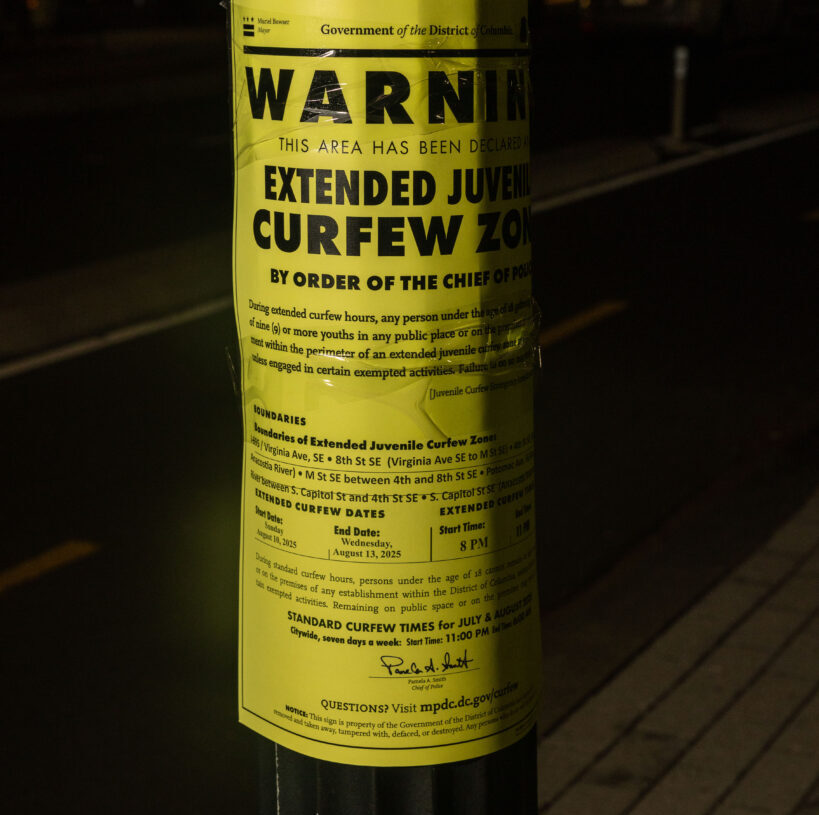
D.C.’s recreation department hosted a party for more than 1,000 young people in Southwest Washington on Saturday night. Nearby, a special 8 p.m. curfew zone was in effect, one of five the police chief put in place to stave off chaos at large weekend gatherings that often draw hundreds of youths to commercial areas.
The sanctioned party and curfew were part of a dual strategy by D.C. officials to address “teen takeovers” — a nationwide phenomenon. Still, several fights erupted just outside the event at the King-Greenleaf Recreation Center, leading to the arrests of eight youths ages 12 to 17, police said.
The weekend’s events once again have exposed fault lines among D.C.’s politicians, who can’t agree on how best to approach to the sometimes-unruly events, along with the frequent disconnect between adults and teens. It’s a policy question that has even higher stakes in the nation’s capital, where President Donald Trump has fixated on issues of public safety and order and is willing to flex his authority over the city in unprecedented ways.
The D.C. Council recently postponed a vote on whether to extend the stricter youth curfew ahead of its expiration April 15 — catching the attention of U.S. Attorney Jeanine Pirro and others in Trump’s orbit. “These alleged social gatherings turn into criminal chaos,” Pirro said last Wednesday on Fox News, wanting to see tougher consequences.
D.C. Council Chairman Phil Mendelson (D), who supports the curfew, said lawmakers were acutely aware “that we’re being watched like fish in the fishbowl” after postponing the vote, which he moved to do after realizing there was not enough support to extend the restrictions.
Still, he said, it seemed the teens were managing to “outfox” the adults — and the adults were going to have to “keep thinking of new ways to deal with this.”
“I think the incident highlights that dealing with this relatively new juvenile phenomenon is more complicated than simply looking at recreational activities such as Greenleaf or curfews,” he said. “I don’t think it helps, though, that we’re still not at a supermajority of the council for continuing the curfew.”
The expanded curfew policy allows the police chief to declare zones where people age 17 and younger are forbidden from gathering in groups of more than eight after 8 p.m. To date, police say, they have not arrested anyone for violating the curfew but have made arrests for numerous other alleged offenses in curfew zones.
The policy has been one of the city’s main responses to recent cases in which hundreds of teenagers gather in a buzzy district like Navy Yard, the Wharf or U Street, often after coordinating on social media. In some cases, fights break out and some are arrested. Video clips go viral on social media. And politicians and residents spar over why young people are behaving this way, and what should be done about it.
For D.C. Mayor Muriel E. Bowser (D), getting rid of the curfew policy is out of the question. She lambasted lawmakers for delaying debate, which she saw as effectively killing the policy ahead of next week’s spring break, and suggested they were “soft on crime.”
“The council will say, ‘Oh, we drove crime down. So let’s start going back to soft-on-crime policies,’” Bowser told reporters after the delay. “Let’s start making the job of the MPD officer more difficult than the job of the Capitol Police officer or the United States Secret Service.”
Violent crime plummeted by nearly 30 percent last year and has dropped further since January, D.C. police data shows. Homicides are down 68 percent compared with this time last year.
Spokespeople for lawmakers who have previously voted against the curfew — including council members Brianne K. Nadeau (D-Ward 1), Robert C. White Jr. (D-At Large) and Janeese Lewis George (D-Ward 4), who is running for mayor — said Monday they weren’t available to comment or did not comment.
Days after the council’s inaction, violence broke out at two separate youth gatherings.
On Friday, police shut down a gathering behind the Banneker Recreation Center and made three arrests after a fight broke out — an hour and a half before the 8 p.m. curfew. A 17-year-old male from Hyattsville was seen brandishing a knife and charged with assault with a dangerous weapon, and an adult female victim was treated at a hospital for a non-life-threatening stab wound, according to police.
The next day, the city hosted the Teen Spring Jam at the Greenleaf recreation center to offer a safer late-night space for young people looking to listen to music and dance. Inside, it went off without a hitch, observers said.
“The actual event was beautiful,” said Jawanna Hardy, who runs youth programming through her nonprofit Guns Down Friday and said the event reminded her of the go-gos of her youth.
Still, the melees outside the party — and blocks away from another curfew zone — drew alarm from some corners. Officers arrested eight young people on various charges related to three fights in the blocks near the recreation center between 8:30 and 9 p.m. Saturday, according to D.C. police.
From the front porch of her home across the street from the rec center, Gwendolyn McKoy, 62, said she could see the drama unfold. A fight broke out in the line of young people waiting to get inside the event, she said. Bikes and scooters were scattered everywhere. Kids were jumping the fence, and she said police tried to calm the situation down. Then, McKoy said, a second fight broke out on the field.
“A lot of kids got robbed,” said McKoy, including a young boy who approached her without shoes on. He needed to call his mother, she said. When McKoy asked what happened to his shoes, she remembers him telling her, “they just took them.”
“That little boy was so scared,” she said. “He couldn’t even think.”
A spokesman for the D.C. Department of Parks and Recreation said “a small number of individuals on the perimeter declined to follow our safety guidelines and were not admitted” — but that the fights outside had no impact on the young people inside the event.
“Young Washingtonians deserve safe places for fun and fellowship,” Parks and Recreation Director Thennie Freeman said in a statement. “As we continue into Spring Break and the summer, DPR and our public safety partners will continue to offer and expand places for our young people to gather safely.”
Some lawmakers said it was time to start getting parents more involved in prevention — with accountability for those whose kids misbehave.
“We saw this weekend that individuals still chose to break the curfew zone rules despite alternative options being provided, so it’s clear we need other solutions,” council member Wendell Felder (D-Ward 7) said in a statement, noting that he supports extending the curfew as one tool to stem takeovers but that it was time for a “serious conversation” about parental accountability.
Council member Anita Bonds (D-At Large) broached the possibility of fining parents. She pointed to a law in Prince George’s County that imposes fines of up to $250 on parents whose children violate a curfew, a policy passed after repeated mass gatherings of teens at National Harbor caused disruptions.
“I think really and truly we need to be a little tougher with the parents. You should know where your kid is,” she said.
Bonds said she believed the government was doing “about as much as we can.” Government, she said, could not replace family support or redirect all the teens who might be thinking of going to a “takeover” to instead attend city-sponsored events.
“We think we can do everything,” Bonds said. “We cannot.”
But despite all the intense debate among adults, for many teens the situation was simple: Violence from a few youths aside, many of them are seeking out the “takeovers” because they want a space to meet other people their age and have a good time on the weekends. Convened via large group chats on social media, the takeovers satisfy a craving for connection in real life, not through screens, they said.
“Honestly, there isn’t really a place for the youth to actually have fun and party,” said Ky’onna Hinton, an 18-year-old from Southeast Washington. “It’s not like we really have teen clubs and stuff like that. So we try to find open spaces like Banneker or Navy Yard by the water — places where there is space to occupy everyone and have fun at the same time.”
Hinton was in a McDonald’s parking lot in Northwest Washington early Friday evening, surrounded by dozens of other young people after police shut down the nearby gathering of hundreds behind the Banneker rec center.
The teens milled about the parking lot, playing music and dancing.
“It’s drama everywhere,” said Tyrone Crest, 19, a self-described “streamer” who was there to enjoy and capture the scene on his camera. But ultimately, he said, the takeovers were a way to “try to come together as one.”
Several D.C. police officers were in the parking lot, monitoring the young crowd. Signs posted on nearby light poles said the block was part of a curfew zone. Shortly before 8 p.m., officers told the groups to disperse.
The teens slowly scattered into the night.
The post Why D.C.’s ‘teen takeovers’ have become a political lightning rod appeared first on Washington Post.