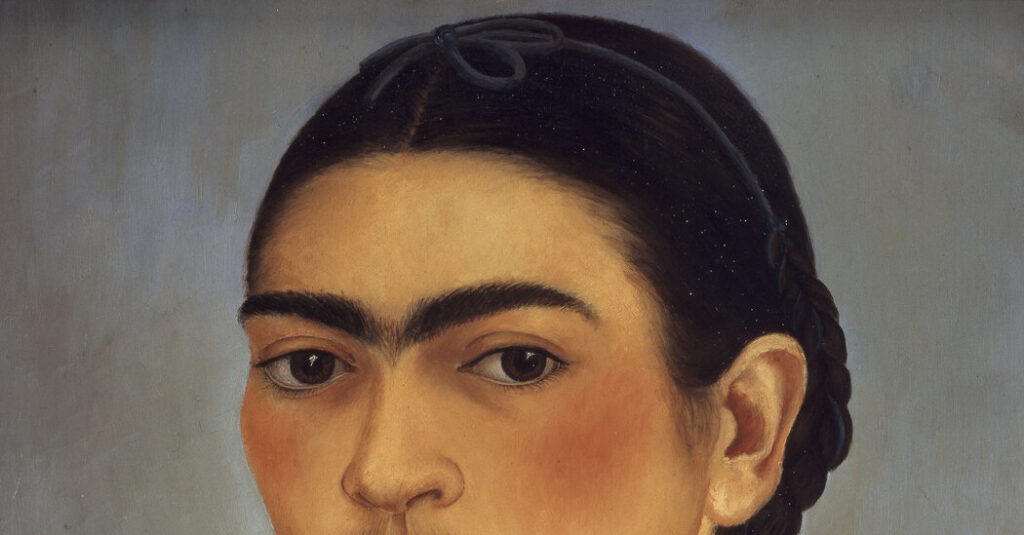
A storied collection of 20th-century Mexican art that includes a trove of paintings by Frida Kahlo has drawn tens of thousands of visitors to Mexico City’s Museum of Modern Art in recent weeks. Record crowds have lined up to see some 70 pieces from the esteemed Gelman Collection, which hasn’t been shown in Mexico in nearly 20 years.
For many art fans, though, the exhibition is cold comfort.
That’s because the artworks are scheduled to leave Mexico in July, when they will be shipped to Spain as part of a deal between their Mexican owner, a prominent industrial family named Zambrano, and Spain’s Santander Bank, which will manage the collection while it’s abroad.
The agreement to move the collection, originally assembled in Mexico by Jacques and Natasha Gelman, a glamorous Eastern European émigré couple, has angered the country’s cultural elite. They say it robs Mexicans of an artistic treasure and breaks cultural heritage rules that forbid important works from leaving the country long term.
Around 380 academics, artists and other cultural figures signed a letter published on the Mexican art website De Museos in March, demanding that the government of President Claudia Sheinbaum explain why these works are being allowed to leave the country. In a separate letter they called on museums in Norway, Switzerland and Germany that have upcoming Kahlo shows to “stand in solidarity” in defending Mexicans’ rights.
“An entire generation in Mexico has been deprived of the permanent public presence that the original owners envisioned for this collection,” the group wrote in the second letter, published on the art platform e-flux.
The dispute has drawn in President Sheinbaum, who on Monday defended the agreement and said officials were obeying the law. Speaking at her daily news conference, Sheinbaum said the “majority” of people who “insist that the collection is not going to be in Mexico” are “against our government.”
In the deal between Santander and the Zambrano family, from northern Mexico, the artworks will be shown at Faro Santander, a museum in northern Spain that is due to open in June. They will be displayed alongside artworks from the roughly 1,000-piece collection of the Santander Foundation.
A person close to the Zambrano family, who asked not to be named because they were not authorized to speak publicly on the issue, said that the Gelman collection was worth “hundreds and hundreds of millions of dollars.” (It was insured for “less than a billion,” they said.)
Objections to the Santander deal hinge on rules designed to keep the work of about 10 celebrated 19th- and 20th-century Mexican artists in the country. Kahlo’s art was declared an “artistic monument” in 1984, and any Kahlo that was in the country at that time cannot leave permanently, although it can be lent to a foreign institution for up to two years. Works can be sold, provided they stay in Mexico.
The decree, published a year after Hayden Herrera’s 1983 biography of Kahlo lit the fuse of Fridamania, proved “prescient,” said James Oles, a professor of art at Wellesley College who lives in Mexico. International demand for Kahlo’s oeuvre has soared over the past 30 years. A self-portrait from 1940, “El Sueño (La Cama)” sold at auction in New York in November 2025 for $55 million with fees — a record for a Latin American artist.
Opponents of the agreement between the Zambrano family and the Spanish bank have also said that it betrays the wishes of Natasha Gelman, who died in 1998.
According to Janet C. Neschis, a lawyer representing the Jacques and Natasha Gelman Foundation, the family always intended to keep the collection within Mexico. However, a copy of Natasha Gelman’s will from 1993, seen by The New York Times, is less explicit. While it stipulates that the artwork be on display in a museum, it outlines specific steps for taking the collection out of the country, which the Zambrano family is following, according to a person close to the family.
“It was always Natasha’s intent to keep the collection in Mexico,” said Neschis.
Gelman left the collection to Robert Littman, an American curator who was her longtime adviser and friend, but a tangle of claims over ownership of the art prompted Littman to stop showing the works in Mexico in 2008.
The claims were defeated in court, said Gerardo Estrada, a former director general of Mexico’s National Institute of Fine Arts and Literature (INBAL), a government institution that runs several museums. He added that he believed Littman was the rightful owner. Indeed, the Gelman will says the collection is “bequeathed” to Littman. The will also stipulates that the original core of 95 artworks in the collection remain intact, but Littman sold pieces and added hundreds more. (According to Estrada, Littman offered to sell the Gelman Collection to the government in 2000, but the government passed. He could not recall the price, but press reports say it was then valued at $200 million.)
For years, the collection’s fate was a mystery until Santander revealed in January that the Zambrano family had bought it in 2023. Littman did not respond to phone messages.
Estrada said the plan to move the Gelman Collection to Spain was “very regrettable.” Comments by Spanish and Mexican officials that it could remain in Spain for five or 10 years had stoked “suspicions and rumors,” he said, that the collection might not return for many years.
For Mexicans, the collection had “become a myth,” said Estrada. “It’s really cherished.”
Indeed, “Modern Tales,” the Museum of Modern Art exhibit, has drawn nearly 120,000 visitors since it opened in mid-February, said Alejandra de la Paz, the current director general of INBAL. Its attractions include a 1943 oil on Masonite by Kahlo called “Self-Portrait (Diego on My Mind),” and her 1933 “Self-Portrait (With Necklace),” as well as works by Diego Rivera, José Clemente Orozco, David Alfaro Siqueiros, Gunther Gerzso and María Izquierdo, all key members of the modern movement.
Under growing public pressure last week, government officials scrambled to reassure Mexicans that their beloved collection would not be gone for long.
“It’s not a goodbye to Mexico,” de la Paz said. Speaking by telephone from Mexico, she said the artworks would return from Spain by 2028. In a later text, she added that they could leave Mexico again after that.
Arturo Saucedo, an expert in Mexican cultural policy, said that he doubted the government was interested in bringing the Gelman Collection back to Mexico quickly. He added: “I think they are counting on us to just forget.”
For some experts, the focus on cultural heritage rules on how long artwork can leave Mexico misses the point. Even when artworks remain in Mexico, regulations do not oblige collectors to put art on public view, Oles said. The best way to ensure that important Mexican art remains visible is to encourage collectors to give it as gifts, or museums to buy it.
Axel Stein, an art dealer and former head of the Latin American Art department at Sotheby’s, agrees with that logic.
“If you want to have a Frida Kahlo on your wall in the Museum of Modern Art in Mexico, then buy the painting,” he said.
But Mexico has many economic demands, from hospitals to schools to leaky museums, experts said. So, it has bought very little of Kahlo’s work.
While there is a constant roster of Kahlo exhibitions — this year, in Houston, London and New York — there are few Kahlo works in Mexican museums.
INBAL owns a handful of paintings, according to Luis-Martín Lozano, an art historian. They include “The Two Fridas,” a well-known 1939 oil on canvas, which is part of the collection at Mexico’s Museum of Modern Art.
At the same time, the world’s most important Kahlo collection, held at the privately owned Dolores Olmedo Museum south of Mexico City, has been closed for six years.
The museum, which also houses a large collection of Diego Rivera’s artworks, announced in February of this year that it would reopen in late May. (The announcement followed a monthslong campaign by local Indigenous organizations who contended that the closing violated their right to access their cultural heritage.)
Kahlo’s work is so expensive it may no longer make sense to buy it, Oles said.
“Should they spend money on one Frida?” he said of the Mexican government, “Or should they spend money on repairing museums?”
Zachary Small is a Times reporter writing about the art world’s relationship to money, politics and technology.
The post Protests in Mexico Challenge Move of Frida Kahlo Trove to Spain appeared first on New York Times.