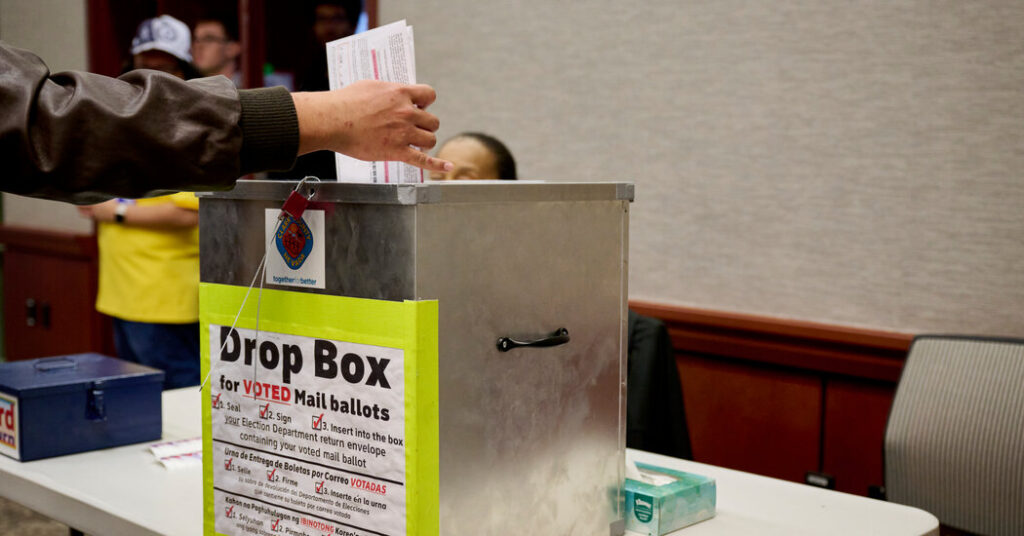
President Trump has for months promoted a number of baseless claims about rampant voter fraud to try to justify a federal takeover of the country’s election system. It is an effort that has spread to other parts of government, which have peddled questionable assertions.
In public remarks and executive orders, Mr. Trump has escalated his attacks on mail-in voting and made misleading comparisons to other countries’ election systems. In lawsuits and affidavits, the Justice Department has repeated debunked claims about the 2020 election and selectively highlighted data to criticize how certain states maintain voter rolls. And in Congress, Mr. Trump’s allies are pushing to pass a bill restricting voting and voter registration by falsely suggesting that noncitizens were voting en masse.
Here’s a fact-check.
Attacks by Trump on mail-in ballots and casting American elections as insecure
What Was Said
“The cheating on mail-in voting is legendary.” — Mr. Trump in signing an executive order in March
This lacks evidence. Documented cases of fraud in mail-in voting are extremely rare, according to election officials, data and a body of research.
A 2025 analysis by the Brookings Institution found that cases of fraud accounted for four out of 10 million mailed ballots. The analysis noted that universal mail-in systems, in which all voters are mailed ballots, are actually less susceptible to fraud than absentee ballot systems, in which voters must request a ballot.
A database of proven election fraud cases maintained by the Heritage Foundation, a conservative think tank, includes 289 cases that involved “fraudulent use of absentee ballots” from 1982 to 2025.
A 2020 report by researchers at the American Statistical Association found “no evidence that voting by mail increases the risk of voter fraud overall.”
Repeating Mr. Trump’s criticism of mail-in ballots, Abigail Jackson, a White House spokeswoman, said that “the president will do everything in his power to defend the safety and security of American elections and to ensure that only American citizens are voting in them.”
What Was Said
“We’re the only country in the world that has mail-in ballots.” — Mr. Trump on March 29 in remarks to reporters
False. More than 30 other countries allow for postal voting, including 10 that allow all voters to vote by mail, according to the International Institute for Democracy and Electoral Assistance, a pro-democracy group.
The 10 countries are Canada, Germany, Iceland, South Korea, Liechtenstein, Luxembourg, New Zealand, Poland, Switzerland and Britain. In the United States, 28 states allow all voters to vote by mail, with no excuses required, and eight others and the District of Columbia conduct elections entirely by mail.
What Was Said
“Despite pioneering self-government, the United States now fails to enforce basic and necessary election protections employed by modern, developed nations, as well as those still developing.” — the White House, in an executive order from March 2025
This is misleading. A number of American officials under the Trump and Biden administrations have deemed recent elections the most secure to date. It is true that other countries rank higher for election integrity than the United States, according to multiple independent analyses. But none of these analyses raised a lack of election protections as an issue with American elections.
The United States scored 0.9 out of 1 — 1 being a perfect score — for free and fair elections in an index developed by V-Dem Institute, a nonprofit based in Sweden that monitors democracy. Thirty-four other countries, out of more than 200 measured, received higher scores.
Staffan I. Lindberg, a University of Gothenburg political scientist who is the founding director of V-Dem, said that the United States’ score was slightly lower than that of European countries because of election violence and intimidation by government officials — including by Mr. Trump himself — not because of fraud or lack of election security.
“The autonomy of election management was more in question,” Mr. Lindberg said, referring to Mr. Trump’s phone call pressuring a Georgia election official in 2020.
“The talk and claims by the Trump administration that it’s a big problem with the integrity and security of American elections is, plainly speaking,” not accurate, he added, using a more colorful word.
The 2024 election in the United States scored just 54 out of 100 in an index from the Electoral Integrity Project, which evaluates the fairness of election systems globally. That represented a nearly 20-point drop from the 2022 midterm elections. More than 80 out of 170 countries total had a higher score. The index noted that “counting, results and procedural aspects of the election were strong” but that the main areas of weakness were gerrymandering and disinformation.
Criticism by the Justice Dept. on state and local election administration
What Was Said
“Michigan also removed only 4.2 percent of registered voters, versus a national average of 9.1 percent.”
“California reported 378,349 voters (11.9 percent) were removed because of death, which was well below the national average.” — the Justice Department in lawsuits filed against the two states in 2025
This needs context. The Justice Department has sued more than 20 states for personal information from voter data, after many refused to turn over voter rolls. In some lawsuits, the agency has argued that the federal government has a duty to maintain clean voter rolls, and in citing data from an election survey, suggested that some states, like Michigan and California, do not do an adequate job.
The numbers are accurate, but the same data source also shows that Michigan is actually among the states that is most active in removing dead people from voter rolls, while California has one of the highest rates of voter removal overall. Moreover, higher removals do not necessarily mean a state is maintaining voter rolls more accurately.
The lawsuits referred to the 2024 Election Administration and Voting Survey, a biennial analysis from the federal Election Assistance Commission. Overall, states removed more than 21 million voters from voter rolls between the 2022 and 2024 elections, about 21 percent of whom were removed because they had died. Michigan removed over 350,000 voters (about 4.2 percent), including nearly 199,000 who had died (about 55 percent of all removals). California, for its part, removed more than 3.1 million voters (about 12.4 percent), including about 378,300 who had died (about 11.9 percent of all removals).
But these data points are an incomplete gauge for voter roll maintenance and are not evidence of fraud, given the differences in state populations, data reporting and approaches to list maintenance, experts said. (Among the three states that have not shared voter data or been sued by the Justice Department, Iowa and Alabama have lower rates of removal than Michigan.)
Michael Morse, a law professor at the University of Pennsylvania who has researched voter list maintenance, cautioned against the suggestion that a rate of removal below a “national average” means negligence or malfeasance, or the very notion that there is a single, standard way of ensuring voter roll accuracy.
“The fundamental problem is that election administration is decentralized, such that states are not equivalent,” he said.
Some states may report a voter moving within a state as simply a transfer, while others may report a cancellation and then a new registration. Some states rely on automatic voter registration systems, which can more frequently catch people who already registered at a prior address. Some states have more transient populations that move, while others have older voters or higher death rates. (California, conversely, has one of the lowest rates of mortality in the country.)
There is also the matter of timing. Removing a name from rolls can often take years because of protections in federal laws that require states to notify voters of potential registration cancellations. Many states maintain lists of “inactive” voters who are in the process of being removed. (Michigan, for example, has identified more than 600,000 registrations slated for removal between 2025 and 2027.)
Charles Stewart, a professor of political science at the Massachusetts Institute of Technology and an expert on election administration, said that most experts would agree that every state “does well enough to ensure that only legally eligible people vote and they only vote once.” And while it is fair to ask questions about how to ensure more accurate rolls, the election survey data “is just not intended to guide scrutiny of maintenance,” he said.
What Was Said
“The tabulator machines used by Fulton County are designed to create and save a scanned image of each ballot. Fulton County has admitted that it does not have scanned images of all the 528,777 ballots counted during the original count or the 527,925 ballots counted during the recount.”
— the F.B.I. in a February affidavit used to seize ballots in Georgia
This needs context. In January, the F.B.I. searched an election center in Fulton County, Ga., and seized ballots from 2020. The unsealed affidavit from that search relied on many previously debunked claims, including about complaints suggesting that missing ballot images, which are similar to photocopies of ballots, were evidence of fraud.
During an investigation into the matter, Fulton County provided 518,960 ballot images to investigators, according to a 2024 report by Georgia’s secretary of state. But the report noted that the county still retained all the physical ballots and that state law at the time did not require preservation of the images. (That changed in 2021, when the state passed a new election law.)
The report also rejected the suggestion that the absence of ballot images suggested tampering. “It is important to note that ballots can be scanned and tabulated without capturing ballot images,” the report said.
Regardless, the results of the 2020 election in Georgia have been affirmed in two recounts with the original ballots.
Claims by congressional allies about noncitizen voters
What Was Said
“There are at least tens of thousands, probably hundreds of thousands by the time all the research is done, of people who have registered to vote in elections in one state or another.” — Senator Mike Lee, Republican of Utah, in March in an interview on Fox News
This needs context. In January, Mr. Lee introduced in the Senate the SAVE America Act, a strict voter identification measure that Mr. Trump has characterized as his top legislative priority. Its supporters say it is needed to crack down on voter fraud, including by noncitizens, and to clean up voter rolls.
A spokesman for Mr. Lee cited comments made by Harmeet K. Dhillon, the Justice Department’s assistant attorney general for civil rights, in a radio interview in March about the agency finding “tens of thousands of noncitizens on the voter rolls.”
The Justice Department did not respond when asked to clarify this figure, but The New York Times reported in January that of 49.5 million voter registrations run through a federal immigration verification system since last year, state officials have referred 10,000 cases for further investigation. It is unclear how many of these cases are confirmed noncitizens and how many voted. Moreover, the system has mistakenly flagged American citizens as noncitizens in several states that use it to examine voter rolls.
The Center for Election Innovation and Research, a nonpartisan nonprofit organization, recently noted that often “claims of large numbers of possible noncitizens on voter records are revised significantly downward after proper investigation and scrutiny.”
For example, Iowa revised an initial estimate of more than 2,100 potential noncitizens on its voter rolls to 277 after further review. Of those cases, 35 noncitizens cast a ballot that was counted in the 2024 general election out of more than 1.6 million ballots across the state.
What Was Said
“This is long overdue, because we know that noncitizens had been participating in elections.” — Speaker Mike Johnson, in a news conference in February
This needs context. It is true that noncitizens have illegally voted in past federal elections, but there is no evidence this is widespread or has altered any elections results.
The Heritage Foundation’s database of documented cases of voter fraud includes 100 cases of noncitizens voting from 1982 to 2025. That is about 0.000008 percent of more than 1.3 billion votes cast in presidential elections during that time.
State audits through the years show similar results.
Michigan announced last year that it had identified 15 credible cases of noncitizens voting in the 2024 election, representing 0.00028 percent of more than 5.7 million total ballots cast.
A 2017 investigation by Pennsylvania estimated that almost 250 noncitizens had voted at least once from 2000 to 2017, casting some 500 ballots. That represented 0.000006 percent of some 93 million ballots.
Linda Qiu is a Times reporter who specializes in fact-checking statements made by politicians and public figures. She has been reporting and fact-checking public figures for nearly a decade.
The post Fact-Checking Republicans’ Misleading Claims About Problematic Elections appeared first on New York Times.