Scott Solomon is a biologist and professor at Rice University and the author of “Becoming Martian: How Living in Space Will Change Our Bodies and Minds.”
When Apollo 11 astronauts Neil Armstrong and Buzz Aldrin set foot on the moon in 1969, they changed the course of human history.
The geopolitical victory of the United States being first to the moon was followed by technological developments by NASA and an environmental movement spawned in part by photos of Earth from space. As influential as these developments were for the second half of the 20th century, NASA’s Artemis program could eventually be more consequential.
Artemis, which includes the current lunar flyby mission, was established during President Donald Trump’s first administration with the goal of sending humanity back to the moon. While the original plans were largely maintained by the Biden administration and during the first year of Trump’s second term, the program recently received a significant boost from NASA. During an event dubbed Ignition on March 24, NASA Administrator Jared Isaacman said the U.S. plans to build a moon base by the 2030s.
A major objective for the base is to develop and test technologies enabling a sustained presence in space that is less reliant on resupply missions from Earth. This includes using lunar soil for building infrastructure and frozen water for drinking and growing crops. Water can also be split into hydrogen and oxygen to breathe and for use as rocket fuel. These are essential for the Artemis program’s ultimate goal: establishing a human presence on Mars.
The ripple effects of these plans will echo long into the future. As an evolutionary biologist, I see parallels between establishing an enduring human presence on the two celestial bodies and the processes by which animals and plants that arrive on islands evolve into new species. When species become isolated in new places, they adapt to the local conditions. The textbook examples are Galapagos finches, which evolved into 18 new species from a single ancestor that arrived on the islands and rapidly adapted to the surroundings. The environments on the moon and Mars are unlike anything our ancestors have experienced in our evolutionary history. Future generations living there will adapt and change.
Being in space alters the human body, from weaker muscles and bones to shifts in body fluids that can lead to vision deterioration. Many of these changes aren’t heritable, but some are. When astronaut Scott Kelly spent nearly a year aboard the International Space Station as part of the NASA twins study, researchers observed several changes to his body. These included the addition of chemicals that turn particular genes on or off, such as genes involved in the immune system. This type of epigenetic adjustment can be caused by stress, from lack of sleep to being confined to a small space for extended periods of time. Changes were also found in the structure of some of his chromosomes, which can affect the function of multiple genes and is thought to be caused by radiation exposure. If genetic and epigenetic shifts happen in cells within the reproductive system, they can be passed to the next generation.
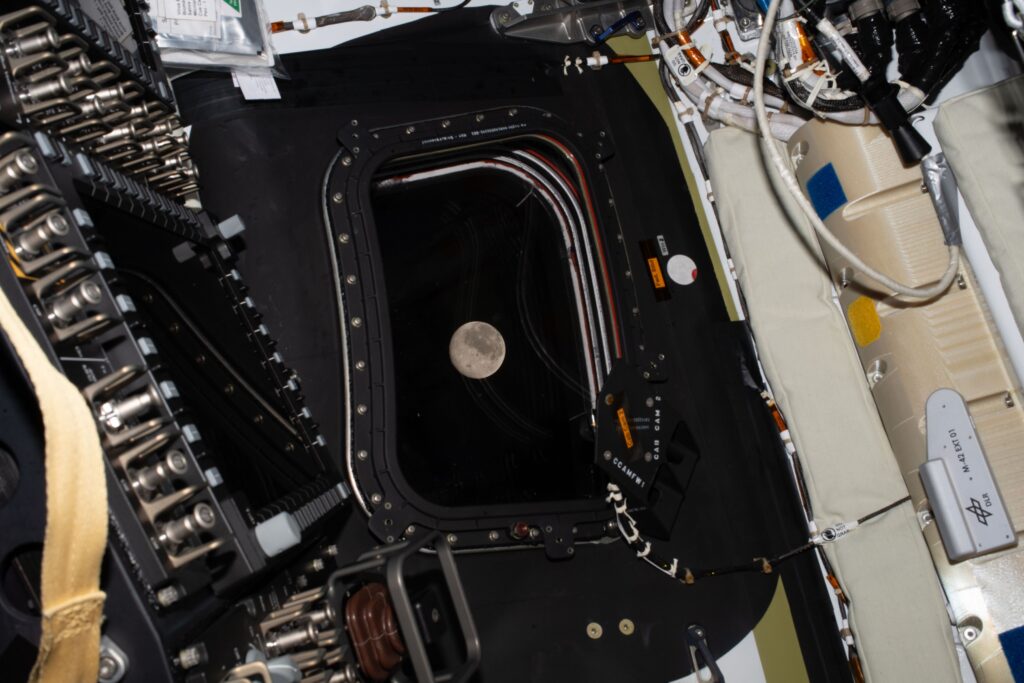
The Artemis II crew members are now traveling through a part of space with higher levels of DNA-damaging radiation than where the ISS operates. Earth’s magnetic field extends beyond low Earth orbit, trapping radiation from deep space in a region called the Van Allen radiation belts. The moon does not have a magnetic field of its own, so radiation levels are significantly higher for astronauts traveling around it or spending time on its surface. While shielding, for example with lunar soil, can block radiation for the crew while they are indoors, time spent conducting activities on the lunar surface will increase exposure to DNA-damaging radiation. Similar conditions exist on Mars, which also lacks a magnetic field.
People living and working on the moon or Mars who later have children have the potential to pass mutations caused by radiation exposure. While NASA monitors crew radiation exposure and imposes career limits intended to minimize the risk of crew members developing cancer, no policies exist regarding reproduction following spaceflight. So far, there’s no evidence to suggest that the children of astronauts have increased risk of inheriting harmful mutations caused by exposure to space radiation. But that could change as people spend longer amounts of time in lunar and Martian outposts.
If children are born on the moon or Mars, experts are unsure whether they would be able to return to Earth. The lower gravity of those two environments is predicted to stunt bone growth and could weaken the heart. Development of the immune system could likewise be compromised by lack of exposure to diverse bacteria and viruses. Being born on another planet could mean being confined to it.
If subsequent generations are born on other worlds, mutations caused by radiation exposure combined with the effects of natural selection will cause them to gradually become different from people on Earth, just as plants and animals on islands diverge from their source populations. Given enough time, they could evolve into new human species. Understanding how they are likely to change, and whether technology such as gene editing could be used to facilitate it, will require more research into human biology in space.
The Artemis II mission may be just one small step toward living in deep space, but it could be the first step toward a giant leap for all humanity.
The post The ripple effects of NASA’s Artemis mission could be bigger than you think appeared first on Washington Post.