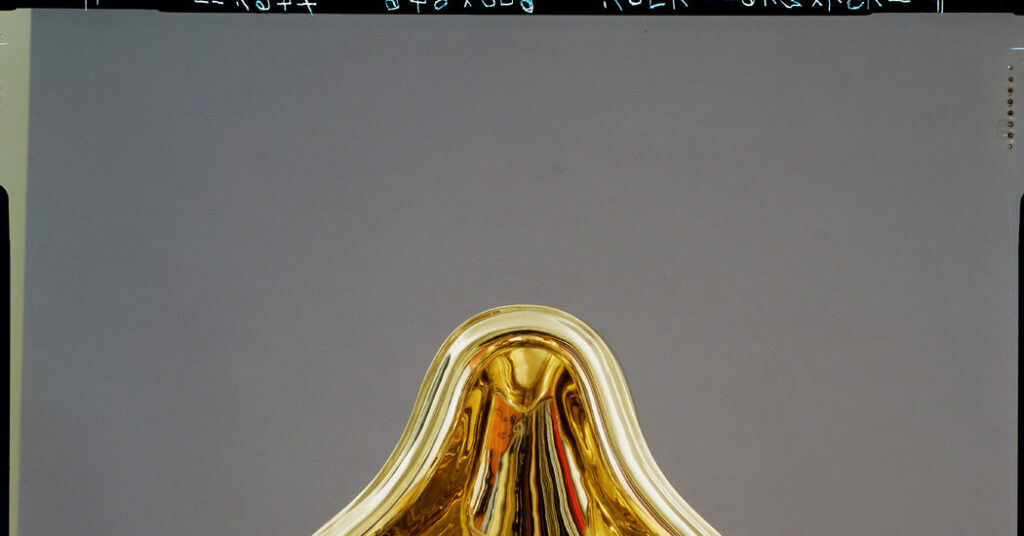
Sherrie Levine
‘Fountain (After Marcel Duchamp)’ (1991)
The New York artist Sherrie Levine is famous for appropriating artworks by others as her own, much as Marcel Duchamp appropriated a commercial urinal as his sculpture. But when she riffed on “Fountain,” she told me, she altered her source a fair bit. She’d found an ancient urinal in a shop — “I thought, ‘Wow, that’s beautiful,’ so I bought it, not knowing what I was going to do with it” — then had it cast in bronze and polished. She likes the “preciousness” this process added to Duchamp’s original, which can come off as simply abject. Also important: Her golden metal looks openly expensive, while Duchamp’s porcelain can pretend to be modest, although a 1964 replica sold at Sotheby’s in 1999 for $1.7 million. That’s what a Fort Knox gold bar goes for today — something Duchamp might have loved.
Alex Schweder
‘Peescapes’ (2001)
Where Duchamp turned a real working urinal into a hands-off sculpture, the New York artist Alex Schweder collaborated with Kohler, the bathroom company, to turn toilets into sculptures meant to be plumbed for use.
“Duchamp took a functional work and created shock by putting it an art context, but I’m arriving at a similar affect by putting an artwork in daily spaces,” Schweder told me.
Duchamp’s nonfunctioning “Fountain” seemed to avoid any obvious aesthetics, while Schweder said that “Peescapes” adds aesthetics, giving waste a roundabout detour as it heads for the drain. Another innovation of Schweder’s: Since “Fountain” is so unavoidably wrapped up in maleness, he thought to design a new version that women could use.
Maurizio Cattelan
‘America’ (2016)
In 2016, the Italian artist Maurizio Cattelan had a real toilet cast from more than 200 pounds of 18-carat gold, then installed it in a bathroom at the Guggenheim Museum in New York for any art lover to use. “He took an object out of the world and placed it into art. I took it back into the world and gave it a price,” Cattelan told me. “Duchamp asked what art is. I asked what it’s worth.”
A piece that screamed value was tempting: In 2019, while on loan to Blenheim Palace in England, it was stolen. The thieves were caught, but the piece, estimated to be worth about $4 million, never reappeared: It looks as though it got sold for (golden) scrap. And Cattelan went on to duct-taped bananas.
Ai Weiwei
‘Letgo’ (2015)
The photograph “Letgo,” by the Chinese artist and activist Ai Weiwei, was inspired by a moment when the Lego company, in Denmark, refused to supply Ai with three million plastic bricks he’d planned to use in an immersive environment featuring portraits of human-rights activists. Ai used knockoff building blocks from China instead (he’s often made work about Chinese industry), but decided to commemorate Lego’s refusal in a Duchamp-inspired image that sent plastic bricks down the drain. “Like Duchamp, I treat everything as a readymade,” Ai told me. “His readymades might be a urinal or a coat hook; mine are the realities of contemporary politics and culture.”
Ai said that, in the course of his career, Duchamp has been the “most significant influence and a decisive factor; no one else has played a comparable role.” Many other artists might say the same.
The post How Duchamp Inspired These 4 Artists appeared first on New York Times.