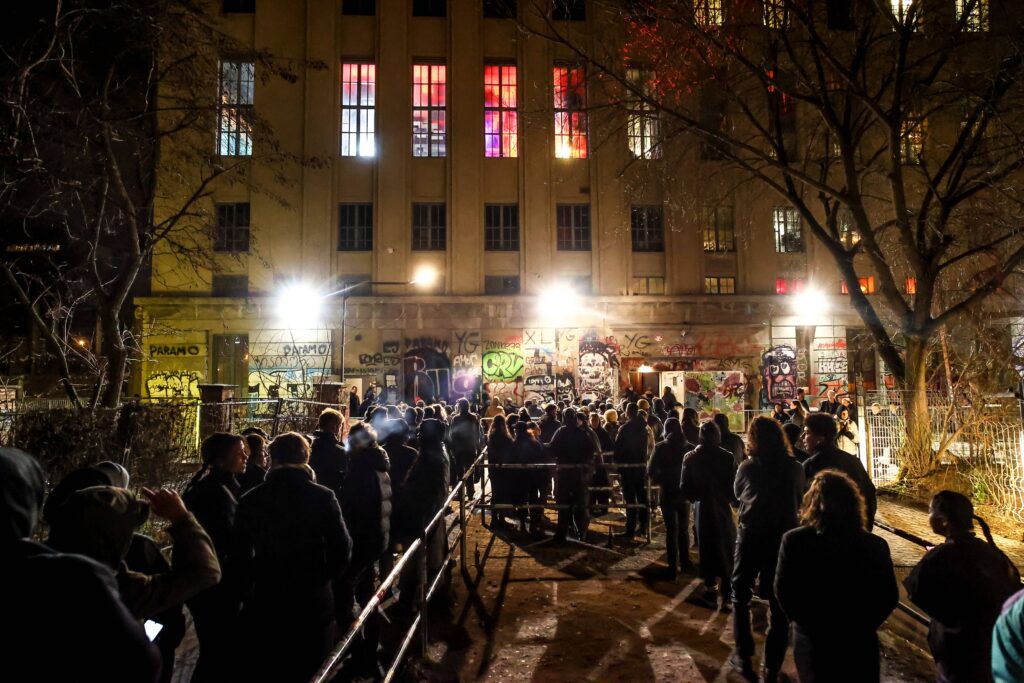
BERLIN — Even in the light of a Thursday afternoon, Berghain looks impenetrable. The former power plant turned nightlife venue is housed in a massive brutalist building, its base covered in graffiti. A maze of metal barricades stands ready to wrangle the club’s notorious line.
Since the advent of social media, Berghain has become one of the most famous clubs in the world for its state-of-the-art sound system, anything-goes kinky atmosphere and notoriously strict door policy. Getting in has gone from a fringe experience for techno enthusiasts to a rite of passage for the average young(ish) tourist. It’s not that everyone suddenly got into electronic music. It’s about the bragging rights. Most people are turned away at the door at the whim of bouncers.
There are endless videos online of travelers recounting their attempts. There’s even a video game “simulator” to practice the screening process. Money and fame cannot guarantee entry, as Elon Musk allegedly learned in 2022.
As lore of the club has spread, the line to get in has grown. Some people have waited up to 10 hours, and the odds are not in the waiter’s favor — tourists and locals alike.
“You can’t call yourself a Berliner without having been rejected at Berghain at least once,” said Jeff Mannes, a tour guide, social scientist and sex educator, who’s been both accepted and rejected at the door.
But Berghain is just one club in a city synonymous with nightlife, and not representative of the scene as a whole.
A common misconception is that Berlin’s club culture only exists in extremes with “drugs and chaos and excess,” Ralf Ostendorf, a spokesperson for Visit Berlin, said in an email.
Instead, “there is a strong emphasis on music quality, community, and self-expression,” he continued. “Many people actually go primarily for art, sound, and atmosphere and some spaces feel closer to cultural institutions than ‘clubs.’”
I booked Mannes’s “Ultimate Berlin Club Tour” to get a primer before trying to experience a few of them myself. Like many travelers, I love to find opportunities to get to know a place through a local custom. Berlin’s club scene felt like an important slice of life to investigate.
But being married, monogamous, mid-30s and with my wildest days of partying behind me, I felt out of my depth. Where does an outsider even start?
Leave your pants at the door
On a Friday night, my husband, Dan, and I followed the advice of a server at dinner and ventured to Crack Bellmer, a modest venue in East Berlin where we danced to house music. There was no line to get in, and the place was sparsely populated. We were way too early, even at midnight.
Berlin has no nightlife curfew, which has given way to a tradition of marathon partying. That’s not hyperbole. Some people bring toothbrushes into Berghain knowing they could be inside for days if they get in.
“A weekend party means starting on Friday and going to bed on Sunday evenings,” said Robert Sommer, a tour guide and historian who grew up in East Berlin.
Some people stay awake with party drugs, others with disco naps back at home between parties.
The novelty of it all may also keep you going.
On Saturday night around 3 a.m., Dan tapped out after we hit Kater Club at Holzmarkt 25 and I continued on solo to KitKatClub, a popular venue Mannes had shown me on my tour, known for its kinky fetish parties — potentially shocking for outsiders but commonplace in Berlin.
Since Berlin’s clubs were often built by marginalized communities, they often served as “safer spaces for marginalized people,” Mannes said, “and in some cases, also for people who want to explore their sexuality.”
Berghain was born out of gay fetish parties, and — like other clubs including KitKat — remains a place where public sex is sanctioned (so is semipublic sex, taking place with more privacy in dedicated rooms).
When I got to the door, the bouncer said I could come in if I took my pants off.
I’d gotten dressed that night with a Berghain attempt in mind, and followed the advice of a friend who’d been before. He recommended combing my hair into a “severe” slicked-back bun and wearing a black leotard. The best I could do was a black one-piece swimsuit. In absolute opposition to the vibe, I couldn’t bring myself to leave my hotel room so exposed and slipped on black cotton pants and my navy chore coat over the ensemble. Now I looked modest enough to go to a museum.
But at the KitKat coat check, I dropped trou and proceeded into the club’s labyrinth in my swimsuit. I soon realized I would have been in good company in my underwear alone — or even fully bottomless. Club goers dressed in lingerie, leather gladiator skirts, demon horn headpieces, glittering pasties and complicated harnesses. Some wore only the shoes on their feet. I danced in a sea of sweaty bodies, feeling free and anonymous — albeit a little guilty for not being there to partake in the more … intimate affairs going on.
MINQ, a DJ from New Orleans who moved to Berlin in the summer of 2016, told me tourists should feel welcome going to clubs, so long as they come with the right attitude.
“My rules are that it doesn’t matter who you are, where you come from,” he said. “The people I like to party with are people who like to contribute to the environment and not just people who are there to consume the environment.”
The bouncer is not your enemy
Barbara Woolsey, a DJ who goes by the stage name babxi (pronounced “Babsi”), has a nonnegotiable for Berlin’s nightlife tourists: follow basic club etiquette, like don’t use your phone on the dance floor.
“This idea of get out your phone and film the whole thing … that’s just such a vibe killer,” Woolsey said.
In fact, many venues have strict no-photo policies, asking patrons to put stickers over their phone cameras when they enter to protect those inside. The bouncer does a similar job at the door. Mannes said it’s not necessarily about judging who’s cool, but determining whether they’ll play by the rules and contribute to the spirit of the place. Some venues — including Berghain and KitKat — also have “awareness teams” available for club-goers to report any misconduct once inside.
It’s not a perfect system. Last year, Berlin police investigated a claim of an alleged sexual assault at Berghain, and KitKatClub has also faced sexual assault claims, among other controversies.
After a recent allegation, KitKatClub’s founders said in a statement that “unfortunately, it is not within our power to prevent every crime in our space; people, with their desires and personal histories, are simply too complex.”
Mannes gives a similar message to his tour clients.
“I like to talk about ‘safer’ spaces and not ‘safe’ spaces because I don’t think that a 100 percent safe space can exist,” he said.
“When you have clubs like KitKat, where many different communities come together that might have different consent languages, there’s, of course, always a reason for potential conflicts,” Mannes continued. “So learning about consent and different consent rules is crucial, really, before you go to these spaces.”
Attempting Berghain
I knew I was not the target demographic, but I couldn’t write this story without a swing at Berghain. So deep into Saturday night, ill-advised cotton pants back on, I hopped on an e-bike and headed over to begin my humiliation ritual.
In line, I smoked a cigarette to play it cool, feeling deeply uncool behind a lithe, androgynous couple wearing outfits worthy of a Spice Girls photo shoot circa 1997.
Many people advise sticking to all black, although I’ve heard plenty of stories of people gaining entry in hiking clothes, sundresses or jeans. Mannes told me he was dressed casual the first time he got in, and turned away a time he was fully clad in leather.
After just 20 minutes of waiting (a Berghain miracle), it was my turn at the door.
“How old are you?” the bouncer asked.
I couldn’t remember. My heart pounded.
“Um, 34! I’m 34!” I finally said.
The bouncer walked over to his associate, whispering something in his ear. He came back and let me down easy, something along the lines of: “I’m sorry, I can’t let you in tonight.”
‘That Berlin feeling’
I licked my wounds and walked to Tresor, another famous club in a power plant that Mannes told me “brought techno from Detroit’s Black community to Berlin in the beginning of the ’90s.” It was huge and cavernous, hazy with smoke machines.
After 6 a.m., I decided to give Berghain one last shot. Maybe there’d be a new bouncer now that the sun was up? As I approached, I recognized the face at the door. The face recognized me back. Curses.
“I still can’t let you in,” my familiar bouncer said.
MINQ, who’s been to Berghain on multiple occasions, said I didn’t miss out entirely.
“You suffer outside. The line sucks. You stand outside for hours, maybe it’s raining or snowing … no one’s talking,” he said. (There’s a myth that you’ll have a better chance of entry if you do not talk, smile or laugh in line.) “The last time I remember trying to go there, so many people were skipping the lines that I was just like, ‘I don’t want to party with you people if you’re so unfriendly outside,’ so I left and went somewhere else.”
Woolsey also made me feel better about my rejection. Sure, partying for hours (or days) at Berghain is a “special, once-in-your-lifetime thing to do,” she said, and worth trying to experience.
“But if that’s going to just eat up your entire day and you’re not going to see anything else,” she said, “there are at least 10 other clubs in Berlin where you can go and really properly get that Berlin feeling.”
Woolsey suggests checking out the events website Resident Advisor, where you can find cool smaller parties with shorter lines. If you don’t want to subject yourself to lines and door deliberation at all, you can also look for events where you can buy tickets in advance.
Poke around the site for a few minutes and you’ll see there’s something for everybody, from the usual suspects (techno, house), as well as “more niche, different sounds,” Woolsey said. That could be pop, Afrobeats, disco or classical music at dark raves in industrial warehouses or colorful, open-air parties in the city’s parks.
“It’s not just young people that love it,” Woolsey said. “It’s really people of all ages.”
Alternatively, you could always microdose a club adventure in a Teledisko, a coin-operated, phone-booth-size contraption that bills itself as the “world’s smallest nightclub.” You can find them scattered around the city. No bouncer, no line.
The post Pants are optional: What I learned navigating Berlin’s famous club scene appeared first on Washington Post.