President Trump has given Iran mere hours to reopen the Strait of Hormuz or face a Tuesday onslaught on its civilian infrastructure by the United States. Iran has shown no sign of releasing its chokehold on the strait, a critical shipping route for global oil supplies.
Despite the impasse, both countries have put forward proposals that could serve as a basis for negotiations. Though their leaders have publicly rejected the other side’s ideas, diplomats and mediators have signaled a willingness to talk.
Here’s what we know about the various proposals.
What does Iran want?
On Monday, Iran put forward a 10-point plan to end the war, according to Iranian state media reports.
The details of the plan, to be conveyed by a mediator, Pakistan, were not immediately clear. But officials said Iran was seeking a guarantee that it would not be attacked again, as well as an end to Israeli strikes against Hezbollah, its proxy militia in Lebanon.
In exchange, Iran would lift its blockade of the Strait of Hormuz. Iran wants to impose a fee of roughly $2 million per ship traveling through the waterway. It would split the proceeds with Oman, which sits across the strait, and use its share to reconstruct infrastructure destroyed by American and Israeli attacks, rather than demand direct compensation for the damage.
How did the U.S. respond?
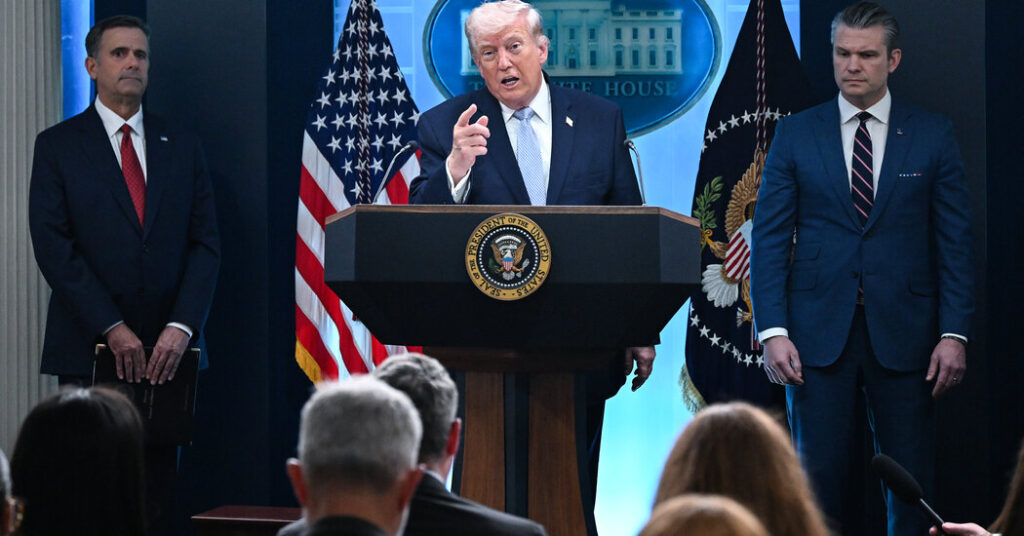
Mr. Trump described Iran’s latest proposal as “a significant step.”
“It’s not good enough. But it’s a very significant step,” he told reporters on Monday, adding that the United States was negotiating with a new Iranian leadership.
“We’re dealing with different people now,” he said. “They’re smarter. They’re sharper, I think less radical,” he added. “I can tell you they’re negotiating we think in good faith.”
Vice President JD Vance; Steve Witkoff, Mr. Trump’s special envoy to the Middle East; and Jared Kushner, the president’s son-in-law, are all involved in the negotiations, Mr. Trump said.
Last month, Iran publicly rejected a 15-point U.S. plan to end the war. But it has signaled a willingness to attend negotiations hosted in Pakistan’s capital, Islamabad.
The details of that initial U.S. plan were not publicized, but officials who had been briefed on the proposal said it addressed Iran’s nuclear programs and maritime routes.
Who is mediating?
Pakistan has been mediating between the United States and Iran. Its army chief, Field Marshal Syed Asim Munir, has emerged as a key interlocutor, passing messages between the warring sides.
He is believed to maintain close ties to Iran’s powerful Islamic Revolutionary Guards Corps, according to officials with knowledge of the talks. He also met twice in 2025 with President Trump, who showered praise on him. Egypt and Turkey have also encouraged the Iranians to engage constructively, these officials added.
Pakistan and other regional allies have proposed a 45-day cease-fire, an idea that Iran has rejected. White House officials said Mr. Trump had not signed off on Pakistan’s proposal.
Where does the rest of the world stand?
Military planners from more than three dozen countries were expected to meet on Tuesday to discuss options for securing international shipping through the Strait of Hormuz. That meeting, organized by Britain, will not include the United States.
Last week, officials from more than 40 countries met virtually to consider a political and diplomatic response to the war. Britain, France, Germany and Canada, along with Gulf nations, were represented. The United States was not.
The group of nations released a joint statement condemning attacks on civilian infrastructure and Iran’s disruption of traffic through the Strait of Hormuz.
During the meeting on Thursday, Italy’s foreign minister, Antonio Tajani, proposed creating a humanitarian corridor with the United Nations to provide safe passage for crucial goods to prevent widespread hunger.
In the face of a mounting energy crisis, Prime Minister Sanae Takaichi of Japan told her Parliament that she would seek talks with the Iranian government this week.
Tyler Pager, Erika Solomon, Farnaz Fassihi, Max Bearak, Stephen Castle and Michael D. Shear contributed reporting.
Lynsey Chutel is a Times reporter based in London who covers breaking news in Africa, the Middle East and Europe.
The post Amid Escalating Threats, U.S. and Iran Float Ideas to End War appeared first on New York Times.