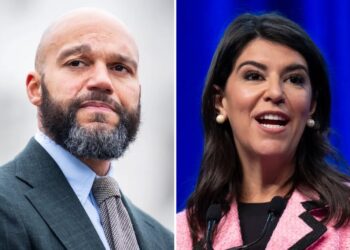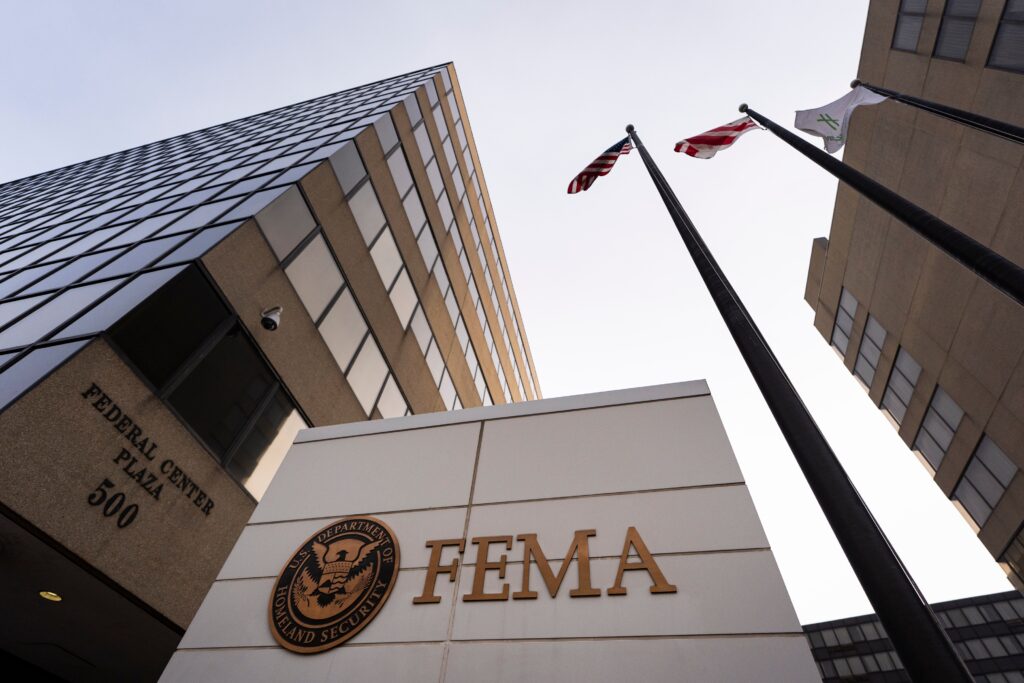
On a Monday in mid-March, a group of Department of Homeland Security investigators entered the Federal Emergency Management Agency’s headquarters and headed up to the eighth floor, past two access-controlled doors, and to an office near the administrator’s. The agents roped off the area, copied notebooks left on the desk, and put stacks of documents and equipment in boxes.
That workspace belonged to an influential figure at DHS who had been integral to overseeing much of FEMA’s day-to-day operations — including decisions on grants and awards that are now part of an Office of Inspector General review of contracts issued under then-Secretary Kristi L. Noem’s leadership, according to several current and former DHS officials, including two with knowledge of the headquarters search.
Kara Voorhies joined DHS early in Trump’s second term and worked closely with Noem’s top aide, Corey Lewandowski, as a contractor. Both held unusual roles at DHS that stationed them at the top echelons of the agency and put them at the center of some of its most controversial and consequential moves over the past year.
Last June, Noem demanded that DHS headquarters approve all contracts worth more than $100,000, giving top officials significant control over everyday spending and creating major delays. Noem’s successor, Secretary Markwayne Mullin, has swiftly scrapped that rule and said leadership should review contracts valued at more than $25 million, a cap that he called “appropriate.”
Among the awards that have come under public scrutiny are a $1 billion contract fast-tracked to a pro-Trump donor last year; a $200 million contract to purchase two private jets for Noemand other top officials to use for travel; and another $200 million contract, for ads that Noem starred in last year.
Sen. Richard Blumenthal (D-Connecticut) said that the Senate Permanent Subcommittee on Investigations is conducting a probe of “potential wrongdoing by Lewandowski and Noem in connection with DHS contracts.” He said he is also aware of information indicating that the DHS Office of Inspector General is investigating the handling of grants and contracts by Noem, Lewandowski and others.
The DHS inspector general’s office declined to comment on a probe, saying it has “a longstanding policy neither to confirm nor to deny the existence of any specific investigation.”
The Washington Post reviewed emails, meeting records and memos from the past year and spoke with more than 12 current and former DHS and FEMA officials, including several senior officials who spoke on the condition of anonymity because of the sensitivity of the matter. The review offers a rare inside window on the power wielded by Lewandowski and a handful of advisers, Voorhies chief among them, while Noem led the agency. The Wall Street Journal and CNN first reported details about the investigation and Voorhies’s outsize influence on FEMA as a shadow administrator. The Post is reporting previously unpublicized details about Voorhies’s role within FEMA.
Voorhies worked in “lockstep” with the U.S. DOGE Service — the government cost-cutting operation headed by Elon Musk — for a time, according to one senior official, and enforced priorities such as canceling grants that mentioned “climate change, social media, diversity, equity or inclusion.” She also worked to ensure that Muslim groups did not receive security grants, and participated in high-level conversations trying to block California from getting any money because of its status as a sanctuary state.
Inside FEMA, concern grew as Voorhies was given broad authority over spending, taking the lead on grants even over the agency’s own grants manager. She also had access to proprietary information, including details about large contracts and planned projects. Many people who worked with Voorhies at FEMA did not know she was a contractor, several former senior officials said, despite federal regulations that require contractors to clearly identify themselves as such in conversations, in meetings and on emails.
“In 20 years I have never seen this done,” said one former senior official. “This was a huge shift.”
Voorhies did not respond to requests for comment. DHS and Noem did not respond to a list of questions. In a statement provided by an intermediary, Lewandowski’s office said he never benefited personally from DHS contracts. The office indicated that he had helped to implement reforms that saved American taxpayers $15 billion and said that his critics include “entrenched interests” that opposed those reforms.
“Contracting decisions rest with authorized officials at DHS,” Lewandowski’s office said. “During Mr. Lewandowski’s voluntary tenure at DHS cutting waste, fraud and abuse, Mr. Lewandowski did not solicit nor has he been compensated by companies in any way, shape or form.”
‘Access to whatever she wanted’
Last spring, Voorhies seemed to appear out of nowhere.
Suddenly, according to a former senior agency official, she was in FEMA meetings “that should have been government-only” and that were mostly focused on the agency’s budget. At the time, the former official said, agency staffers were scrambling to justify “every penny of contracts” and grants as the U.S. DOGE Service carried out a major overhaul of the federal government.
It was quickly understood that Voorhies was Lewandowski’s eyes and ears, the senior official said, and “we were told to give her access to whatever she wanted.”
Voorhies set up processes to manually review every grant and contract that FEMA had already awarded, and she gave directions on which ones to cancel, according to two current and three former senior officials. The grant review process was chaotic and frustrating, they said, and sparked multiple lawsuits and delays in disbursing funds across the agency.
Voorhies was known for enforcing Noem’s $100,000 rule for reviewing contracts, and as a contractor, she should not have been given wide latitude on matters such as personnel decisions and spending during and after natural disasters, according to three former FEMA officials and one senior FEMA official. She previously worked for financial consulting firms and had no known prior experience in emergency management.
Many of the instructions Voorhies gave reflected Noem and Lewandowski’s political agenda, nearly a dozen former and current FEMA officials said.
California came up often as a target, particularly in connection with the Urban Area Security Initiative, which FEMA manages. Lewandowski and Voorhies were involved in discussions about how to withhold money from the state because it provides protections for undocumented immigrants, said two former senior officials.
Voorhies also helped delay grants that went out to nonprofits and religious organizations, according to the two former officials and emails reviewed by The Post. She was heavily involved in ensuring that money for a security grant program at first went only to Jewish organizations, the officials said, after DOGE provided FEMA a list of Muslim groups with supposed terrorist ties. The list came from an outside organization, which one former senior official said FEMA had never relied on before. Eventually, the federal money also went to Muslim organizations.
In June, Voorhies became involved in a multimillion-dollar project that DHS ordered FEMA to rapidly pull together: the creation of an immigration detention facility in South Florida that became known as Alligator Alcatraz. Noem had traveled to Florida to help orchestrate the deal, said a former senior official with direct knowledge of the situation.
FEMA’s staff was told to design a grant that would enable the department to pay Florida to erect and run the migrant center by restructuring the agency’s Shelter and Services Program, according to the official and pages of the plan reviewed by The Post.
While FEMA acting administrator David Richardson played a key role in the process, Voorhies provided employees “with lots of direction and drove many of the conversations and even approvals on what we were doing,” according to the former senior official with direct knowledge of the situation. The official described how Voorhies would tell employees as well as some FEMA lawyers what they needed to do and how to do it.
Some FEMA officials were irked by her involvement, and became concerned again a month later when she had a hand in allocating resources after the July 4 floods in Texas. As federal and local teams worked to send technical assistance to search-and-rescue crews, Voorhies was one of the people who questioned the need for those resources, according to a senior official.
Once the urgency was explained, Voorhies and others enabled a request for help to go up the chain to Lewandowski and on to Noem, who rapidly approved it.
“It was getting through everyone, a.k.a. Kara, to get to Noem,” the official said. “That was the problem.”
Fast-track contract, stalled audit
As concern grew inside the agency, outside it, Noem was drawing attention to DHS by pushing through controversial policies that sparked protests, lawsuits and violent confrontations in cities around the United States.
Two months after Trump’s inauguration, she signed off on sending three planes filled with Venezuelan and Salvadoran men — whom the administration accused of being gang members — to a notorious prison in El Salvador. Then she visited the Terrorism Confinement Center herself and posed for photos before detainees while sporting a $50,000 Rolex watch. In the months that followed, Noem dispatched thousands of officers to Democratic-led cities, where they shot and killed three people, including two U.S. citizens. ICE detention numbers soared to record levels as immigration officers began picking up more people — many with no criminal record. Noem defended those actions as necessary for national security, and a spokeswoman said the watch was purchased using proceeds from Noem’s book sales.
By the fall, Noem’s use of government resources was also making headlines. In October, The Post reported that the Coast Guard was planning to buy two Gulfstream private jets to be used by Noem and other top DHS and Coast Guard officials, at a total estimated cost of $200 million. Noem was also living rent-free at a home reserved for the Coast Guard’s top admiral. DHS later said she had begun paying to reside there.
DHS had also fast-tracked a contract worth almost $1 billion to Salus Worldwide Solutions, according to records reviewed by The Post. The company is led by William Walters, a donor to a pro-Trump nonprofit group. The contract involved a DHS program called Project Homecoming that offers cash bonuses, free flights and a “concierge service” at airports for departing migrants.
According to a lawsuit from a competing company challenging the award, as well as an official familiar with the process, DHS officials shared nonpublic information with Salus to help prepare its bid, prompting an investigation by agency lawyers. An internal investigation found that DHS employees exchanged at least 40 emails with Salus to discuss the contract, and determined that Salus had an unfair advantage in helping to design the contract it bid on, the competing company said in a Dec. 2 court filing.
In an email to The Post that month, a lawyer for Salus denied that the company received “inside” information.
Rep. Robert Garcia (D-California) sent a letter to Walters last week as part of a House Oversight and Government Reform Committee investigation into “potential corruption, self-dealing, and mismanagement” at DHS under Noem and Lewandowski’s leadership. He requested that Walters share records of all interactions between Salus and Lewandowski, among other documents.
“Every day, we find new evidence that corruption tied to Corey Lewandowski runs deep inside the Department of Homeland Security,” Garcia said in a statement. “Our taxpayer dollars may have been diverted to pay off connected insiders on a massive scale.”
Voorhies and Lewandowski continued to play high-profile roles in DHS even as concerns grew. During the State of the Union address, Voorhies was among a small group of DHS leaders allowed to depart to Virginia in a helicopter meant for high-ranking officials and support staff. The chopper may have intruded on restricted airspace near the Capitol, according to two officials with direct knowledge of the situation, alerting security personnel.
Voorhies’s name was on the manifest beforehand, but people had no idea she was a contractor and not a government employee until there was an issue with the flight path, said one official.
“She should never have been on that aircraft,” that official said.
The inspector general launched an audit in January of DHS grants and contracts awarded “by any means other than full and open competition” during fiscal 2025. But in a letter to Senate and House appropriators, Inspector General Joseph Cuffari wrote that DHS had “systematically obstructed” his office’s work and that the obstruction was “particularly egregious in a specific pending criminal investigation.”
Cuffari did not offer specific details about the investigation, but he wrote that another federal law enforcement agency had asked his office to join a criminal inquiry. When his office requested access to a DHS database, Cuffari said, the department imposed conditions that could compromise the investigation.
Days before her firing, Noem faced contentious oversight hearings in the House and the Senate, where lawmakers asked her about the agency’s contracting process and the inspector general’s letter.
“Does anybody have any idea how bad it has to be for the OIG in this agency to come out and do this publicly?” Sen. Thom Tillis (R-North Carolina) asked at a Senate Judiciary Committee hearing. “That is stonewalling, that’s a failure of leadership, and that is why I’ve called for your resignation.”
During the same hearing, Sen. John Neely Kennedy (R-Louisiana) pressed Noem on the $200 million ad contract that DHS had fast-tracked early in her tenure as secretary. When asked if Trump had approved the ad campaign, Noem replied that the agency “went through the legal processes” and claimed Trump knew ahead of time. Kennedy replied, “It puts the president in a terribly awkward spot.” Noem also denied that Lewandowski played a role in approving contracts.
During a House Judiciary Committee hearing the following day, Noem maintained that the inspector general “has been told repeatedly in writing, verbally on the phone, that he can have access to anything at the Department of Homeland Security.”
“He just needs to provide a scoping memo,” Noem said. “He wants unfettered access to every single thing in the department, and that’s not the process.”
In late March, Cuffari wrote to Blumenthal that his department’s audit of spending under Noem had stopped for another reason: the partial DHS shutdown.
“We will resume our audit upon the cure in funding,” he wrote, “and would welcome the opportunity to brief you on our findings once it is complete.”
Douglas MacMillan contributed to this report.
The post How a little-known contractor helped direct operations at FEMA for a year appeared first on Washington Post.