Texas education officials are considering sweeping changes to English and social studies instruction that would put readings from the Bible on a new state-required reading list for millions of public school students.
The changes would also bring a U.S. and Texas centric lens to history, with less emphasis on world history, a shift some historians and progressive groups have opposed.
The Texas State Board of Education, an elected board with a 10-to-5 Republican majority, is scheduled to meet on Tuesday to consider the proposals, including the hotly debated required reading lists for each grade level.
One draft of the list, proposed by the Texas Education Agency, includes widely recognized classics such as “The Very Hungry Caterpillar” by Eric Carle for kindergartners, “A Wrinkle in Time” by Madeleine L’Engle for seventh graders and the Rev. Dr. Martin Luther King Jr.’s “I Have a Dream” speech for eighth graders.
But it also includes passages from the Bible in middle and high school, such as the story of David and Goliath from the Old Testament and a meditation on love from First Corinthians.
The list includes select texts from Black historical figures like Langston Hughes and Frederick Douglass, but has relatively few Hispanic and Black authors, a move that has drawn criticism from Democratic members of the state board.
“There is a mass lack of representation,” said Marisa Pérez-Díaz, a Democratic member who represents San Antonio and part of South Texas. She noted that Hispanic and Black students make up a majority of public school children in the state.
The board will also consider a second proposal, from a board member, which requires fewer books overall and includes texts from the Bible starting in elementary school.
In social studies, the board is considering a chronological version of history, with an emphasis on U.S. and Texas history in most grades.
Progressive groups and mainstream historians have criticized the proposal as promoting a vision of American exceptionalism, with a focus on Christianity’s influence, while leaving little room for world history or the contributions of other religions.
“Do we want the next generation of Texas students competing in a global economy never having really learned very much about China?” said Brendan Gillis, the director of teaching and learning for the American Historical Association, a national group representing historians, which has been critical of the proposal.
Texas is home to 5.4 million public school students, about 11 percent of the total U.S. public school population.
The proposals in Texas are part of a broader push by Republicans, including President Trump, to embrace the role of Christianity in America’s founding and promote a sense of patriotism. The Trump administration has pumped more than $150 million into history and civics education ahead of the 250th anniversary of American independence this July.
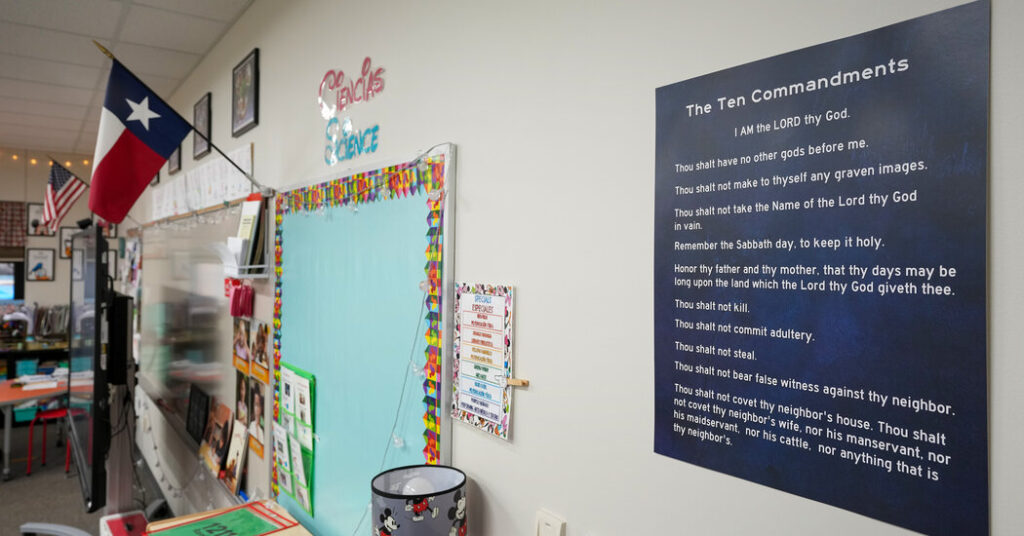
Several states, including Texas, have sought to hang the Ten Commandments in public school classrooms. And lessons about the Bible are already included in an optional English curriculum in Texas.
Supporters say that the latest proposals would give Texas students something more akin to a classical education, an approach that focuses on the roots of western thought and culture and teaches classic works of literature, including the Bible as a cultural touchstone.
The approach has grown popular with conservatives, who say that it gives students an important foundation, and that recent efforts to include diversity should be rooted in academics, not inclusion for inclusion’s sake.
“Islam and Buddhism didn’t found the west,” said Mandy Drogin, a senior fellow at the Texas Public Policy Foundation, a conservative think tank based in Austin, who supports the changes.
She said that while some world history and instruction about other religions is needed, Judeo-Christian values were central to America’s story and culture.
“To not know the story of the good Samaritan, for example, you’re really going to miss on not just important lessons, but rich cultural and historical significance as an American,” she said.
Many Americans appear to support a balance in history instruction. In 2022, more than 75 percent of Republicans and Democrats alike said they supported teaching about patriotism and the founding fathers, as well as critical thinking and the contribution of women and people of color.
The debate over the required reading list comes as U.S. reading scores have been on a yearslong decline and many schools have moved away from teaching whole books from beginning to end, something the list’s supporters aim to change.
The state board is expected to take a preliminary vote on the book and social studies proposals later this week, with a final vote expected in June.
Any new requirements would not go until effect until 2030.
Sarah Mervosh covers education for The Times, focusing on K-12 schools.
The post Texas Considers Required Reading List for Schools, Which Includes the Bible appeared first on New York Times.