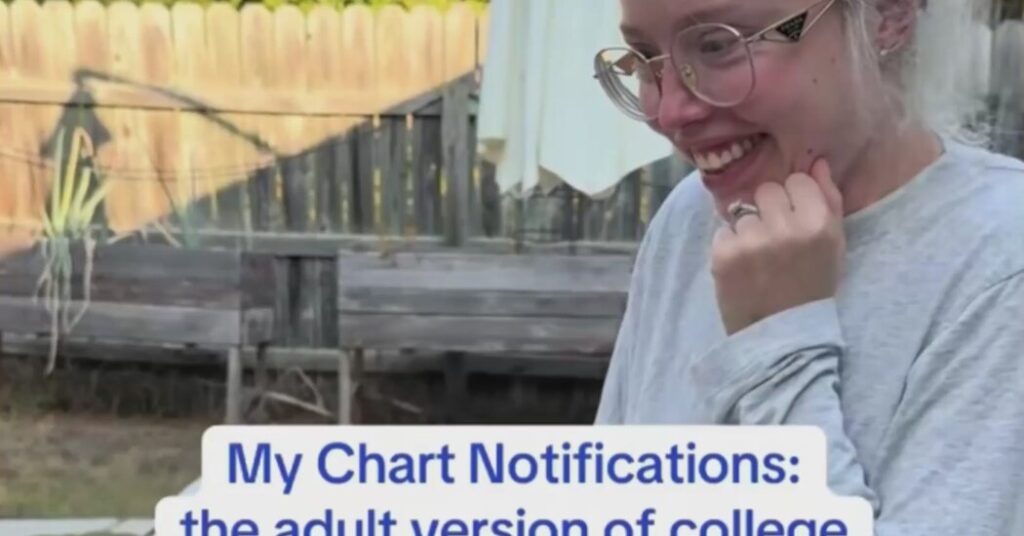
A woman sits at a table in her backyard, her laptop open in front of her. “OK,” she says. “I’m home after my scan, and I have my results that I’m going to open.” She describes what a beautiful day it is; she prays to God to keep her strong for whatever is coming; she moves her finger on the laptop track pad. “I just need to click ‘view results,’” she says. “But I’m starting to feel a little sick to my stomach.” Finally, she clicks, reads — and keeps reading. What is she seeing? We can’t tell — until she tells us. “No evidence of localized disease recurrence or metastatic disease in the abdomen or pelvis.”
I started seeing videos like this two years ago after anxiously Googling about some scan results of my own. I quickly came to understand that I had fallen into an entire new genre of social video, one built around people’s responses to medical tests. Cancer patients checking the status of their tumors. Exhausted people reading the results of bloodwork in hopes of figuring out why they’re so tired. In some cases, creators looking to optimize, using their results to fine-tune their health for bodybuilding.
Some of the videos I saw started right on the brink of revelation, with their subjects about to receive potentially life-altering new information. Sometimes the person was already responding to the results and I was playing catch-up, trying to figure out what had caused this reaction. One video, showing a young woman sitting at a desk, staring at her computer, began with the label “Finding out if the cancer treatment worked.” After several tense moments in which she seems to be clicking through successive screens looking for information, we arrive at the climax, when she begins to cry and then breaks into a smile.
These videos are an unintended result of a law passed by Congress in 2016, mandating that providers give patients full access to the entirety of their medical records as quickly as possible. The law went into effect in 2021, and ever since, “raw” test results have arrived on our screens the instant they’re processed at the lab. This may be a victory for patients’ rights. But it also has the potential to be extremely unsettling. Information that was once delivered via live conversation with a human being, one trained in medical interpretation, is now frequently encountered first as decontextualized data on the screen.
This unmediated medical data is now arriving at random moments in our lives. It can come any time of day, when you’re surrounded by people or all alone. Suddenly, you’re faced with a private decision — open? ignore? wait? It is out of the strangeness of this moment that the genre of medical results videos was born. People don’t know what to do with the experience of getting their data, and so they turn their cameras on.
The videos they make have become so popular that there are now memes about the anxiety of waiting for results (or trying to decipher them once they’ve arrived) and jokes about the popular patient portal MyChart — that it’s “the adult version” of college admissions, per one video.
When I first started watching, I viewed the videos as acts of human expression fueled by our innate desire to connect. In them, or through them, a potentially quite lonely experience could be transformed into a communal one. The individual is no longer alone with the screen and the data; they’re in community, of sorts, with people all over the world, who chime in with comments celebrating the good news or lamenting the bad or worryingly ambiguous. In December, I watched a 37-year-old woman in a “Bluey” T-shirt share her labs on TikTok as part of a series about trying to reprioritize her health. She had the nervous, befuddled air of someone trying to follow a recipe written in a foreign language. “Let’s dive in even though im clueless,” the caption read.
The comments were full of support: “Your blood work is amazing,” wrote one pseudonymous commenter. “Especially your A1c and cholesterol. Amazing.” Some also offered gentle concern: “not understanding why you are not consulting your primary doctor about your results?” The original poster’s response? “Not all of us are that blessed.” (The approximately 100 million Americans without reliable access to a primary care provider, as estimated by the National Association of Community Health Centers, might agree.)
But while these videos generate communal warmth, it’s impossible not to see in their simple repetitive structure a pattern of human expression honed by the algorithm itself. Each delivers a carefully calibrated sequence of uncertainty (what’s the result?), resolution (here’s the result) and emotional payoff (the tears, the sadness, the relief) that is extremely effective at keeping a viewer engaged. The frisson of the real — these are real patients, after all — is overlaid with the detachment that’s so crucial to the entertainment value of reality TV. It’s no coincidence that the same template is used for videos about people receiving all manner of big news, from bar exam results to pregnancy and DNA tests. I did not know these people, and I found it hard to say what, if any, obligation I had to them or their plights. But it felt hard to look away.
The more I watched, the more I felt that people were scratching their tickets in the lottery of 21st-century American life, hoping that the medical results — or, barring that, the views and financial rewards they could rack up online — would go their way.
Peter C. Baker is a writer in Evanston, Ill., and the author of the novel “Planes.”
The post Why Am I Watching People Get Their Medical Results? appeared first on New York Times.