A few years ago, Menucha Latumaerissa found a 1917 book in a thrift shop that sparked his curiosity. The book described studies performed on human skulls from the Moluccan archipelago in Indonesia. They’d been taken to the Netherlands during the period when Indonesia was colonized by the Dutch and examined by researchers in the field of “race science.”
Latumaerissa, 46, a Dutch customs official with family roots in the Moluccan archipelago, has a serious hobby of tracking down anything related to the Moluccan people. After the Indonesian war of independence, a small diaspora from the Moluccan islands began arriving in the Netherlands in 1951 but were forced into interment camps and minority districts.
He wondered: Could those skulls still be in the Netherlands after all these years?
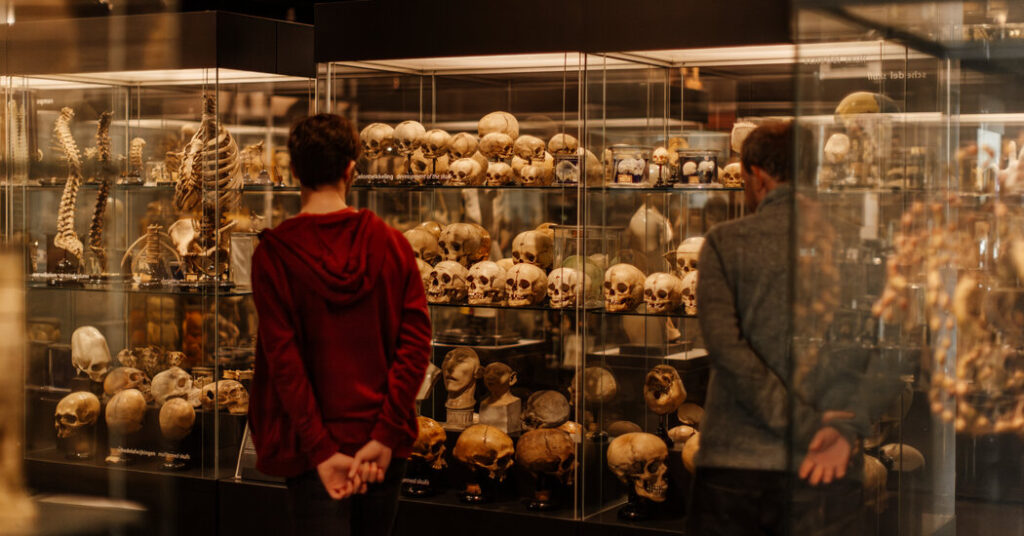
After some sleuthing, Latumaerissa tracked them down in the Museum Vrolik, a tiny anatomical museum within the Amsterdam University Medical Center that dates to the 19th century, and which displays jars of body parts, like feet and ears, as well as irregular fetuses, alongside cabinets filled with skulls and bones.
Today, the Moluccan skulls are back on the archipelago that they came from. Their former presence in the museum is marked only by the metal stands that once held them. They sit in otherwise empty display cases at the entrance to the Museum Vrolik as part of the exhibition “Imagine: The Future of Human Remains from Colonial Contexts,” which runs through June 27, 2027.
The idea, said Laurens de Rooy, the museum’s director, is to call attention to these problematic troves. “What it should emphasize is the idea that, in an ideal situation, collections like these — racialized collections — should reach their final resting place, with their communities,” he said. “The empty stands show this important absence so we don’t forget these things happened in the past.”
The show explores a problem that faces the Museum Vrolik and many other European museums today: What to do with the colonial-era skeletons in their closets?
“We do feel a sense of shame, but also responsibility,” de Rooy said. “What does it mean to have these remains housed here? We need to find a way to somehow address these collections.”
There are thousands of colonial-era human remains, including skulls, skeletons, mummies, hair and teeth, in European collections. Many are from anatomical troves that medical institutions used for scientific research, and others belong to natural history museums. Most were acquired from local hospitals, dug up from paupers’ graves or purchased through the commercial trade in skeletons. A small portion were gathered through archaeological looting or taken as trophies from colonized lands in Africa, Asia and Oceania.
While the United States has a 1990 law, the Native American Graves Protection and Repatriation Act, that requires cultural institutions to recognize and return Indigenous human remains when possible, the European Union doesn’t have any similar legislation to cover its member states’ colonial ventures. Instead, European institutions rely on a patchwork of local laws and regulations, and ethical guidelines set by individual countries or museum councils.
Steph Scholten, a board member for the International Council on Museums, a global museum association, said his organization asked members to conduct provenance research on all remains in their collections and to return what they can. “‘Rehumanizing’ is a really, really important word in this process,” Scholten said.
European museums have collected skulls and bones since their origins as “cabinets of curiosities” in the 17th century. Anatomists like Frederik Ruysch in Amsterdam developed methods for preserving human and animal specimens in jars as educational tools and for spectacle, leading to more structured museum displays in the 18th century.
It wasn’t until the late 19th century that scientists and anthropologists collected human bones in the name of “race science.” Western scientists often collected specimens from Indigenous and local people in colonies and took them back to Europe, where there used techniques like “craniometry” and “anthropometry” to invent hierarchies that were used to justify colonial subjugation, discrimination and slavery. Such theories led to eugenics and genocide.
Today, these ideas are taboo, and museums that still hold those collections tend to be eager to distance themselves from the ideologies that guided the collecting practices.
“What the museums have in common is that they all see it as a problem — and that’s already progress,” said Jos van Beurden, a repatriation expert and senior researcher at the Free University of Amsterdam. “They all deal with it in different ways, although there are many similarities,” he said. “Some are more proactive than others.”
The Karolinska Institute in Stockholm, founded in 1810, collected and measured skulls to study racial characteristics, among other things. It once held thousands of human remains, but in the 1940s it changed locations and many of the specimens were cremated or discarded. Only about 5 percent of the original trove remains.
Today, said Eva Ahren, the head of medical history and heritage at the Karolinska, said that about half of the extant 700 skulls came from non-European countries.
“All of these collection practices were colonial in a way, because they were dependent on the colonial structures of the time and on networks of trade,” she said. Scientific explorers “were sent wish lists from museums to get herbs or plants, or to collect animal products, or pelts, or birds, but also skulls.”
Since 2015, the Karolinska has repatriated 122 skulls to Australia, Finland, North America and French Polynesia, Ahren added, noting that she would like to return more but that the institute often doesn’t have enough documentation to know where the remains came from.
Museums in Germany have faced slightly different problems when trying to repatriate their collections of remains. Although, in many cases, they want to return them, local laws often require a government to make the request.
The Museum of Prehistory in Berlin has conducted two major research projects, costing about $4 million, to determine the origins of more than 1,500 skulls in its collection, according to Bernhard Heeb, who oversees its anthropological collections. Some were repatriated to Hawaii, Chile and Japan, but a number of African countries they approached did not want to take them.
“Politically, there is no will on the part of the African countries,” Heeb said. “We said we would want to repatriate, but nobody claimed them so far. Families have said they want to have the remains from the ancestors back, but they were blocked by the governments.”
Another German museum, attached to the Charité hospital in Berlin, has had a different experience, said its former director, Thomas Schnalke. Since 2011, the medical history museum has participated in 10 repatriation events, with Australia, Namibia, New Zealand, Paraguay and Tanzania, turning over 216 ancestral remains so far.
Schnalke said that in 2010 the chief executive of the Charité made it clear that “specimens of the colonial past are no longer a subject of study of anthropological research or exhibitions,” and that the institution “was 100 percent willing to repatriate.”
“This really helped us to get into the conversations,” Schalke said, “and then to have the repatriation ceremonies.”
In the case of the Vrolik, the repatriation of the Moluccan remains was largely down to the efforts of Latumaerissa, who worked with de Rooy, the director, to find out that the skulls described in the 1917 book had been taken five years earlier, in 1912, from a village called Amtufu. A Dutch medical officer with the colonial army had removed them from their burial site and taken them to Amsterdam.
“It makes me sad,” Latumaerissa said in an interview. “The Dutch destroyed everything of ours, our language, our culture. First they forbid it, and we all had to become Christians and learn the Dutch language, and then they displayed and traded our ancestors’ skulls.”
He was also dismayed that the anthropologists of that era were more interested in categorizing his people than trying to understand their rich heritage.
“They studied our people for racial science, so they looked at our hair and said, ‘This is more Polynesian than Asian,’” he said. “I don’t know why they did that. You could also just ask us. You can appreciate our culture, our language, our traditions. Isn’t that enough?”
Latumaerissa is now on a new quest to see another set of remains in another Dutch museum returned: the full skeleton of a baby that was taken from the Aru Islands, also part of the Moluccan archipelago, in 1929. “They want it back,” he said, “to give her some peace.”
The post Europe’s Museums Confront the (Literal) Skeletons in Their Closets appeared first on New York Times.