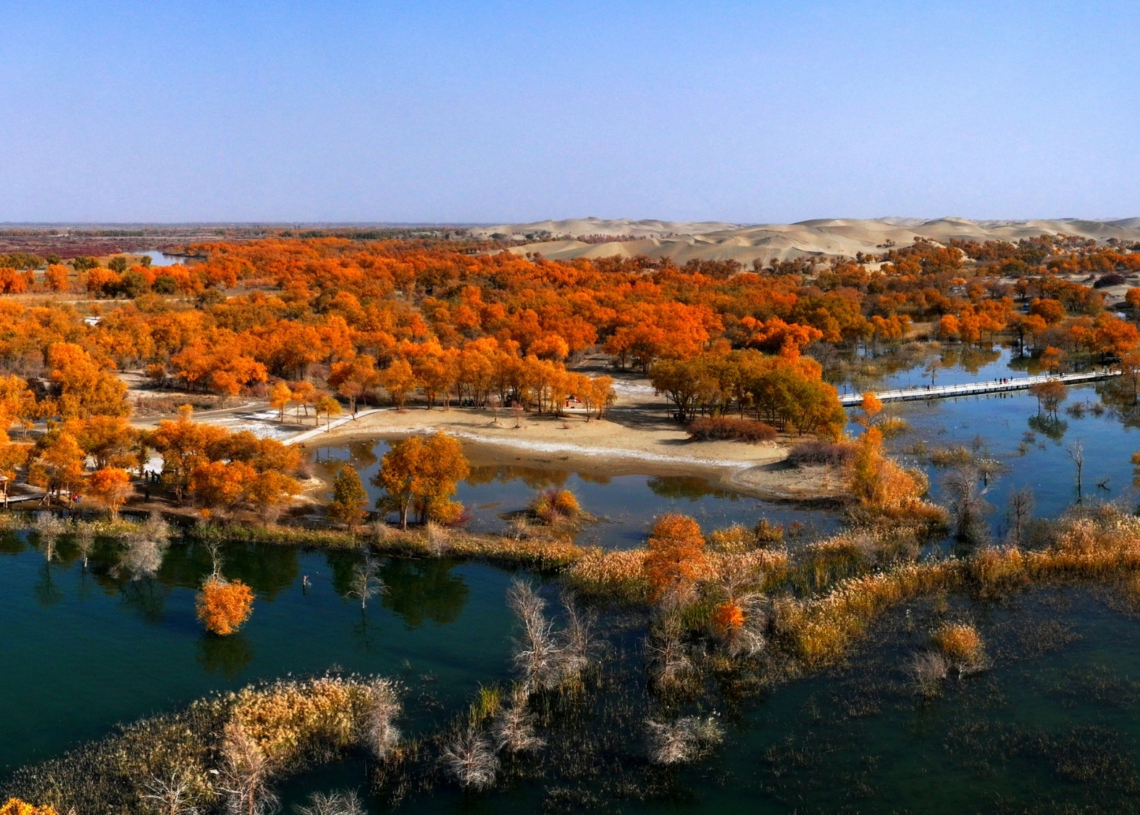
China’s Taklamakan Desert was an unforgiving landscape. Was is the operative word here, since it isn’t as unforgiving anymore. That massive change is thanks to a decades-long bioengineering project that has transformed the once-so-called “sea of death” into a lush green forest. According to recent research, it is pulling tons of carbon dioxide out of the atmosphere.
According to research published this past January in PNAS, researchers from the University of California, Riverside, found that since 1978, when China began building a vast belt of trees around the desert’s outer rim as part of its “Great Green Wall” initiative, the attempt to stop desert expansion and protect nearby farmland had the unintended effect of turning into a big weapon against climate change. Thanks to data collected by NASA satellites, the researchers found that the planted trees were now a major carbon sink, absorbing tons of the pollutants humans are pumping into the air.
Scientists observed increased vegetation growth correlated with a small but consistent drop in atmospheric CO2, roughly about 1 to 2 parts per million lower in this area. It’s not the kind of absorption you usually see in, say, a rainforest. But it’s a real, statistically noticeable absorption, which is made all the wilder by the fact that it was once one of the harshest environments on Earth.
China Tried to Cover the ‘Sea of Death’ in Trees. Then Things Got Weird.
That’s especially wild when you consider that it was never supposed to do this. More than 95 percent of the Taklamakan is hot sand. It was considered to be a biological dead zone. The mere idea that you could engineer even its outskirts into a productive forest that helps filter out some of the mess were pumping into our atmosphere is an astounding achievement.
Researchers say that even if the entire desert were converted into a forest, it would only offset a fraction of global emissions, absorbing only about 10 million tons of the 40 billion tons we release annually. There is also the pesky matter of it being a desert, where water is scarce. The current forested ring largely relies on runoff from the surrounding mountains, which wouldn’t scale neatly if the desert forest were expanded.
Overall, the project is proof that large-scale environmental projects can work, even in the harshest environments. They aren’t ultimately solutions to our problems, but rather supplemental aids and the larger war of cutting back on carbon emissions in the first place.
The post China Covered the ‘Sea of Death’ in Trees. Here’s What Happened. appeared first on VICE.