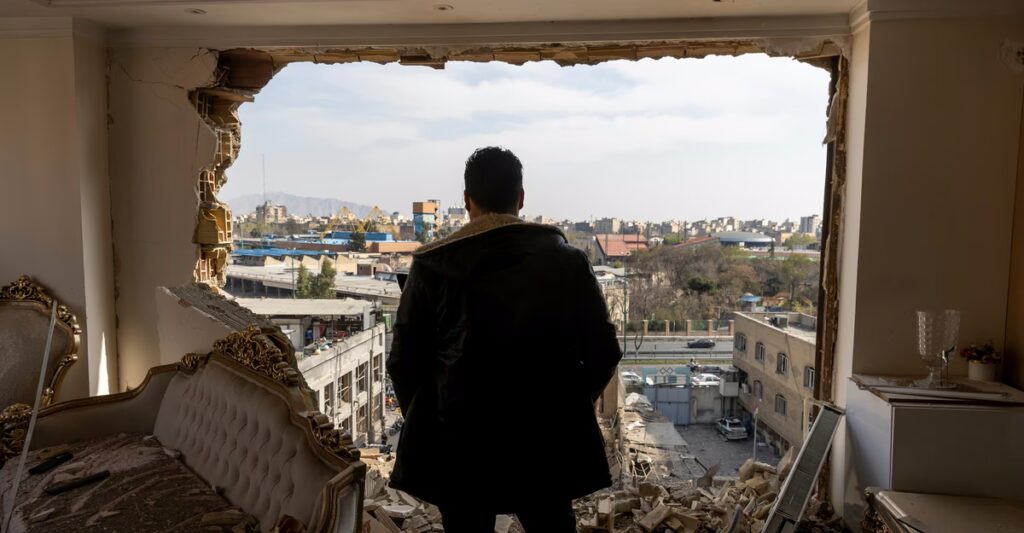
Open a newspaper or turn on a television these days, and you will likely find a dark view of the United States’ war with Iran. In part, this reflects difficult realities. The Strait of Hormuz is seemingly under Iranian control, salvos of missiles are still hitting the Persian Gulf states and Israel, and there is no clear path to victory, however defined.
But such dark views also rest on other factors. Journalists, analysts, and intelligence officers are professionally inclined toward skepticism about their own side’s prospects. “A good intelligence officer who smells flowers looks for a funeral,” one former senior CIA official told me. If your job is to search for the contradictions, flip-flops, lacunae, and flat-out lies in a spokesperson’s happy talk, you will find them. Besides, other incentives in these lines of work align with pessimism: You look much more like a fool if you say things are going well and then disaster occurs than if you say the situation is grim but your side succeeds anyway. The latter may bring gentle mockery, soon forgotten; the former may bring scorn and a reputation for being gulled by the authorities.
Sometimes, the pessimism simply reflects ignorance. When an American F-15E was shot down over Iran and an A-10 so badly damaged that its pilot had to bail out over Kuwaiti territory, one major news organization declared that this “belied earlier assertions by the Trump administration that U.S. forces had obtained air superiority.” But air superiority—a term of art—means that you can do pretty much whatever you want from the air in given times and places, not that the other side is unable to shoot back. On D-Day, the Luftwaffe flew some 200 sorties over Normandy, shooting down four Allied airplanes, but there is no question that the Allies had air superiority on June 6, 1944.
[Nancy A. Youssef and Jonathan Lemire: Trump’s fateful choice]
Finally, those who view the Trump administration, its leaders and its policies, as uniquely distasteful—incompetent, corrupt, possibly criminal, belligerent, and occasionally cruel—generally find it viscerally difficult to say anything positive about its enterprises. Because most of the commenting class, myself included, hold some version of this opinion, the commentary will be accordingly bleak. But this represents its own form of cognitive bias.
So although the dark view of the war predominates, it may be wrong in at least three ways.
First, the war has not, despite what many claim, trashed America’s alliances. NATO was battered by Donald Trump well before the war began, and not least by his egregious threats to wrest Greenland from Denmark. No doubt, some of our European allies have bristled at this war and in some cases refused to assist with it. Not all, though: German bases are important for the air bridge to the Middle East. In a moment of candor during Israel’s 12-day war with Iran last June, Chancellor Friedrich Merz allowed that the fight against Iran was “dirty work Israel is doing for all of us.” He understood, in other words, that Iran poses a challenge to European security that Europe chooses not to address on its own. “We are also victims of this regime,” he said.
More to the point: The United States is actually working very closely with a group of allies, just not the Europeans. Israel, of course, is actively engaged in the war, employing an air force twice as large and more than twice as capable of conducting this kind of campaign than the United Kingdom’s Royal Air Force. The Gulf states are providing basing, and some Asian nations have been quietly supportive. Several hundred Ukrainian drone experts, who have behind them the most advanced military industry of its kind anywhere, are sharing what they’ve learned. If the Trump administration could only see Ukraine as a powerful partner rather than a charity case, even more could be done. A new partnership, joining Gulf finance with Ukrainian military technology, appears to be emerging from this war, to the advantage of the United States.
Second, the common claim that the war is a boon for Russia and China is exaggerated. Will it provide a short-term boost for Russian oil earnings? Probably, although it will be offset by the spectacular success the Ukrainians are having in hitting its petrochemical industry and its ability to export. Russia has profoundly deformed its backward economy, and now appears to be getting the worst of it on the battlefield. Meanwhile, the prospect that Ukrainian military innovation might be powered by Saudi and Emirati money cannot be a happy one for Moscow.
China, for its part, might indeed be licking its chops at the idea of the United States depleting its stocks of expensive interceptor missiles in this war. If governments choose to attack because they think they know exactly how many exotic munitions their opponents have in their warehouses, then China might well invade Taiwan. But, by and large, that is not how governments decide to launch global wars. Rather, they look at a host of considerations, including the nature of their opponents. In this case, the Chinese will see a president quite willing to wage an unpopular war and employ extreme violence. That president possesses a remarkably capable armed force, and is willing to spend the money ($1.5 trillion in the latest budget) to build an even larger and considerably more modernized one. Sober Chinese analysts, moreover, will have some appreciation of how the United States and its armed forces have a history of innovating and adapting when the pressure is on.
And finally, there are people who argue that Iran has been turned into a great power by this war. But being subjected to tens of thousands of precision air strikes; having your senior leadership assassinated, your air defenses almost entirely destroyed, your navy virtually annihilated; and losing crucial parts of your industrial infrastructure do not make you stronger. Can Iran keep the Strait of Hormuz closed? For now, yes. Perpetually? That is harder to believe. Ukraine has been able to keep its grain corridor in the Black Sea open despite Russian attacks; the U.S. Navy, ill-prepared as it was for the mine-clearing mission that it should have anticipated, is no doubt working full-time on solving what is essentially a tactical problem, albeit one with strategic implications.
[Eliot A. Cohen: Lions led by donkeys]
Iran’s leaders and their sympathizers may declare that survival means that Iran wins this war, but that is, on the face of it, preposterous. The regime has profoundly alienated its neighbors by lashing out at them, brought the two most powerful air forces in the Middle East into intimate cooperation against it, and suffered new blows to its already impoverished economy. Is Iran’s new leadership—the members of whom have not fallen to Israeli bombs, that is—inclined to take an even harder line than its predecessors? Possibly. But the pictures published this week of the niece and grandniece of Qassem Soleimani—the head of the Islamic Revolutionary Guard Corps’ Quds Force killed in Trump’s first term—who have been living the good life in the United States, should trigger the thought that the elite leadership of Iran might be less pure and hard than one might think. And even committed ideologues have their breaking point; Heinrich Himmler was as hard-core as they come, yet attempted open negotiations with Allen Dulles of the Office of Strategic Services in 1945.
There is so much that we do not know—including which targets have been hit, what damage has been done, and to what effect. But when we see things like the extraordinary rescue of the aircrew of the F-15E shot down over Iran, we need to remember that the military organizations pounding Iran are extremely formidable. That does not guarantee success. But it should make us, at the very least, thoughtful about where this war may go.
The post Three Things the Consensus Gets Wrong About the Iran War appeared first on The Atlantic.