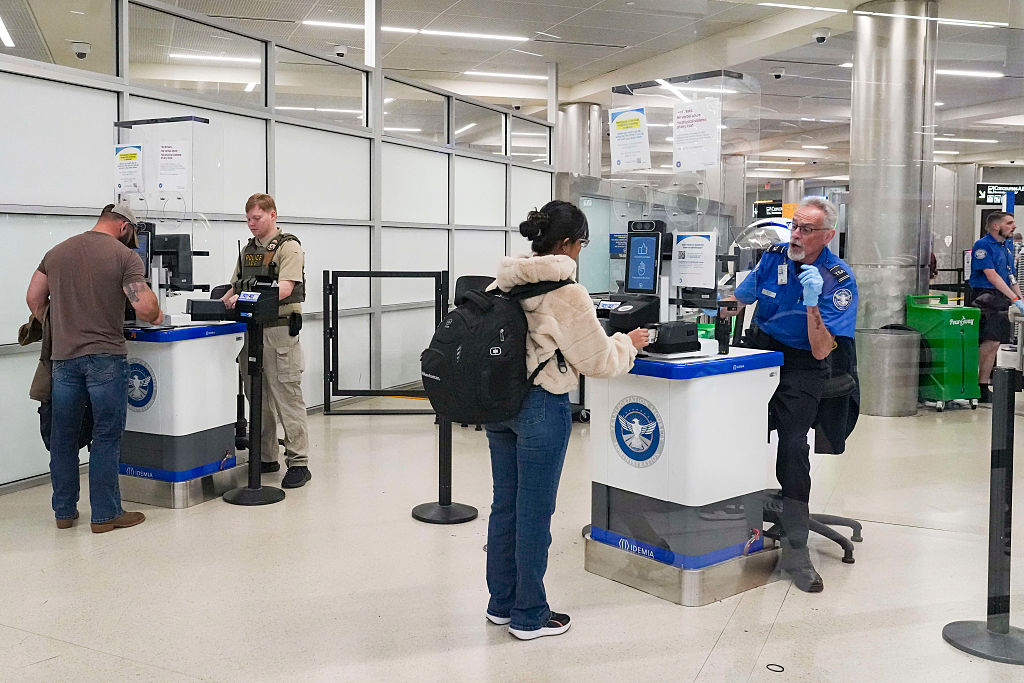
When thousands of Transportation Security Administration workers called out of work in recent weeks as Congress was stuck in a standoff that withheld their pay, Americans saw how vital a well-staffed TSA is to smooth travel. But recent budget documents show the Trump Administration wants to cut a number of TSA jobs, replacing some with a private workforce, in an effort to reduce costs.
The White House requested, according to a Department of Homeland Security budget congressional justification document released on March 31, a TSA budget of $11.7 billion for the next fiscal year, which would represent reductions of almost 8,400 positions and about 9,400 full-time equivalents (FTEs).
This includes the reduction of 2,462 Transportation Security Officer (TSO) positions and 4,351 TSO FTEs. Such officers are known as airport frontliners, performing passenger screening and searches. The proposal also includes the reassignment of more than 800 TSA posts for staffing exit lanes, which the White House says would save some $97.3 million.
“Despite these reductions, TSA will maintain all priority mission-critical positions to ensure operational effectiveness and mission continuity,” the document read.
To offset workplace reductions, the White House’s proposed budget suggests privatizing security operations in smaller airports. The proposal suggests airports be required to sign up for the TSA’s Screening Partnership Program, which facilitates contracting private firms for security screening services.
According to the White House Office of Management and Budget, the about 20 airports that are already using this program “have demonstrated savings compared to Federal screening operations,” and a more sweeping approach to the program’s use is estimated to save $52 million. The overall proposed budget is estimated to save more than $500 million in the TSA’s outlay.
But the White House’s proposed budget doesn’t just cut. It also requests allocating $225.9 million for procuring and deploying Computed Tomography machines to enhance security screening capabilities and $48.1 million to replace “outdated” screening systems. The budget also requests $20 million for e-Gates, “which will enable secure, accurate, and self-service identity matching, streamline ID checks, double passenger throughput, and reduce person-to-person interactions.”
Congress is set to hold hearings on the White House’s budget proposal later this month, with a goal to finalize a deal before the 2026 fiscal year ends on Sept. 30.
Pushback against privatization
President Donald Trump has long targeted TSA, criticizing it for inefficiency and allegedly facilitating illegal immigration. On the first day of his second term, Trump forced out the head of the agency, and in May of last year, the White House proposed a $247 million budget cut for the 2026 fiscal year.
“Despite constant budget increases since their inception, TSA has consistently failed audits while implementing intrusive screening measures that violate Americans’ privacy and dignity,” the White House said at the time. It claimed that under President Joe Biden’s Administration, the agency had been “abused to facilitate mass illegal migration by allowing illegal migrants to fly into the interior without proper documentation.”
His latest efforts, however, come after more than 500 TSA workers, representing some 0.8% of total TSA personnel, have quit in response to the February shutdown, and Immigration and Customs Enforcement officers were controversially brought in to try to help with airport security operations, despite criticisms that they lacked the ability to do the job and were unhelpful toward alleviating long lines.
The proposal to privatize airport security has elicited even more safety and security concerns. The American Federation of Government Employees, representing about 47,000 TSA officers, has previously argued that privatization compromises travel security and safety, deprioritizes security workers’ well-being, and could cause staffing shortages and high employee turnover rates.
Privatizing TSA was a proposal from the controversial conservative blueprint Project 2025, which Russell Vought, Trump’s current director for the White House Office of Management and Budget, was a key architect of. The playbook argued that the current TSA model is “costly and unwisely makes TSA both the regulator and the regulated organization responsible for screening operations.”
But critics say that TSA was created, after the Sept. 11, 2001, attacks, to increase security standards from the previously private operations. Johnny Jones, secretary treasurer for AFGE TSA Council 100 told NPR last month that private contractors’ priority is to “make a profit, not to worry about the security of the passengers.”
The post What to Know About Trump’s Proposal to Cut Thousands of TSA Jobs appeared first on TIME.