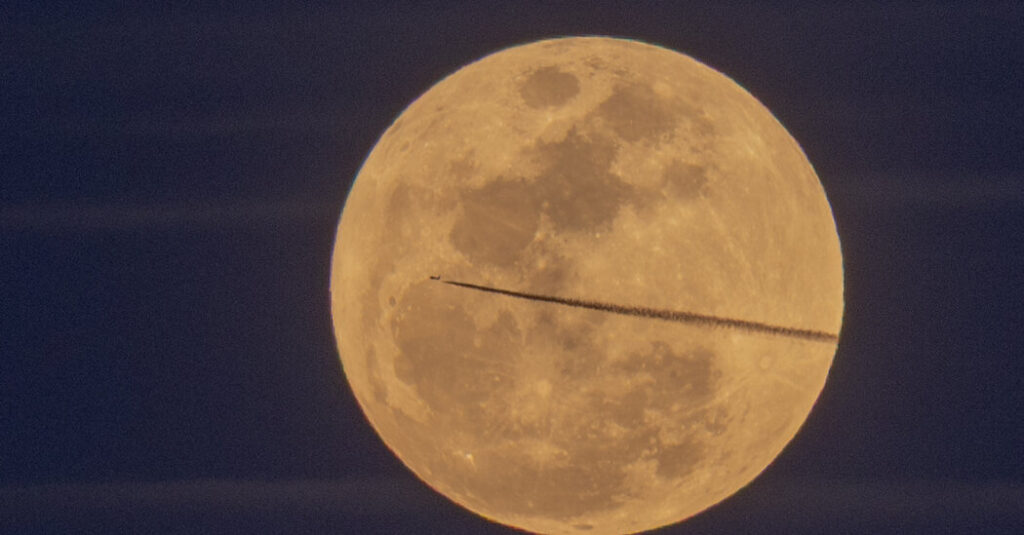
“The dark side of the moon”: The term has a poetic ring. It has long been mined in popular culture, not least by Pink Floyd, the English band whose so-named top-selling semi-psychedelic rock album cemented the term in the 1970s.
But as with most poetry, the evocative phrase needs a little interpretation to arrive at accuracy.
In fact, if “dark” means “without light,” there is no dark side of the moon.
The moon rotates along its orbital path such that one side faces eternally toward the Earth. The backside of the moon is brightly lit by the sun, out of reach of human vision from our planet’s surface.
Science prefers to call that face the moon’s “far” side. Soviet probes began photographing its densely cratered surface in the late 1950s, and NASA probes soon followed. In 2019, China’s Chang’e 4 mission, named for a mythological moon goddess, made the first soft, or intact, landing on the moon’s backside.
It was not until 1968, with NASA’s Apollo 8 mission, that the light of human gaze finally reached the far side. A total of 24 astronauts, all Americans during the Apollo missions, have so far directly seen the moon’s most mysterious face.
The Artemis II mission will add four more pairs of human eyes to absorb the rocky, battered expanses of the far side. Like the earlier 24 viewers, three will be Americans: Reid Wiseman, Christina Koch and Victor Glover. Jeremy Hansen will be the first Canadian to do so.
Out of the more than 100 billion humans thought to have ever existed, the number of witnesses of the orb’s hidden side will climb on Monday to 28. With planned Artemis missions and crewed moon orbits scheduled by China, it may not be long until that total crests 30.
But as the far side steadily becomes more familiar, let’s appreciate the mysteriousness of “dark side.”
Consider “dark” as something that was in the sense of “hidden from view or knowledge” — a once common definition used at least as early as 1532, according to the Oxford English Dictionary. The O.E.D.’s citation: “To be drawen to heuenly thynges, to know that thynge that god hath hydde and kepte darke,” a translation from Gherit von der Gouda, a Franciscan friar writing in Flemish.
If “dark” worked for Shakespeare and many other wordsmiths, it’s easy to understand why so many take license when using it to describe our lunar companion.
Andrea Kannapell leads the international team that produces the Morning, Evening and Weekend Briefings.
The post NASA Isn’t Going to Dark Side of the Moon appeared first on New York Times.