The Artemis II astronauts have already traveled farther from our planet than humans have ever gone. Soon, they are set to zip around the far side of the moon and see parts of its surface that have never been observed with human eyes.
Here’s how to follow along.
What time does the action begin?
The astronauts begin their passage behind the far side of the moon on Monday at 6:44 p.m. Eastern time.
You won’t actually be able to see them do this live. The astronauts and their Orion spacecraft will fall out of contact until 7:25 p.m., because the moon blocks radio signals from Earth. NASA says spacecraft camera views won’t be available during the planned communications blackout, but you can follow updates here and on NASA’s site.
Where can I watch coverage of the astronauts’ journey?
You can watch it here on The Times’s website.
NASA is streaming live video coverage of the mission 24 hours a day. You can view it on YouTube, X, the agency’s website and its smart TV apps.
What will be happening?
There will be plenty of action to follow.
At 7:02 p.m., the astronauts will make their closest approach to the moon, about 4,070 miles from its surface.
At 7:07 p.m., they will hit their maximum distance from Earth, 252,760 miles, which until more people travel toward the moon will be the record for how far into space humankind has ventured.
At 7:25 p.m., the astronauts will come out of the blackout, where they will be able to describe our planet coming into view over the moon’s edge, an event described as “Earthrise” when humans first saw it in 1968.
And at 8:35 p.m., as they journey back toward Earth, the astronauts will experience a solar eclipse.
What will the astronauts (and soon, the rest of us) get to see?
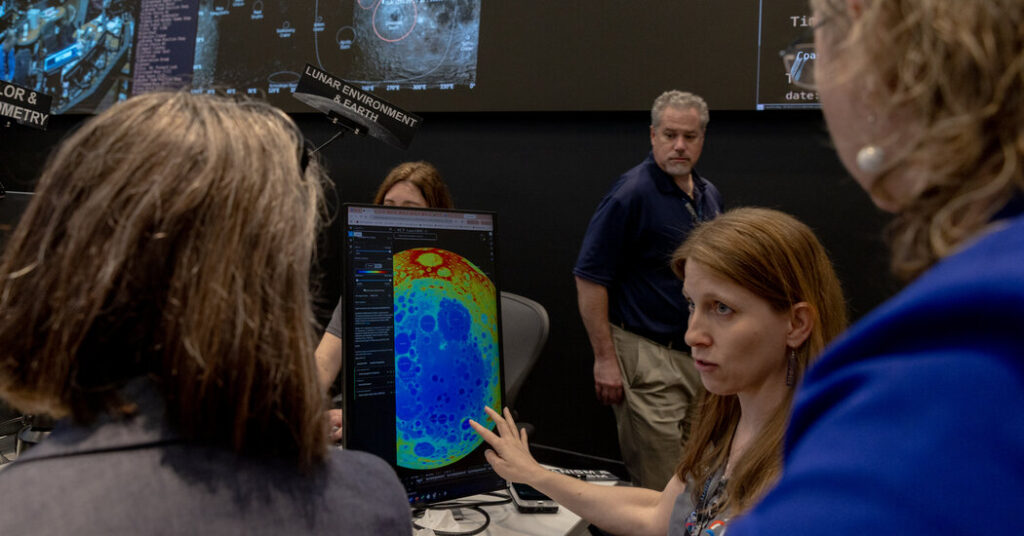
The far side of the moon is different from what we can see from Earth, with a thicker crust and more craters. Though it has been photographed by spacecraft, it hasn’t been seen by humans since 1972. Parts of it have never been seen by human eyes because of the times at which the Apollo missions launched.
The astronauts will be observing the geological landscape of the far side and taking pictures of their own. Their efforts will help inform scientists about the history of the moon, and help NASA’s efforts to land humans on its surface in the near future.
Anushka Patil is a Times reporter covering breaking and developing news around the world.
The post How to Follow NASA’s Artemis II Around the Far Side of the Moon appeared first on New York Times.