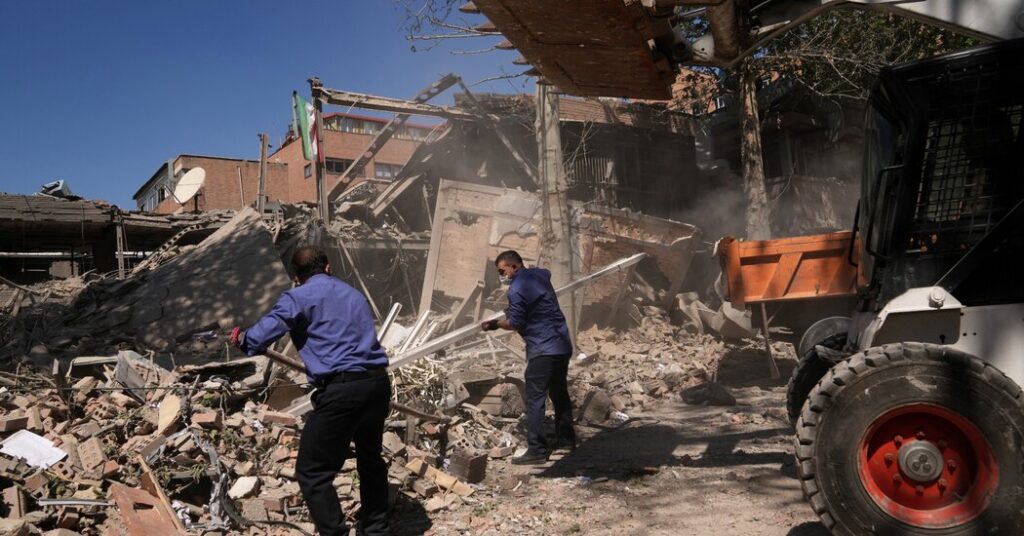
Iranians from across the political spectrum expressed outrage on Monday at overnight strikes that hit Sharif University of Technology in Tehran, one of the country’s most prestigious academic institutions. It is the latest in a string of attacks that have battered Iran’s higher education centers.
The university, founded in 1966, is the top destination for science and engineering students in Iran and has been called the country’s equivalent of M.I.T. Its alumni include Maryam Mirzakhani, the first woman to win the Fields Medal, the most prestigious prize in mathematics.
Intentional attacks on educational institutions could be a war crime under international law. According to state media reports, the school’s information technology center and mosque were targeted.
“Iran’s knowledge is not embedded in concrete to be destroyed by bombs,” Mohammad Reza Aref, Iran’s first vice president, wrote on social media. “Knowledge is rooted in our being, and this stronghold cannot be brought down.”
The university has been subjected to sanctions by the United States, European Union and Britain, over accusations that it cooperated with entities involved in Iranian military and nuclear activities.
Some Sharif University graduates living abroad also condemned the attack.
“This would be akin to a foreign power targeting MIT,” Isa Bria, a former student living in the United States, wrote on X. She also posted a group picture of herself and classmates on their graduation day, wearing blue caps and gowns, above a video she said showed the mangled wreckage on that same campus.
“Academic spaces are sacred. They should not be drawn into conflict,” she wrote.
Neither the United States nor Israel took credit for the strikes. Israel has claimed one attack on a university, saying it struck buildings used to research and develop missiles and chemical weapons.
Israeli officials have often argued that the civilian sites they have attacked, such as pharmaceutical or petrochemical facilities, are dual-use, meaning they are also used by security forces for economic gain or developing materials that can be used militarily.
Some student groups active in antigovernment protests this year have suggested that certain Iranian campuses had dual-use research facilities. The Amirkabir student newsletter on Monday said parts of the Sharif University campus that were attacked were used for drone research.
Experts say international law stipulates that strikes on dual-use sites are prohibited if they are “expected to cause” damage to civilian life or property that exceed anticipated military gains. The military must also work to minimize damage and harm to civilians if such an attack is launched.
Many of the campuses that have been attacked were the sites of widespread student protests demanding an end to Iran’s clerical rule. In February, student protesters at Sharif University hanged a mouse toy in effigy — a mocking reference to Iran’s former supreme leader, Ayatollah Ali Khamenei. Days later, Mr. Khamenei was killed in the opening salvos of the U.S.-Israeli attack on Iran.
Critics of the Iranian government, however, were equally strident in their objection to attacks on the university.
“Beyond the damage, these actions provide the regime with a propaganda lifeline and risk creating deep rifts within the opposition,” Siamak Aram, an Iranian opposition activist and associate professor of computer science at Harrisburg University in Pennsylvania, wrote on social media.
Sharif University, one of the first places in the country to connect to the internet, likely had a dual-use role, according to Amir Rashidi, a cybersecurity expert at Miaan, a digital rights group focused on Iran.
But he argued that under Iran’s tightly controlled, authoritarian system, many institutions were unavoidably used for such purposes.
“In a country like Iran, everything has a dual-use function,” Mr. Rashidi said. “There will always be some excuse to justify it. What I understand is that my country is being destroyed. The Islamic Republic continues its executions and kills my fellow citizens, and the bombs being dropped also kill my fellow citizens.”
The post Iranians Condemn Strike on a Top University appeared first on New York Times.