Beneath California’s Salton Sea, there is so much metal essential to rechargeable batteries that Gov. Gavin Newsom calls the vast lake “the Saudi Arabia of lithium.”
An estimated $500 billion worth of lithium here could help power our smartphones, electric cars and electricity grids. And a so-called white gold rush could bring jobs, tax dollars and economic revitalization to one of the most impoverished places in the nation.
But not everyone is eagerly welcoming the lithium industry.
The Salton Sea is already an environmental disaster zone. It’s shrinking, and as it does, it spews plumes of pesticide-laden dust throughout Imperial County, home to 182,000 people. Extracting lithium requires a steady supply of fresh water, and locals worry the process will deplete the region’s scarce water resources. Some also fear that the industrial disruption of the lake will create even more air pollution.
Environmental groups have sued to try to slow the lithium extraction. Some residents say it’s unfair that their neighborhoods might suffer while those well beyond Imperial County will reap the financial rewards and environmental benefits.
Many residents feel they have been burned before. The geothermal and solar industries also descended on the region with big promises, but the quality of life has continued to deteriorate in Imperial County, said Michael Luellen, mayor of Calipatria, a desert town of about 6,500 people that is best known for its state prison.
Minutes after his sedan started spinning its wheels as asphalt turned to dirt, Mr. Luellen pointed out several streets where the city can’t afford sidewalks. A dilapidated gas station and bakery have been empty for more than a decade. Between abandoned buildings, tumbleweeds rose from dirt lots.
“It’s like a ghost land — it’s truly astounding the conditions our residents live in,” said Mr. Luellen, a sixth-generation Imperial Valley resident. “Unfortunately, all of those other promises fell through. Ask a resident about lithium, nine times out of 10 they’ll roll their eyes and say, Here we go — we’re not holding our breath.”
The sand dunes and cactus-dotted washes just north of California’s border with Mexico were once simply part of the sprawling Colorado Desert. Summer temperatures regularly soar past 110 degrees, and only three inches of rain fall per year. In the early 20th century, a development company gave the region a more hospitable name, Imperial Valley, in hopes of turning it into a desirable agricultural mecca.
The land is fertile from years of flooding by the Colorado River, which deposited nutrients in the soil. Imperial Valley, which extends from Imperial County to neighboring Riverside County, also has 300 days of annual sunshine on average. So a canal was built to deliver water from the river, and the Imperial Valley eventually began growing most of the nation’s vegetables in the winter.
But over the years, Imperial County residents have been left behind. The region has crumbling infrastructure and few well-paying jobs. People tell their children “sal si puedes,” meaning “leave if you can.”
Jazmin Rodriguez, 24, has been waking up before dawn to pick carrots, broccoli and kale since she graduated from high school six years ago. The work is exhausting, she said, but she hasn’t been able to find any other. Sometimes, after hours in the fields, she comes home with her sneakers full of mud and water.
“You get wet, and you can get sick, but we have to deal with it,” said Ms. Rodriguez, who lives in Calexico and spoke to a reporter during her lunch break from picking wheat. “There’s nothing more here.”
Officials hope that a 21st century rebrand will offer a transformative opportunity for the region. Now they’re calling it Lithium Valley.
Scientists have long known that lithium existed in the hot, mineral-rich brine below the Salton Sea, but the silvery white metal wasn’t particularly valuable until the rise of electric cars; laptops; and wind and solar power, which need it for their electrical storage systems.
The United States has only one active lithium mine, in Nevada, and otherwise imports nearly all its lithium from South America, Australia and China. The federal government has deemed that foreign reliance a national security concern.
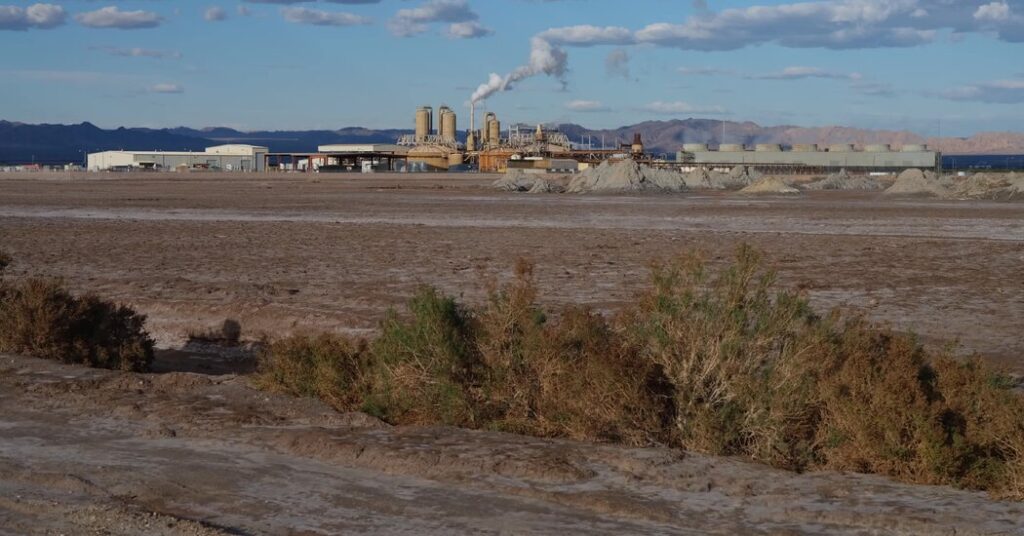
The Salton Sea region, about a two-hour drive east of San Diego, is believed to house one of the world’s largest lithium reserves, enough to meet the entire nation’s demand for decades. Three companies in the area are working to extract the metal, though none have begun doing so at a commercial scale yet.
If they eventually do, lithium could become Imperial Valley’s largest job engine in decades, according to a report from the nonprofit RAND Corporation. The lithium companies could collectively create 1,000 construction jobs and 700 permanent operations jobs, the report found. Each long-term job could create two additional positions in retail, housing and other industries, the report found.
Standing near agricultural fields on the edge of town, Mr. Luellen, the Calipatria mayor, nodded to smokestacks in the distance, where new geothermal plants brought jobs in the 1980s — his grandfather worked at one for decades — but not the downtown revitalization that was promised. Calipatria’s only grocery store had been closed until recently, so there was no fresh produce available in town for years.
He hopes lithium won’t let them down.
The county is drafting a plan to manage the emerging lithium industry, but it includes the possibility of other development that critics say would not offer jobs and instead could pose harmful environmental burdens. That includes automobile wrecking, recycling centers and data centers. Already, there’s a fight underway in Imperial County over a proposal to build a data center that would be nearly a million square feet, one of the largest in the country.
“Is Lithium Valley really a vision that’s going to be a clean energy hub?” said James J. A. Blair, a professor at California State Polytechnic University, Pomona, who has studied lithium extraction. “Or is it kind of a Trojan horse for these other industrial harms?”
The novel technology used to collect the Salton Sea’s lithium is known as direct lithium extraction, in which lithium-rich brine is pumped from deep aquifers to the surface, where it is then extracted.
It has been promoted as less destructive than methods used elsewhere, such as hard-rock mining. But it hasn’t been proved on an industrial scale, and there’s emerging evidence that it can require at least double the amount of fresh water used in traditional mines, opponents say.
Overuse of water could exacerbate pollution at the Salton Sea, which for years has been fed by industrial runoff but recently has been shrinking. The exposed lake bed already kicks up dust with toxic elements, such as DDT and arsenic. That has pushed the communities closest to the lake, including Calipatria, to the 99th percentile for asthma and the 92nd percentile for cardiovascular disease in the state, according to the California Office of Environmental Health Hazard Assessment.
“I feel like it’s just going to cause more damage,” said Roberto Talavera, 24, who noted that the air in El Centro, where he lives, sometimes reeks of dead fish from the lake breeze. “Why are all the environmentally friendly jobs somewhere else and not here in the Valley?”
Two nonprofits sued Imperial County in 2024, saying that it had not adequately considered the impacts of lithium extraction when it approved an environmental review for one company, Controlled Thermal Resources. A judge dismissed the suit last year, but the dismissal has been appealed.
“We aren’t opposed to lithium development — we want to see it done right,” said Jared Naimark, western mining senior manager at Earthworks, one of the plaintiffs.
Rod Colwell, the chief executive of Controlled Thermal Resources, said he expected to be commercially extracting lithium by 2028. He rejected any concerns that the project could use more resources than initially stated.
“The judge said that everything to the letter of the law was adhered to,” he said. “The Valley needs a win, and we need to just get on with it.”
He and others pointed out the safeguards in place to ensure that the county benefits from lithium. In 2022, the California State Legislature approved a tax on each pound of lithium that companies pull out of the ground. Eighty percent of the revenue will go to Imperial County communities, and 20 percent to the state for restoration efforts along the Salton Sea.
Ryan Kelley, an Imperial County supervisor who has been a booster of lithium, said he was frustrated by the delays. The county desperately needs the money to repair its bridges, wastewater systems and other infrastructure, he said.
“We’re not living the California dream,” he said.
Scott Rossi contributed reporting.
Soumya Karlamangla is a Times reporter who covers California. She is based in the Bay Area.
The post The California Lake Billed as the ‘Saudi Arabia of Lithium’ appeared first on New York Times.