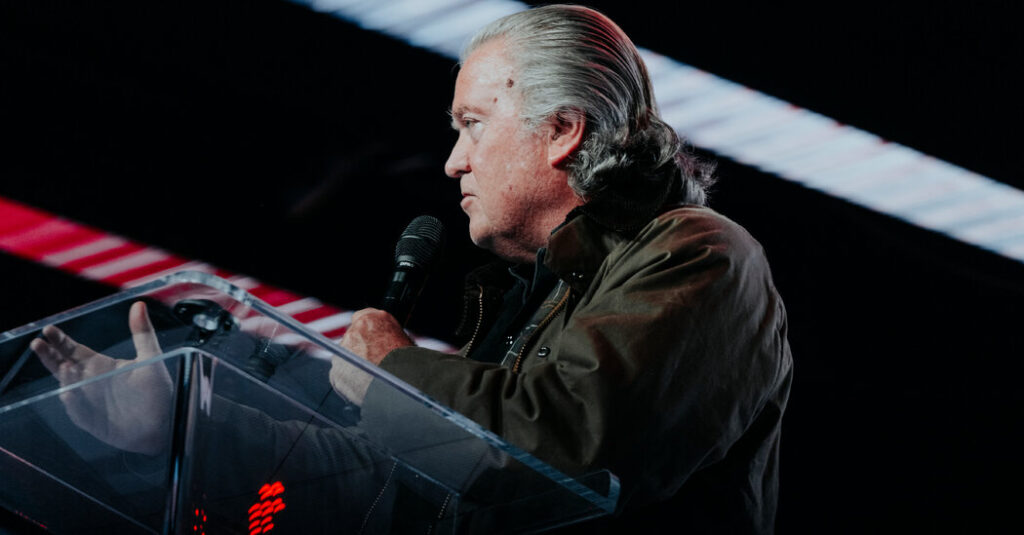
The Supreme Court on Monday agreed to clear the way for the dismissal of the criminal conviction of President Trump’s longtime adviser, Stephen K. Bannon. The court’s action came in response to a request from the Trump administration, which had asked the justices to help wipe out the conviction from Mr. Bannon’s record.
Mr. Bannon already served four months in prison as a result of his 2022 conviction for contempt of Congress for refusing to testify to the House committee that investigated the Jan. 6, 2021, attack on the Capitol. He had asked the justices to intervene after an appeals court affirmed his conviction.
But D. John Sauer, the solicitor general, in February subsequently asked the Supreme Court to send the case back to the lower court to be dismissed. The administration told the justices that it had determined “in its prosecutorial discretion that dismissal of this criminal case is in the interests of justice.”
The Supreme Court’s action was announced in a routine two-sentence order that sends the case back to the U.S. Court of Appeals for the D.C. Circuit for “further consideration in light of the pending motion to dismiss the indictment.”
Mr. Bannon’s conviction was affirmed by the D.C. Circuit. The Supreme Court’s order on Monday formally gets rid of the appeals court judgment. The Trump administration’s request to dismiss the indictment is pending before Judge Carl J. Nichols of the Federal District Court in Washington.
A dismissal would effectively wipe out Mr. Bannon’s conviction but have little practical effect since he has already served his sentence. It follows a pattern of Mr. Trump using the Justice Department to go after his perceived enemies and protect his allies by repeatedly granting clemency to supporters and pardoning rioters charged in connection with Jan. 6.
Todd Blanche, then the deputy attorney general, said in a previous statement that Mr. Bannon’s conviction was the result of an “improper” House subpoena and should be vacated.
“This department will continue to undo the prior administration’s weaponization of the justice system,” he said.
While other major Trump allies cooperated with the Jan. 6 committee, Mr. Bannon defied a subpoena seeking information about his role. The House voted to hold him in contempt and referred the matter to the Justice Department for prosecution.
Mr. Bannon pleaded not guilty but was convicted by a jury after a trial in Federal District Court in Washington in July 2022.
At trial, his lawyers argued that Mr. Bannon was acting on the advice of lawyers who had counseled him that he could disregard the subpoena under the protections of the executive privilege Mr. Trump enjoyed.
Mr. Bannon had served briefly as Mr. Trump’s top political adviser in the White House during the first Trump administration but left the position long before the attack on the Capitol. At the end of his first term, Mr. Trump pardoned Mr. Bannon after he was criminally charged in an unrelated matter, accused of defrauding donors to a charity.
Ann E. Marimow covers the Supreme Court for The Times from Washington.
The post Supreme Court Clears the Way for Dismissal of Bannon Conviction appeared first on New York Times.