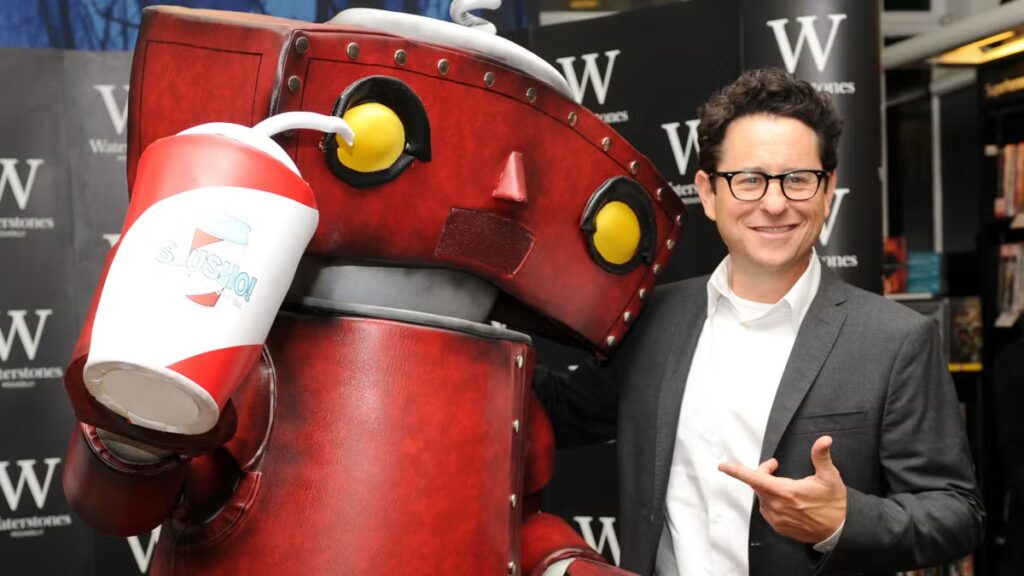
While production companies come and go in Hollywood, the announcement last week that J.J. Abrams’ Bad Robot would be shuttering its Los Angeles offices and downsizing came as a shock.
After all, if the creator of “Lost,” “Alias” and “Cloverfield” can’t make it, who can?
Indeed, the decline of the company where reshoots for huge “Star Wars” movies could be pulled off in their offices because they were so bursting with creativity, feels like the end of an era in more ways than one.
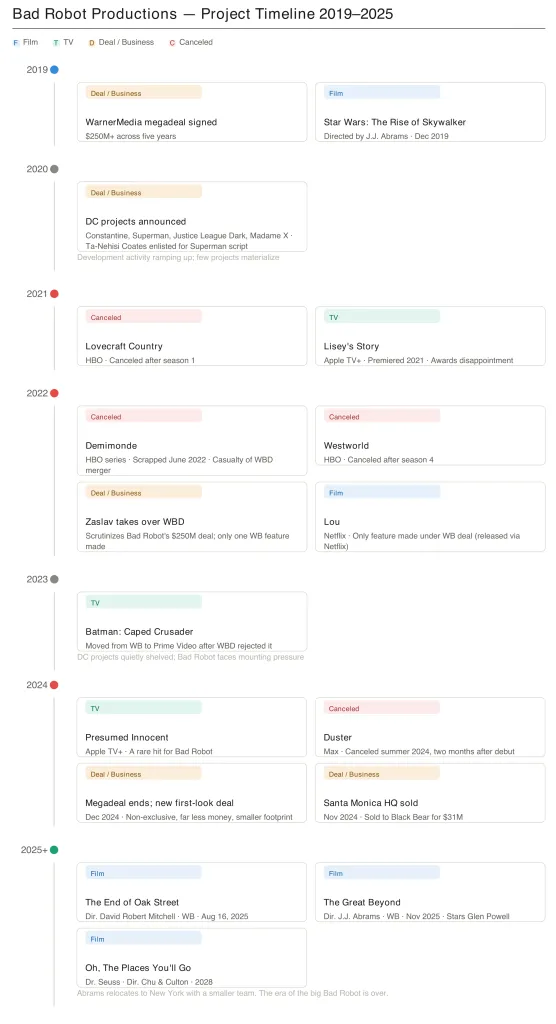
Not only was Bad Robot a haven for original and genre-busting storytelling, but Abrams’ company landed in the middle of a heated bidding war when he set out to find a cushy studio deal in 2019, eventually landing at WarnerMedia for over $250 million across five years.
But the trajectory of the company after that deal was signed underscores how significantly Hollywood has changed over the last half-decade, and how the company failed to live up to the pressure of its megadeal. After few new shows or movies materialized from the partnership, Abrams and Bad Robot re-upped with Warner Bros. at the end of 2024 for a much less pricey first-look deal.
For years, the studios and streamers battled it out to offer nine-figure deals to proven filmmakers, betting they’d keep delivering hits, and overpaying to keep top talent in-house as the streaming wars raged. But amid the industrywide contraction, studios are no longer content to bankroll prestige shingles without proven returns. The contraction has led to fewer films and shows being made, and with the insatiable appetite for new content evaporated. Massive overall deals — once a way to lock down talent — are now seen as risky bets that rarely pay off.
A film producer who spoke to TheWrap offered a sharp take: “It just means the town is contracting and studios no longer get maneuvered by agents to give massive deals that don’t bear out.”
But a studio executive had a different view, suggesting Abrams had lost his touch: “It probably says more about Bad Robot than anything else. And the bottlenecks that can arise at talent-led production companies, and how hard development is.”
“It’s pretty straightforward; they didn’t produce successful stuff and had their deal cut significantly with each new contract until now,” a top talent agent said.
Representatives for Bad Robot did not respond to TheWrap’s request for comment.
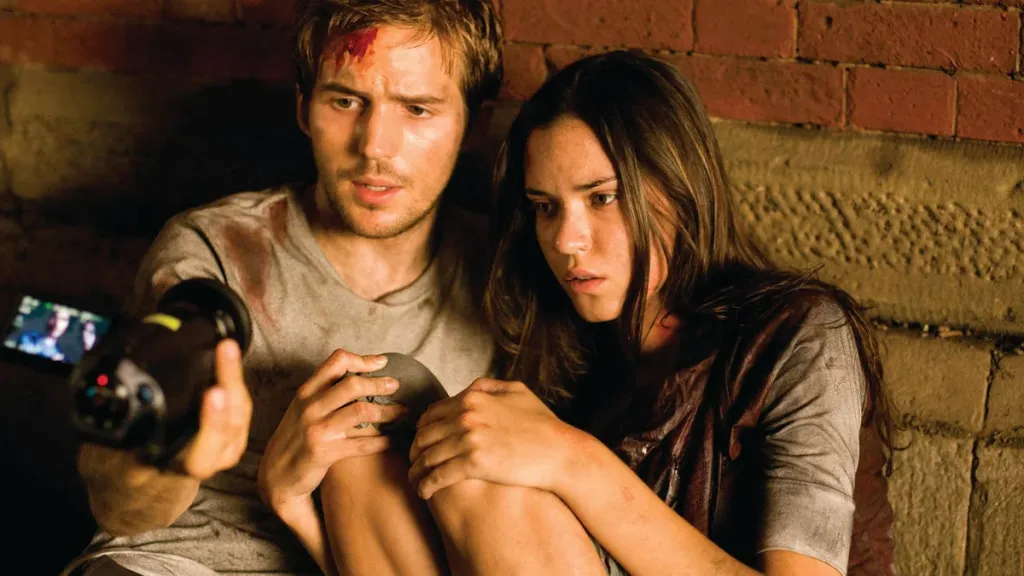
Bad Robot was a high-flying label for one of the most in-demand filmmakers around. It built off the success of “Lost” and “Alias” by backing high concept shows like “Fringe,” “Person of Interest,” and “Revolution” throughout the 2000s and 2010s. There were high-concept films like “Cloverfield” and “Overlord” and Abrams’ “Star Trek” films. It spurred several major TV shows, from Stephen King’s “11.22.63” and “Castle Rock” to “Westworld” and “Lovecraft Country.”
“J.J. had a solid 20-year run, which is far longer than most,” the agent said.
But as Abrams became busy directing “Star Wars,” 2015’s “The Force Awakens” and 2019’s “Rise of Skywalker,” the film development front slowed. TV consolidation made pricey shows like “Westworld” and “Lovecraft Country” unpalatable to studios — both were canceled, the former in 2022 and the latter in 2021. 2024’s Apple series “Presumed Innocent” was a hit, but other recent TV output like “Duster” and “Lisey’s Story” were not. “Duster” was canceled last summer, just two months after it debuted. “Lisey’s Story” whiffed with awards after it was released in 2021.
Abrams’ big return to creating and directing TV, an HBO series called “Demimonde,” was a casualty of the Warner Bros.-Discovery merger — after years of development and writing, on the cusp of starting production in June of 2022, HBO scrapped the show.
After signing 2019’s WarnerMedia deal, Abrams also tried to develop some Bad Robot DC projects — staking claim to characters including Constantine, Madame X, Superman and Justice League Dark, even enlisting Ta-Nehisi Coates to write a “Superman” movie. But a leadership tug-of-war and disarray in Warner Bros.’ DC strategy meant none of Abrams’ projects materialized.
Pressure started building. When David Zaslav took over Warner Bros. in 2022, he took a hard look at Bad Robot’s nine-figure deal. Only one Bad Robot feature film had been made, an Allison Janney-fronted thriller called “Lou,” but it was for Netflix, not Warner Bros. And the new regime decided a planned animated Batman TV series, “Batman: Caped Crusader,” was no longer desired. Bad Robot eventually moved it to Prime Video.
By December 2024, the megadeal was gone. Bad Robot re-upped with Warner Bros. Discovery, but this time as a first-look, non-exclusive pact. Less money. Less commitment. A drastically smaller footprint. Last November, the company offloaded the Santa Monica headquarters for $31 million to Black Bear.
The party, as it were, was over.
But for a moment in time, Bad Robot was the place to be, and former employees took to social media last week to pay tribute to their time at the company.
Jovan Avery James worked at Bad Robot as an intern: “Hands down one of my best jobs. Hired me as an intern right out of NYU Grad Film. Paid me enough to live in LA. Changed my life in so many ways. I’ll always be grateful for my time there, as well as their support of my work. I wouldn’t be in the WGA without them, thank you.”
Writer Ryan Parrott, who worked on the post-apocalyptic 2012 series “Revolution,” praised the company’s commitment to creativity: “I worked at Bad Robot for 3 years. The waiting room had art supplies, so visitors could be creative. The interns learned 3-D printing and silk screening. We had communal meals with movie stars and shot pickups for movies in the theater. It was the greatest place in the world.”
Screenwriter Zack Stentz also called it the end of a specific era in Hollywood: “The Bad Robot building in Santa Monica with its green roof, chef, soundstage, workshops & 3D printers was the closest Hollywood got to a fancy Silicon Valley or SF tech headquarters. So seeing it sold off feels like a ‘bursting of the dot com bubble’ moment for Los Angeles.”
Bad Robot’s current deal with Warner Bros. runs through December, and on the film side, Bad Robot still has some movies that are awaiting release. First up, Warner Bros. will release David Robert Mitchell’s high-concept dinosaur movie “The End of Oak Street” on Aug. 16.
Then, somewhat ironically, comes the first Warner Bros. film Abrams has directed, an original (and mysterious) sci-fi movie called “The Great Beyond,” which stars Glen Powell and will hit theaters in November.
Bad Robot is also producing the 2028 Dr. Seuss adaptation “Oh, The Places You’ll Go” from directors Jon M. Chu and Jill Culton.
For now, Abrams will keep working out of New York with a smaller team. But the Bad Robot that used to exist is no more.
Adam Chitwood contributed to this story.
The post From $250 Million Megadeal to Empty Offices: The Unraveling of Bad Robot appeared first on TheWrap.