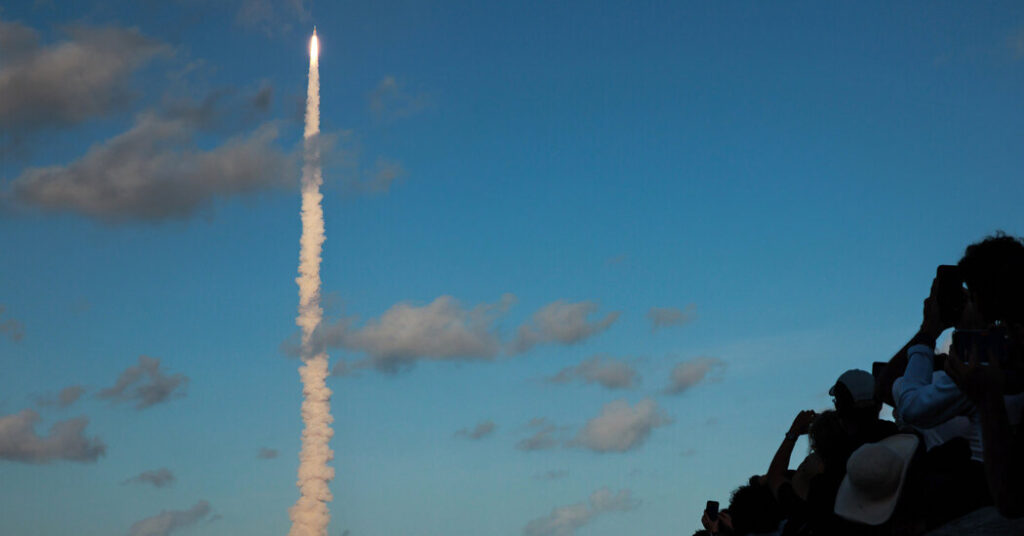
NASA’s Artemis II astronauts are set to fly by the moon on Monday, in humans’ first trip so far into space since the 1970s. Stephen Stromberg, an editor in Opinion, gathered Kate Rubins, an astronaut and microbiologist who spent 300 days on the International Space Station; David Grinspoon, an astrobiologist; and Neel Patel, a science editor in Opinion, to discuss the mission and humanity’s future in space.
This discussion has been edited for clarity and length.
Stephen Stromberg: Kate, what are the Artemis II astronauts experiencing right now? Sleep deprivation? Claustrophobia? Awkwardness as they use the “hygiene bay”? Or is the adrenaline high still going?
Kate Rubins: The quarters are cramped, the schedule is tight, you don’t sleep much and the toilet is very loud. But I imagine that they are intensely focused on their tasks, with an undercurrent of excitement and wonder running beneath everything. There’s a lot going on in a spacecraft, and staying mission-focused is the overriding feeling, particularly in a test flight such as this one.
A space mission is our Olympics. The astronauts have trained for every minute of this mission — and everything that could go wrong. To watch this crew execute flawlessly is extraordinary. The crew and the entire team at NASA are the best at what they do, and they are doing almost unimaginable things when you think about what it takes to fly to the moon.
Stromberg: David, Kate noted that this is a test mission; it aims to assess NASA’s kit in advance of another moon landing. We went to the moon half a century ago, more than once. Why go again? And what’s the significance of exploring the far side of the moon?
David Grinspoon: The far side of the moon has a different kind of geology and a different history, and that relates to the origin of the moon, which is tied to the origin of the Earth, so it’s partly our own origin story we are reconstructing by exploring that other hemisphere.
Stromberg: Explain that a little more. What might we see there? How would it connect to Earth’s history?
Grinspoon: The moon is tidally locked to Earth, so the same side always faces us. Those large dark areas you see on the moon that form the “man in the moon” — or the rabbit in the moon if you’re from Mexico — are giant ancient lava floods. There don’t seem to be many of them on the far side of the moon. The crust is much thicker on that hemisphere, so it was harder for molten rock to penetrate up to the surface.
We don’t fully understand this asymmetry, but it probably has to do with the way the moon assembled itself originally — when it came together in orbit from molten bits ejected after the very young Earth collided with another giant object — in its first 100 million years. The most traumatic event ever to befall our own world was the birth of the moon, and this probably determined many of the characteristics of Earth, which started out as a molten hell but eventually settled down and gave rise to life. So our origins are tied up with the moon’s origins. And much of that ancient natural history is lost from the Earth but likely preserved on the moon.
Rubins: Lunar geology is so fascinating. Some call the moon the Rosetta Stone of the solar system. Because it has little atmosphere and no liquid water, every impact is preserved as a crater. Some of these large craters expose rock that is millions or billions of years old, giving us a record of the solar system that we don’t have access to on Earth.
Grinspoon: And there are almost surely some very ancient bits of Earth that can be found preserved on the surface or near surface of the moon. Earth rocks that are billions of years old don’t exist here anymore but should be found on the moon. This is one of the reasons I am most excited about our long-term scientific return to the moon. We’ll find those missing puzzle pieces from ancient Earth.
Stromberg: How about the broader goal of putting people back on the moon, possibly on a permanent or semi-permanent basis? Neel, what do you make of this larger aim?
Neel Patel: There is a lot to love about the scientific possibilities of going back to the moon. Establishing a more permanent presence would help answer the questions that David and Kate have raised. But there’s more at stake. The Artemis missions are supposed to encourage a new way of thinking about humanity’s presence in space — to lay the foundations for working and living beyond Earth’s orbit.
I’m both really excited and a bit anxious about this goal. It’s exciting to see what we might be able to achieve, but what that future will look like is still unclear. What kind of an outpost do we intend to establish, and how will we sustain it? What is the end goal for developing a community on the moon? Is all of this motivated by the geopolitical goal of beating rivals such as China, for the sake of being first, and maintaining American dominance in space?
I don’t oppose the Artemis program — it’s been such an exciting past few days to watch us finally making a return to the moon. But it’s hard to disentangle Artemis II and the program more broadly from the concerns I have about what the real purpose of human exploration is.
Grinspoon: Neel, I share your ambivalence. I’ve been a space geek all my life and I can honestly say my trajectory in life was shaped by the Apollo program when I was young. But when I hear the rhetoric about beating China to the moon as a major motivation, I find it distasteful and likely antithetical to long-term success at creating an orbital community and economy.
We already won the race to the moon once! Now we are going to win it again? Setting it up as a short-term race is just asking for the public to lose interest again in a few years and decide to cut the budget and end the program, which would be such a shame. One of the lessons of Apollo and the early space age was the need to care for our planet and unite as one humanity. Yet look at the world today. It’s so fragmented, fractious and seemingly unable to marshal the global-scale responses needed to solve our global-scale problems.
So my excitement about Artemis, my admiration for the amazing engineering and bravery and scientific potential, is tempered with sadness and regret for the lost potential, and the split screen with the world today, and the, um, other things we are doing with ballistic missiles right now. On this centenary of Robert Goddard’s first liquid-fueled rocket flight we are rightfully in awe and proud of the fact that we can now launch spacecraft beyond the solar system and humans to the moon. Yet that same technology produced the V-2 and the ICBM.
We humans are not living up to the promise I saw as a kid enthralled by Apollo, and so I dearly hope, but am not convinced, that this can help re-spark more than just cool rocket rides.
Rubins: I’m less concerned with the reasons that we are going and more excited that we are going! To the moon! For some, it is a matter of national pride, and we should be proud of NASA and what we are able to accomplish as a nation. But we are not just going as the United States alone. Sixty-one countries have signed the Artemis Accords, which contain principles governing space exploration, and this is a genuinely international effort. Some are motivated by the science that we will be able to do in lunar orbit and on the lunar surface. Others by the sheer joy and amazement of looking up to this celestial body and knowing that humans are flying toward it. I think about how many people were inspired by Apollo, and what an impact this could have for young people today to become interested in science and exploration.
Patel: It’s also worth noting a huge goal for Artemis is to help the commercial space industry. Establishing a more permanent presence on the moon could allow the private sector learn how to venture out into deep space more independently and conduct the work they are interested in pursuing. Space is hard, and everyone needs to start somewhere.
Rubins: Bringing the commercial sector in extends our ability to make this a permanent program with the logistics and infrastructure needed to sustain committed, long-duration lunar exploration. Commercial space funding augments what the federal government provides and allows NASA to do more science and go further.
Patel: Kate, David: What are your thoughts on the criticism that focusing on a return to the moon is a distraction from making our way to Mars?
Grinspoon: There is great science to be done on the moon, some of which we haven’t mentioned yet. In astrobiology, for example, the moon serves as sort of a control to the experiment of other planets — a surface where there is surely no native life but where there is organic matter so we can study what organics do in a lifeless place. That makes us smarter about what we do on Mars and elsewhere where we want to look at the organics and see if there is evidence for ancient life.
And of course, we are exploring Mars right now with robotic spacecraft and will continue to do so. There’s an argument that we shouldn’t send humans to Mars too fast, until we’ve had a little more time to explore the planet without the disturbances that human landings will inevitably bring. So it would not be right to abandon Mars for the moon, but in my view it’s not a distraction but part of a long-term phased exploration of our solar system.
Rubins: I don’t think we can get to Mars without going to the moon first. We need to learn deep space navigation, master the basic mechanics of keeping humans alive that far from Earth, and do all of that somewhere we can return from in five days. Exploration of the moon allows us to design and test all of these systems.
I also agree with David that the moon is the ideal training ground for the search for life. It is sterile in a way no environment on Earth is. One experiment I am particularly excited about is swabbing astronauts’ spacesuits and tools during lunar geologic expeditions to map the microbial and cellular signature humans carry onto other planets. This could be valuable for understanding how to protect the search for life on Mars from human contamination.
Stromberg: Let me issue a provocation or two. David, you mentioned that we are, indeed, already exploring Mars — with rovers. Why send humans back to the moon or to Mars, when we could use the resources to send out many more robots than we are people, and more often?
Grinspoon: The honest answer is that if I was in charge we would put all that money into robotic exploration and do much more science in the near term. But of course I am not in charge, and NASA is not primarily a science agency. Science has always ridden piggyback on the larger budgets of human exploration.
I’m not saying I’m opposed to human exploration. Kate gave a good summary above of many of the important reasons to send humans — for inspiration, adventure, expansion of the human realm, etc. But for science I would, for the time being, send robots. Eventually, you’d want to send humans, too, because there are things we can do that robots can’t. Human-machine partnership will be the way to explore in the long run.
Patel: The search for extraterrestrial life has always been, for me, the most exciting question that space exploration can answer — scientifically and existentially. And, of course, Mars presents a chance to answer whether or not we are alone. So, given the constraints of the national budget and how much we’re willing to spend, I sometimes feel conflicted that putting more time and money toward human exploration, and away from robotic exploration, has meant less focus on answering that question.
Rubins: We need to send both. Human exploration is not possible without robots, satellites and rovers, and robots alone can’t replicate what a human brings. Humans can cover much more ground, improvise, exercise judgment in the moment, and provide inspiration and public excitement.
Stromberg: Provocation No. 2: The answer I sometimes hear to the question of “Why human space flight?” is that the United States is, indeed, in a new space race. Don’t we have reason to seek resources on the moon and elsewhere — Helium-3, say, which can be used as fuel for fusion reactors? Wouldn’t we be naïve to believe this can be done in neat cooperation with, say, China?
Grinspoon: Nobody has yet made a really good argument that the resources to be found on the moon are so valuable they would be worth bringing back to Earth. The Helium-3 argument has been subject to a lot of critique, though it could one day possibly pay off. But for now, the reasons to go to the moon are not economically sound, unless you are creating a lunar economy. Then the lunar economy is necessary to fuel the lunar economy. A bit circular, it seems to me. Then again, I’m an astrobiologist, not an economist.
Rubins: There is no lunar economy at this moment. We are building it, the same way this country built railroads and the national highway system. As we build infrastructure to go to the moon in a sustained, repeatable way, we make the scientific and economic benefits possible. Costs will need to come way down. Right now the justification is science, exploration, inspiration and infrastructure development, and I believe significant economic opportunities will follow. Look at what reusable rockets have done in low earth orbit: They were designed to get humans to the International Space Station, and they ended up drastically reducing launch costs for the entire satellite industry.
Patel: Another lunar resource people mention, though it’s not something we’d bring back to Earth, is water ice, which could be broken down into hydrogen and oxygen to be used as rocket fuel, making it easier to travel elsewhere.
Grinspoon: Yes, the moon is a place to get resources if you have reasons to do other things in space — water for human sustenance and fuel, oxygen bound in rocks, many metals that could be mined to build structures in space.
Patel: Though I think it’s worth noting that this is still early days. We haven’t proven it’s feasible to extract and use water ice in a meaningful way for these purposes. And I would like to see more evidence that this is possible before we get ahead of ourselves imagining that the lunar economy is possible and inevitable.
But, again, we have to start somewhere. The space community has been waiting for a long time for humans to go back into deep space. It’s wonderful to see things coming together and moving forward in a way that finally feels real.
Grinspoon: I hope this time we are going for the long haul, and that we really do come in peace for all humankind. And I hope these journeys beyond Earth, and the new views of ourselves, can help bring this world together so we can face our future with the global perspective we need to survive.
Rubins: I’m thinking about the crew, as they gather around the window and pass by the far side of the moon. They will see a unique part of our universe and watch the Earth slip behind the moon. I hope people on Earth can join in that moment and experience some of the awe and wonder of exploration.
David Grinspoon (@DrFunkySpoon) is an astrobiologist and a senior scientist at the Planetary Science Institute and the author of “Earth in Human Hands.”Kate Rubins is a former astronaut and director of the Trivedi Institute for Space and Global Biomedicine at the University of Pittsburgh School of Medicine.
Neel Patel and Stephen Stromberg are editors in Times Opinion.
The Times is committed to publishing a diversity of letters to the editor. We’d like to hear what you think about this or any of our articles. Here are some tips. And here’s our email: [email protected].
Follow the New York Times Opinion section on Facebook, Instagram, TikTok, Bluesky, WhatsApp and Threads.
The post What’s the Point of Sending People Into Space? An Astronaut, Scientist and Journalist Debate. appeared first on New York Times.