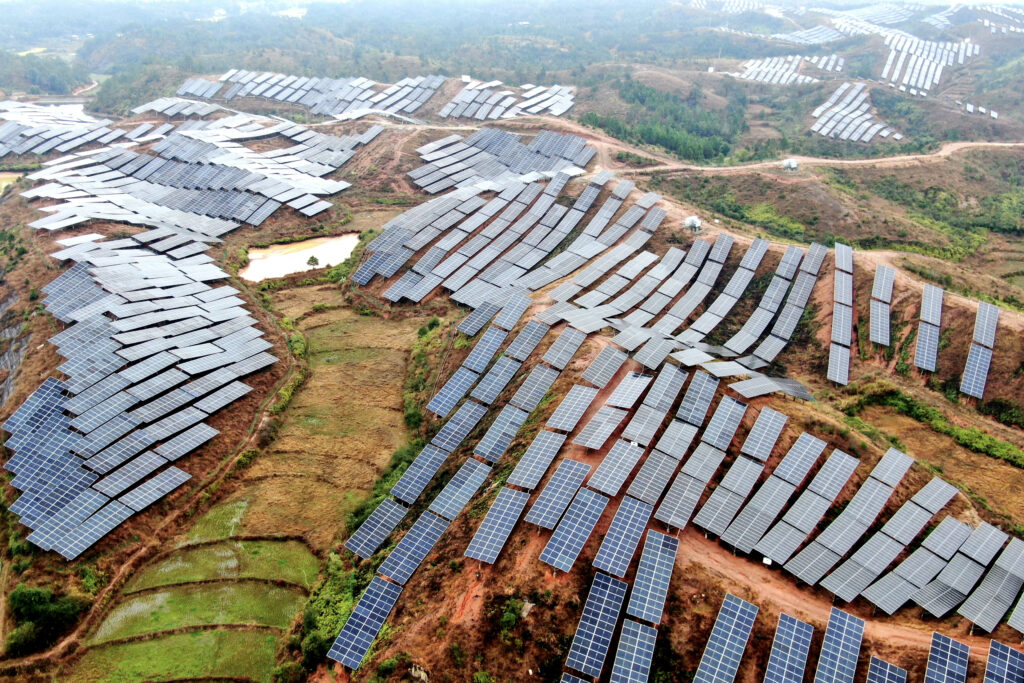
TAIPEI, Taiwan — As the oil and gas crisis set off by the war in Iran drives governments to accelerate their transitions to renewable energy, one country above all stands to benefit.
China dominates renewable energy supply chains, producing a vast majority of the world’s solar panels, wind turbines, batteries and electric vehicles. Exports of these technologies were already climbing to new heights in the first two months of 2026. Now volatility in the supply of fossil fuels is set to give sales another big boost.
Since the United States and Israel launched attacks on Iran in February, the Chinese battery maker CATL has seen its Hong Kong-listed shares jump 29.5 percent and its Shenzhen-listed shares rise 13.6 percent. The electric car giant BYD’s exports and overseas vehicle sales rose 65 percent in March year over year, according to the company’s chief executive. And Jinko Solar, one of the world’s largest solar panel manufacturers, says exports have grown since the war.
China is seizing opportunities in renewable energy as the Trump administration pulls the United States back from the emerging sector in favor of fossil fuels. Last week, as the Trump administration was agreeing to pay nearly $1 billion to stop a French company from building wind farms off the East Coast, officials in Beijing said they intended to raise the share of nonfossil fuel consumed by the country from 21.7 percent to 25 percent by 2030.
While governments are responding to immediate energy needs by ramping up coal production, many are also expressing greater interest in renewable energy.
Indonesian President Prabowo Subianto said in March that his government would build 100 gigawatts of solar power in the next two years. Philippines’ state-owned pension is offering loans of up to $8,300 for members to buy and install solar power for their homes.
Even in Europe, which has not been hit as hard by fuel shortages as Asia, governments are increasing investment in renewables. Germany last week introduced an 8 billion euro package to expand wind power capacity and subsidize electric vehicle sales.
These commitments will bring business to China’s door, said Lin Boqiang, director of the China Center for Energy Economics Research at Xiamen University. Chinese clean tech companies have cornered the market for most products needed for renewable energy production and developed “absolute competitiveness” in terms of cost and quality, Lin said.
In 2025, clean tech sectors accounted for more than one-third of China’s economic growth, according to the Finland-based Center for Research on Energy and Clean Air.
“This is part of a longer trend, not just an immediate response to higher oil and gas prices,” said Yang Biqing, a China analyst at Ember, a London-based energy think tank. “Energy security is becoming more important on governments’ agenda, and the shift toward clean energy is increasingly being seen as something that can reinforce energy security.”
Chinese companies are “in a prime position” to take advantage, analysts at the Council for on Foreign Relations wrote, and this opening comes at a critical time.
After years of heavy state subsidies and price competition, manufacturing overcapacity and falling prices had dogged the so-called “new three” industries of solar, batteries and electric vehicles. In 2024, solar manufacturers recorded $40 billion in losses, which drove China’s top five solar companies to cut their workforce by more than 30 percent, according to Reuters. In 2025, the International Energy Agency said the world made more than twice as many solar panels than it actually needed.
Rising overseas demand could now absorb much of this production, though in parts of the world, particularly in the West, dealmaking could be impeded by national security concerns.
In an executive order last July, President Donald Trump said so-called green subsidies threatened national security by making the United States dependent on supply chains controlled by foreign adversaries, and directed federal agencies to end tax support for green energy.
In March, the United Kingdom blocked a plan by Chinese wind turbine manufacturer Ming Yang to build the country’s largest wind turbine factory in Scotland, citing national security. Lawmakers had raised concerns that Chinese-made turbines could pose remote-access and surveillance risks to critical energy infrastructure.
Beijing has rejected these assertions. On Friday, China’s Ministry of Commerce launched a trade barrier investigation into U.S. measures obstructing trade in Chinese green products, including restricting China’s exports.
“For the future of the energy system, geopolitics matters just as much as a country’s economic choices,” said Li Shuo, director of the China Climate Hub at the Washington-based Asia Society Policy Institute.
The extent to which countries decouple from China, reducing their reliance on Chinese products, will influence their ability to decarbonize, Li said.
“Increasingly, this is no longer simply a choice between fossil fuels and green energy,” he said. “To some extent, it is also a choice between two camps in the world — and how countries position themselves within that divide.”
The post War-driven energy crisis boosts China’s sales pitch for renewable tech appeared first on Washington Post.