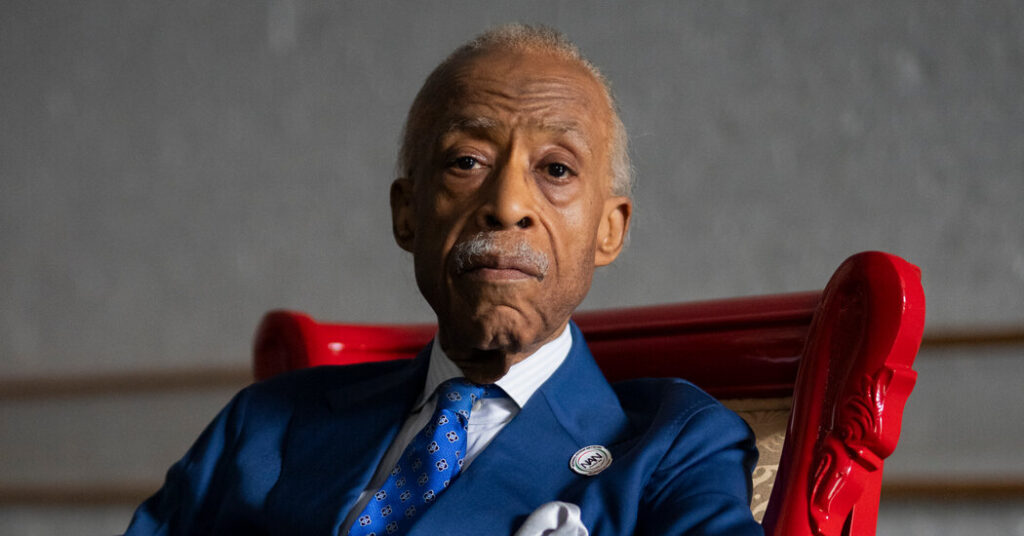
The Rev. Al Sharpton sat in the back of a black S.U.V. last month, a finger pressed to his temple. He wore a gray pinstriped three-piece suit and a gray tie embroidered with the letters “R.A.S.” He was on his way to give the eulogy at the funeral of a Black man who had been killed by a police officer.
Over more than 40 years as a civil rights activist, Mr. Sharpton has had to think about his mortality more than most people. And now, at 71 years old, as he buries more friends and recently his mentor, the Rev. Jesse Jackson, legacy and succession are at the forefront of his mind.
“I ain’t gonna be no more famous,” Mr. Sharpton said. “The question is, what do I leave?”
In Harlem, it will be a new home for the National Action Network, the civil rights organization he founded in New York City in 1991. The organization purchased the Faison Firehouse Theater on Hancock Place, which will be called the House of Justice Rev. Jesse Jackson’s Workshop.
The civil rights group had rented an office on West 145th Street for over two decades that Mr. Jackson named the “House of Justice.” His son Jesse Jackson Jr. said that the organization’s move into ownership reflected his father’s efforts to attain “permanency” in the fight for justice.
“My father saw Reverend Sharpton as one of his best students,” Mr. Jackson said. “He called him disciple No. 1.”
In the early years of the National Action Network, Mr. Sharpton was a divisive figure in New York because of his at times inflammatory rhetoric.
Mr. Sharpton said he envisioned the new space as an epicenter for the arts and activism that would lean into the spirit of the Harlem Renaissance, when salons were safe spaces for Black creative people and thinkers. It’s also part of his effort to push back against gentrification in Harlem, where the Black population has been declining for more than two decades.
The building was designed by the architect Howard Constable in 1909 and originally used as a firehouse. In 1999, George Faison, a renowned choreographer, bought the firehouse, which is more than 10,400 square feet, and revamped it into a community theater and personal residence.
About three weeks ago, Mr. Sharpton received a call from Mr. Faison, who wanted to sell the building to someone other than a developer. He agreed.
Jennifer Jones Austin, the vice chair of the National Action Network board and a poverty relief advocate who negotiated the deal, said the organization was expected to spend no more than $5 million to $7 million on the property and renovations.
The Black population in Central Harlem has been on a gradual decline, dropping to about 50 percent in 2023 from 77 percent in 2000, according to data from New York University’s Furman Center, which tracks demographics in neighborhoods. At the same time, the percentage of Hispanic and white people in the area has increased.
A block away from the firehouse theater, West 125th Street has transformed in recent years into a busy retail strip with Trader Joe’s, Whole Foods, Target, Bath & Body Works and a host of fast food chains.
Mr. Sharpton said he was very concerned about gentrification and the displacement of natives because it affected a community’s influence in the city.
“Harlem was the place of political power and that’s been decimated,” Mr. Sharpton said. “I hope the House of Justice represents people that will print their roots and stay right there.”
Harlem was predominately white and upper-class in the late 19th century, said Kevin McGruder, the author of “Race and Real Estate: Conflict and Cooperation in Harlem, 1890-1920.” Before the Harlem Renaissance, Black people had already lived in Manhattan neighborhoods like San Juan Hill, and they moved further uptown for better living conditions, according to the City University of New York.
Mr. McGruder said some change naturally happens as people move into a neighborhood, but that gentrification is different. “The complicating factor that people don’t talk about is when race fuels gentrification that makes the change not just a benign element of the market,” he said.
Stephen Wilder, a commissioner for the New York City Landmarks Preservation Commission, said it was important for developers to understand and respect the history in neighborhoods before trying to innovate.
“When you’re in a community, the question is how do you add without taking away,” said Mr. Wilder, who is also the principal at Think Wilder Architecture in Harlem.
Mr. Sharpton grew up in Queens and Brooklyn before making Harlem the home base of his activism.
His mother and father broke up when he was 10 years old. During that time, his mother, Ada Sharpton, was overwhelmed with expenses, he said. As a child he used candles to finish his homework in the dark because his mother couldn’t pay the utility bills. Eventually, Ms. Sharpton moved her two children to the Albany Projects in Brooklyn.
Mr. Sharpton spent most of his time watching the news and took a liking to the messages of Adam Clayton Powell Jr., who represented Harlem in Congress. He was eventually introduced to the Rev. William A. Jones, the New York chairman of Operation Breadbasket, the Southern Christian Leadership Conference’s economic program.
Mr. Jones appointed Mr. Sharpton as the youth director of New York’s Operation Breadbasket and connected him to his mentor, Mr. Jackson, at the age of 12. They bonded over being abandoned by their fathers and feeling like the black sheep of their families.
“I went through the same kind of family disgrace that he did,” Mr. Sharpton said. “Through the years he was the one that would spend time with me.”
Jesse Jackson Jr. said his father taught Mr. Sharpton to always keep his feet on the ground with the Black community.
That’s why on March 26, Mr. Sharpton was on his way to a funeral for Steven Jones.
Mr. Jones, 55, was shot and killed by a Hartford, Conn., police officer in February. His sister Audrey Jones had called 911 to seek help because her brother was having an “acute mental health crisis,” according to a preliminary report from the Office of the Inspector General in Connecticut. An officer who arrived fired nine shots, striking Mr. Jones “numerous” times, the report said.
Mr. Jones had a knife and had not responded to orders from several officers to drop the knife before he was shot, according to the report. The shooting is still under investigation.
Mr. Sharpton and Ben Crump, a civil rights lawyer, held Ms. Jones’s hand as she prepared to see her brother one last time in a light blue casket at First Cathedral Church in Bloomfield, Conn. “If I had known they were going to kill my brother, I would not have called 911 for an ambulance,” Ms. Jones said inside the church just before the funeral began.
The next day, Hartford’s mayor announced that he had fired the police officer who shot Mr. Jones because “his performance as an officer is not befitting of the standards” expected in the Hartford Police Department.
Mr. Jackson said: “It’s in the news because Al Sharpton was there. He brings light to dark places, and he sees as Jesse Jackson did.”
Samantha Latson is a Times reporter covering New York City and a member of the 2025-26 Times Fellowship class, a program for journalists early in their careers.
The post Sharpton Moves Longtime Civil Rights Group to New Home in Harlem appeared first on New York Times.