Oil prices rose slightly and stocks in Asia were mixed on Monday despite continued attacks in the Middle East and threats by President Trump to escalate U.S. attacks on Iran. Trading was limited because markets were closed for holidays in parts of Asia and all of Europe.
Mr. Trump taunted Iranian leaders on Sunday after the U.S. rescue of an American airman whose jet had been shot down. The president demanded that Iran open the Strait of Hormuz, a vital passageway for oil shipments in the Middle East.
The conflict, now in its sixth week, has caused energy shocks that could drive up the cost of living around the world and deprive vulnerable regions of staples like electricity, clean water and cooking fuel.
Global oil prices rise.
-
The price of Brent crude, the global benchmark for oil, was about $110 a barrel on Monday, up more than 0.8 percent. That was around a 60 percent increase in price since before the war began.
-
West Texas Intermediate crude, the U.S. benchmark, traded for around $111 a barrel on Monday, down slightly, but a rise of about 66 percent in the same period. The W.T.I. price is usually not above Brent — the gap is partly the result of differences in each oil type’s futures contracts, which are the main way for trading oil.
-
Since fighting began, investors and analysts have been focused on the Strait of Hormuz, the narrow waterway between Iran and Oman that is a vital trading route for oil and natural gas and that normally carries as much as one-fifth of the world’s oil supply. Shipping traffic exiting the Persian Gulf through the strait has been effectively halted since the war began.
-
A French-owned container ship transited the Strait of Hormuz on Thursday, according to data from Marine Traffic, making it among the few known Western-owned ships to have traversed the waterway since the start of the war.
-
Continued attacks on energy infrastructure, by both Israel and Iran, have raised concerns about longer-lasting damage to the world’s oil and gas supply. Attacks on power and energy facilities continued in Iran and throughout the Gulf region on Sunday.
Stocks in Asia were mixed.
-
Stocks rose in Japan and South Korea, with the Nikkei 225 in Japan up 0.9 percent. Indexes in Southeast Asia and India were lower, and markets in Hong Kong, mainland China and Taiwan were closed. Stocks in Asia had mostly declined on Friday.
-
S&P 500 futures were mostly unchanged, providing little indication of how stocks will move when trading resumes in the United States on Monday. Through Thursday, the S&P 500 was down nearly 6 percent since it hit a peak in late January. It came dangerously close to what is known as a correction — a drop of 10 percent from a recent high — before stocks recovered.
Gasoline prices continued to rise.
-
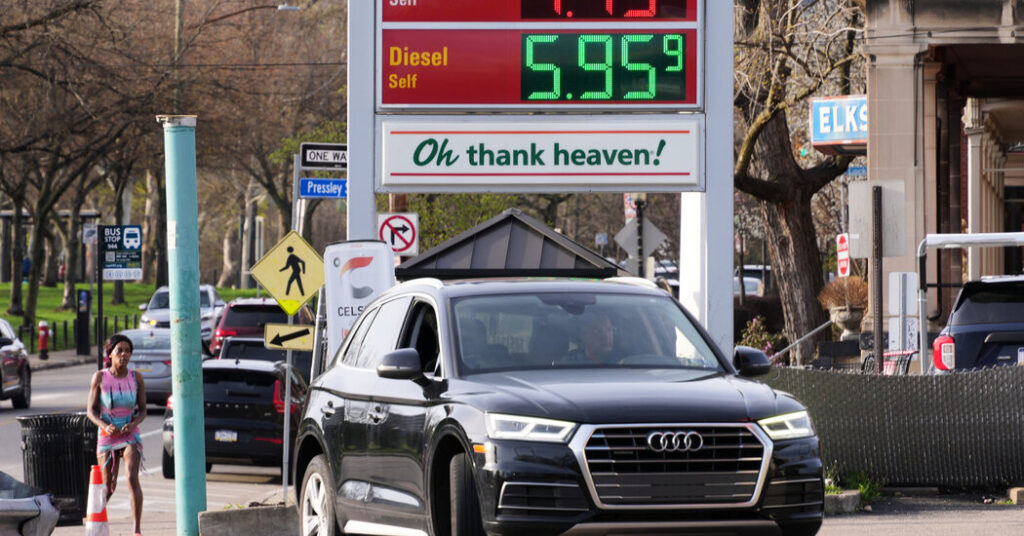
Gas prices rose again on Sunday, jumping to a national average of $4.11 a gallon, according to the AAA motor club. The increase has raised the cost for drivers by 38 percent since the war began.
-
Gas prices don’t move in lock step with crude, usually trailing increases or drops by a few days.
-
Diesel prices have increased even more quickly and stood at $5.61 on Sunday, up almost 50 percent since the start of the war.
Emmett Lindner is a business reporter for The Times.
The post Oil Rises Slightly After Trump’s Latest Threats on Iran appeared first on New York Times.