In recent years, the conventional geopolitical wisdom has been that the world order was moving toward three centers of power: the United States, China and Russia. That view assumed that power derived primarily from economic scale and military capability.
That assumption no longer holds. A fourth center of global power is quickly emerging — Iran — that does not rival those three nations economically or militarily. Instead, its newfound power derives from its control over the most important energy choke point in the global economy, the Strait of Hormuz.
The strait had long been an international waterway through which ships from all countries could travel. But the joint military campaign that the United States and Israel began waging against Iran this year has prompted Iran to create a selective military blockade of the strait.
Roughly one-fifth of the world’s supply of oil and liquefied natural gas moves through the strait. There are no real alternatives to these supply routes in the near term. If Iranian control over the strait persists for months or years, as I believe it may, it will drastically reshape the global order to the detriment of the United States.
Many analysts believe that Iran’s grip on the Strait of Hormuz is only temporary. A widespread expectation is that U.S. and allied naval forces will soon stabilize the situation and that oil flows will resume along familiar lines.
That expectation is flawed. It assumes that to continue to control the strait, Iran must physically close it off. But as we have already seen, you can control the strait without closing it. Today, the strait remains open to tankers. Traffic has dropped by over 90 percent since the war began, though, not because Iran has been sinking every vessel that entered the strait, but because, given the credible threat of an attack, insurers withdrew or repriced war-risk coverage. Hitting a cargo ship every few days was more than enough to make the risk unacceptable.
Modern economies do not simply require oil. They also require oil delivered on time, at scale and with predictable risk. When that reliability breaks down, insurance markets tighten, freight rates spike and governments begin to look at energy access as a complex strategic challenge rather than a simple market transaction.
The problem for the United States is one of asymmetry. Protecting each and every oil shipment that passes through the Strait of Hormuz against potential attacks — mines, drones, missile strikes — is a full-time operation. It requires continuous military presence. Iran needs only to hit an oil tanker once in a while to cast doubt on the reliability of the world’s oil shipments.
President Emmanuel Macron of France said as much on Thursday when he declared that it was “unrealistic” to open the Strait of Hormuz by force and that “this can only be done in concert with Iran.” He was all but admitting that the flow of oil cannot be guaranteed without Iran’s agreement.
For decades, the Persian Gulf had a simple arrangement: Oil producers exported, markets priced and the United States secured the route. That system allowed rivalry without instability. Now, it is falling apart.
Gulf states depend heavily on energy exports for state revenue. When insurance rates spike and shipping becomes uncertain, the fiscal impact is immediate. Governments adjust. Cargoes are rerouted. Contracts are renegotiated.
If uncertainty persists, the Gulf arrangement will inevitably change, giving way to a different regional order — one in which the Gulf states increasingly accommodate the actor that can most directly influence the reliability of their exports. That actor is now Iran.
The global consequences will be most pronounced in Asia. Japan, South Korea and India depend heavily on Gulf energy. China, though more diversified, also depends on the region for a large share of its energy imports. Those dependencies are embedded in infrastructure — refineries, shipping routes and storage systems that cannot be quickly reconfigured.
If disruption to the energy supply persists, the effects will be widespread. Higher insurance and freight costs will raise prices. Trade balances will worsen. Currencies will weaken. Inflation will rise. Energy dependence will begin to shape policy. Governments will prioritize access to energy. Diplomatic choices will narrow. Actions that risk further instability will become harder to sustain. A 1970s world in which oil shocks lead to years of stagflation will no longer be a distant memory but a nearing reality.
Again, Iran will benefit.
China depends on Gulf energy to sustain growth. Russia benefits from higher and more volatile energy prices. Iran gains leverage from its position at the Hormuz choke point.
Each of these three nations has incentives that run counter to the economic stability of the United States and its allies. These three nations do not need to coordinate in a formal way. The structure of the system pushes them in the same direction. This is how a new order emerges — not through a formal alliance (at least not at first), but through converging incentives that reinforce one another over time.
Other plausible scenarios in the emerging new world order are darker still. Imagine Iran with control of about 20 percent of the world’s oil, Russia with about 11 percent and China able to soak up much of that supply. They would form a cartel to deny the West 30 percent of the world’s oil. You don’t need sophisticated analysis to recognize the catastrophic consequences: precipitously declining power for the United States and Europe, and a global shift toward China, Russia and Iran.
The United States faces a difficult choice: either commit to a long-term effort to reassert control over the Strait of Hormuz, or accept a new global energy arrangement in which U.S. control is no longer assured.
If it chooses acceptance, the outcome is clear: The international system will reorganize with Iran as a fourth center of global power. Yet if the United States chooses to reassert military control, it is in for a long battle, one it could well lose.
The Iran war is not a military conflict from which the United States can simply back out, with things reverting to how they were before. Iran would surely demand a heavy price in a new accommodation with the United States — but this price will surely be less costly than that of the alternative future. This is a transformational war, and if these changes continue for even a few years, the global order will change irrevocably.
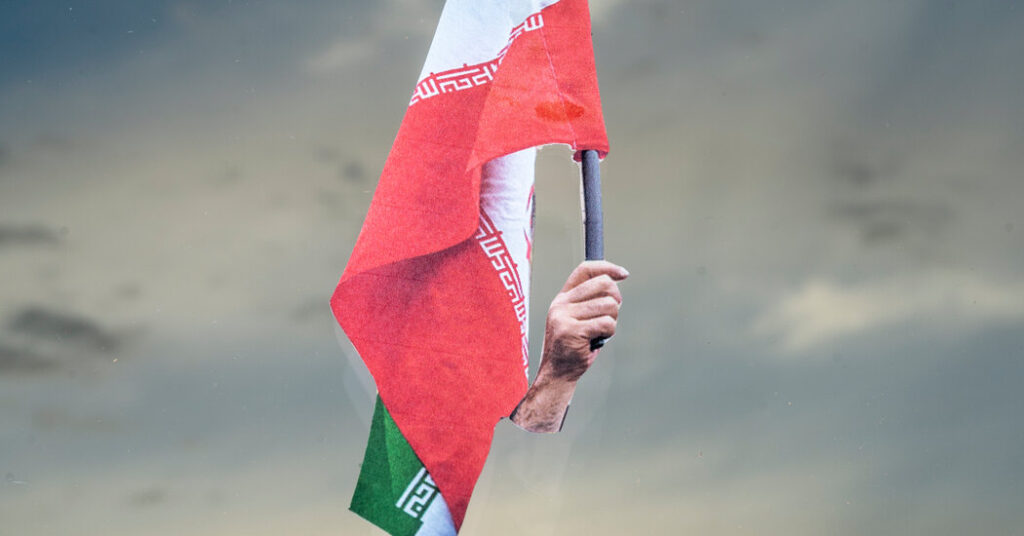
Source photograph by Vahid Salemi/Associated Press
Robert A. Pape (@ProfessorPape) is a professor of political science at the University of Chicago, where he directs the Chicago Project on Security and Threats.
The Times is committed to publishing a diversity of letters to the editor. We’d like to hear what you think about this or any of our articles. Here are some tips. And here’s our email: [email protected].
Follow the New York Times Opinion section on Facebook, Instagram, TikTok, Bluesky, WhatsApp and Threads.
The post The War Is Turning Iran Into a Major World Power appeared first on New York Times.