Zhang Xuefeng became famous in China for telling students and their parents what few educators would: which majors were useless, which careers were dead ends and which dreams ordinary families could not afford.
“Knock out your children if they want to study journalism,” he famously said.
“The humanities all lead to service work, and service work, in one word, is sucking up” to clients.
Critics accused him of reducing education to employability, peddling social Darwinism and teaching students from humble backgrounds to accept the limits of their place.
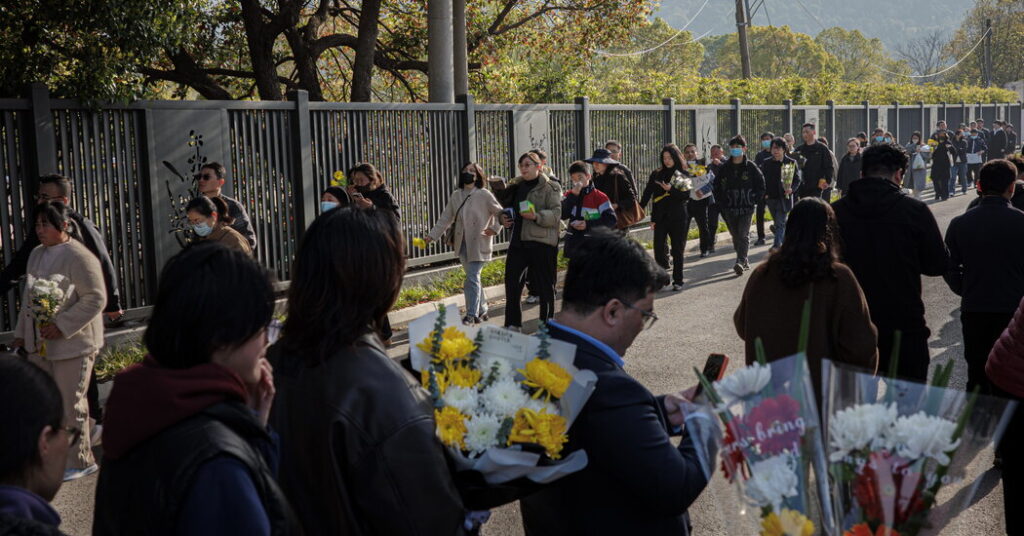
But when Mr. Zhang died last month, at 41, something uncommon in today’s China happened. In a country where large-scale, spontaneous public emotion is rarely tolerated, tens of thousands of people from all over the country showed up at his memorial service in the eastern city of Suzhou. They stood in line for hours to pay their respects, some carrying flowers, one clutching a college admission letter. On the Chinese internet, posts and videos about Mr. Zhang and his death drew more than six billion views in a single day, according to a media monitoring firm.
Online, admirers called him a hero, a savior of underprivileged families and even Prometheus.
The gratitude directed at Mr. Zhang, who had 27 million followers on the short-video platform Douyin, reflected the fears of ordinary Chinese families trying to navigate an increasingly opaque and unforgiving education system. The extraordinary mourning after his death revealed how much of contemporary China is living with that anxiety.
Students and parents thanked him for helping them navigate the high-stakes process of choosing a college major in China. Through livestreams and consulting sessions, he explained which majors led to stable jobs, which industries were declining and which professional certificates were worth pursuing — information readily available to families with connections or advanced education but far harder for everyone else to find.
The public mourning was by no means an organized protest, but it carried an unmistakable social charge. It was a quiet rebuke to a system that many ordinary families experience as punishing and indifferent to their struggles. The censorship that followed suggested that the authorities recognized this, too. Some posts, videos and hashtags related to Mr. Zhang’s death and funeral were censored across Chinese social media.
Mr. Zhang spoke to a huge constituency in China: people who are neither powerful nor protected and for whom securing a stable future justifies almost any sacrifice. They are acutely aware that idealism is a privilege they cannot afford.
Xu, a 34-year-old civil servant in Beijing, wished he had someone like Mr. Zhang when he was choosing a college major. (Like most of the people I interviewed, Xu asked to be identified by one name for fear of government retribution.) Born in a small town in northern China, he grew up in a family where having a “good job” meant being a civil servant, teacher or doctor.
“They have no idea what algorithms or semiconductors are,” he said of his parents, “or what kind of major could lead into those industries.”
Mr. Zhang, Xu said, made visible a set of possibilities that had been hidden.
“He may not have been a guiding light,” Xu said, “but he worked hard to make the maze navigable.”
For decades, the general college entrance exam, known in Chinese as the gaokao, was widely seen as a pathway to changing one’s fate; it was brutally competitive but capable of delivering upward mobility. As universities expanded and the job market deteriorated, that promise weakened. Getting into college became easier. Turning a degree into security did not.
In this environment, choosing the right major has become increasingly important, said Wang, a college admissions consultant in northern Hebei Province. In many provinces, families have less than two weeks between getting the results of the exam and the deadline to apply to college. In that time, they need to make sense of hundreds of majors, universities and career paths. Even educated parents often feel overwhelmed by the decisions. Mr. Zhang’s appeal, Wang said, lay in making an opaque system feel interpretable.
The families who turn to consultants like Mr. Zhang are not, for the most part, China’s elite. But neither are they the poorest. Wang described his clients as families in the broad middle: small-business owners, office workers, skilled laborers and lower-level state employees. They often have money to pay for guidance but lack the social capital or institutional knowledge needed to navigate the system confidently on their own. They’re buying not just advice but also insurance against making a misstep.
Their anxiety has created a thriving market for people willing to decode the system. The service typically costs about $1,000 at firms like Wang’s. But Mr. Zhang was the industry’s biggest star, and his company charged a steep premium. In the summer of 2024, Mr. Zhang offered two tiers of major-selection counseling services through livestreams, priced at $1,743 and $2,615. All 20,000 slots were snapped up almost immediately.
But Mr. Zhang’s influence cannot be explained by market demand alone. His authority also rested on the perception that, after rising above his own class, he had not pulled the ladder up behind him. He came from the same world they did — a working-class family in China’s industrial northeast — and understood, from experience, how unforgiving the climb could be.
He often spoke about his early struggles. In one livestream, he said he had been reluctant to bring a college girlfriend home because his family slept on a kang, a heated brick bed common in northern China, where she, too, would have to sleep. He was rejected by the parents of three former girlfriends who saw his background as a liability.
That biography helps explain why so many followers saw him not just as an education influencer but also as someone who understood the humiliations and calculations of trying to move up in China.
One caller from a small town sought Mr. Zhang’s life advice during a livestream. An alumnus of a prestigious military engineering university, he had been admitted to a top graduate program in the same field. Yet he told Mr. Zhang that he felt lost. How much would he make after graduation? Which city should he move to? And how could he tell if it would be welcoming to someone like him?
“People like us, the so-called small-town strivers, often carry a sense of inferiority,” Mr. Zhang replied. Then he reassured the caller that he had already accomplished a lot and had given his family a shot at upward mobility. Just keep trying, he said.
Hala, a college junior in China, wrote to me that nearly every parent he knew had watched Mr. Zhang’s livestreams.
“People say you don’t necessarily have to study what he recommends,” Hala wrote, “but if he tells you not to study something, you definitely shouldn’t.” Critics accused Mr. Zhang of “selling anxiety,” he added. But for families like his, “the anxiety did not need to be sold.” It came from knowing that one wrong educational choice could close off the future they were struggling toward.
Hala is majoring in computer science, one of the safest bets in today’s China and exactly the kind of choice Mr. Zhang would have endorsed. “And yet,” he wrote, “I am still anxious about the future. I still can’t see a way forward.”
Li Yuan writes The New New World column, which focuses on China’s growing influence on the world by examining its businesses, politics and society.
The post China Mourned an Education Influencer. The Grief Was a Quiet Revolt. appeared first on New York Times.