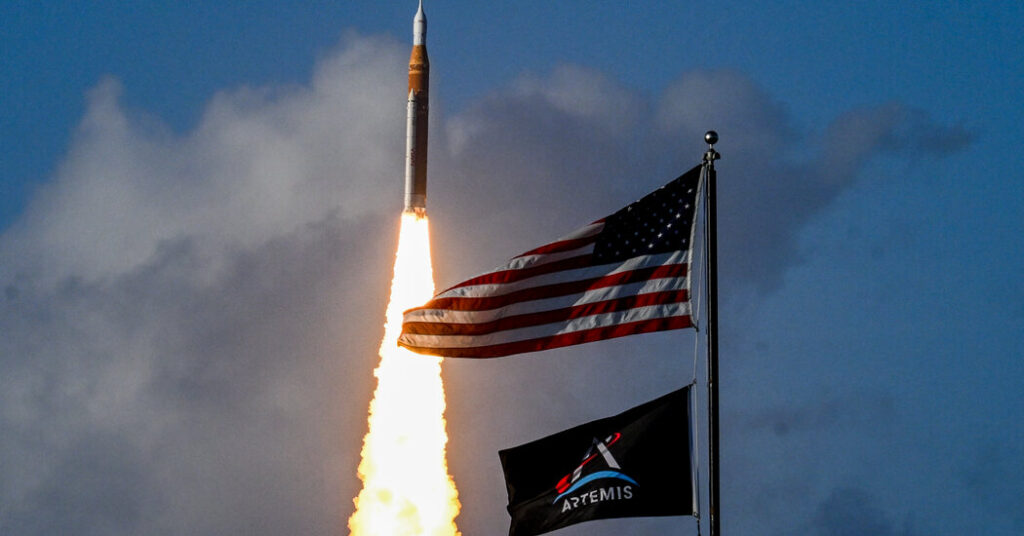
Maybe you weren’t paying attention last Wednesday when the four astronauts of NASA’s Artemis II mission launched on a journey around the moon. But it’s a 10-day flight, and on day 6, you’d be jumping in at the highlight of the trip. It’s moon day!
Here is the information you should know about why three Americans and a Canadian are they are going there but not landing.
What is Artemis II?
Artemis is NASA’s program to send astronauts back to the moon. (In Greek mythology, Artemis is the twin sister of Apollo, which was the name of America’s moon program of the 1960s and 70s.)
The mission’s goal is to test out the life support system and other key systems on the vehicle the astronauts will fly in, Orion. Along the way, they will make geological observations of the moon’s surface, including parts of the far side that human eyes have never seen. In addition, experiments are tracking how deep space affects the astronauts’ bodies.
It is a follow-up to Artemis I, an uncrewed test flight that launched in November 2022.
When was the launch?
The crew lifted off on Wednesday, April 1 at 6:35 p.m. Eastern time. NASA’s Kennedy Space Center in Florida. The launch site known as 39B was originally built for Saturn V rockets used for the Apollo moon missions.
Within eight minutes of lifting off, the crew was properly in space and ready to begin their journey to the moon.
How long will the mission last?
From launch to splashdown, the mission will last about 10 days. Today is Day 6. Artemis II will end with the Orion capsule bobbing in the waters off San Diego.
Where are the astronauts now?
Late Sunday night, the astronauts were more than 230,000 miles from Earth, and within the lunar sphere of influence where the moon’s gravitational pull is stronger than Earth’s.
You can follow the latest real-time distance from Earth and to the moon of the Artemis II astronauts with NASA’s AROW website, which also shows a visualization of the space capsule.
What have the astronauts been doing for the last five days?
The crew launched to space on Day 1. After dealing with computer and communication glitches and a malfunctioning toilet, the crew performed a manual test drive of the Orion spacecraft, which the crew named Integrity. The exercise simulated some of the orbital docking procedures that will be needed for future moon landings.
On Day 2, Integrity fired its engine to take the astronauts out of Earth orbit and send them toward the moon. The trajectory, by design, returns to Earth after passing by the moon without the need for any big engine burns.
Days 3 and 4 were quieter. The astronauts were able to talk with their families, and they conducted some demonstrations and experiments. But problems with the toilet continued.
On Day 5, the crew started getting ready for lunar flyby on Day 6.
Why isn’t Artemis II landing on the moon?
For complex missions like landing on the moon, it is smart not to try to do too many things for the first time, especially when there are people aboard. This is the first time that anyone has traveled this far from Earth since Apollo 17 in 1972.
Current technology, especially computers, have advanced far beyond what was available during the Apollo era, but inevitably something will not work exactly as designed, and it will be good to identify and fix those issues before attempting a landing.
NASA also still needs a moon lander and has contracts with both SpaceX and Blue Origin for designs still under development. NASA also needs spacesuits for astronauts to wear when they step out onto the moon. Axiom Space of Houston is responsible for the spacesuits.
Why is NASA going back to the moon?
That was the priority of President Trump during his first administration, and the program continued under President Biden.
The moon is a logical place to go next, both as a place to explore scientifically and as a place that could provide resources like frozen water for later space missions and helium-3 for future energy technologies.
When is NASA going to land astronauts on the moon’s surface?
NASA hopes to attempt at least one and possibly two missions in 2028 to land astronauts near the moon’s south pole.
How expensive is this mission?
A report by the NASA inspector general in 2021 said that each launch of the Space Launch System and Orion capsule costs about $4.1 billion. There is no precise price tag for Artemis II because it’s a question of accounting — how to allot the tens billions of dollars that NASA spent over the past decade developing the vehicles.
What is the Space Launch System rocket?
It’s NASA’s big new rocket — the present-day equivalent of the Saturn V that NASA used during the Apollo moon landings. It is 322-feet tall and weighs 5.75 million pounds when filled with propellants. It is capable of sending about 60,000 pounds of payload to the moon.
The design is not cutting edge — in large part, it is a remix of technologies from the space shuttles that were developed in the 1970s. Indeed, the four engines on the core booster are literally engines that were built for the space shuttles.
What is the Orion spacecraft?
Orion is the spacecraft that the astronauts will ride in on their trip to the moon and back. The top part, the capsule, was built by Lockheed Martin and it will return to Earth, splashing down in the Pacific Ocean. Orion also includes a cylindrical piece beneath it called the service module, which includes propulsion, power and life support systems. The European Space Agency, one of the international partners of NASA for Artemis, built it.
The crew of Artemis II gave this particular Orion the name of Integrity.
Who are the astronauts?
Reid Wiseman, 50, of NASA is the commander of Artemis II. A Navy test pilot, Mr. Wiseman flew to the International Space Station for a six-month stay in 2014. He served as chief of the NASA astronaut office from December 2020 to November 2022.
Victor Glover, 49, of NASA is the pilot for the mission. He was a test pilot in the Navy before being selected as an astronaut in 2013. He served as the pilot for the first operational mission of the SpaceX Crew Dragon spacecraft to the International Space Station, which launched in November 2020. He was the first Black astronaut to serve on a long-term mission at the space station, and will be the first Black person to fly around the moon.
Christina Koch, 47, of NASA, flew to the International Space Station in 2019 and spent 328 days in space, the longest continuous stay in space by a woman. During her mission, she took part in the first all-female spacewalk with Jessica Meier. She will be the first woman to go around the moon.
Jeremy Hansen, 50, is a Canadian astronaut and Royal Canadian Air Force pilot. Artemis II will be his first trip to space, and he will be the first non-American astronaut to travel around the moon.
Why is a Canadian astronaut on board?
Canada is an international partner for the Artemis program and agreed to provide equipment as part of a collaboration to explore the moon. In exchange, a seat on Artemis II was provided to the Canadian Space Agency, which selected Mr. Hansen.
Kenneth Chang, a science reporter at The Times, covers NASA and the solar system, and research closer to Earth.
The post NASA’s Artemis II Moon Mission: Everything You Need to Know appeared first on New York Times.