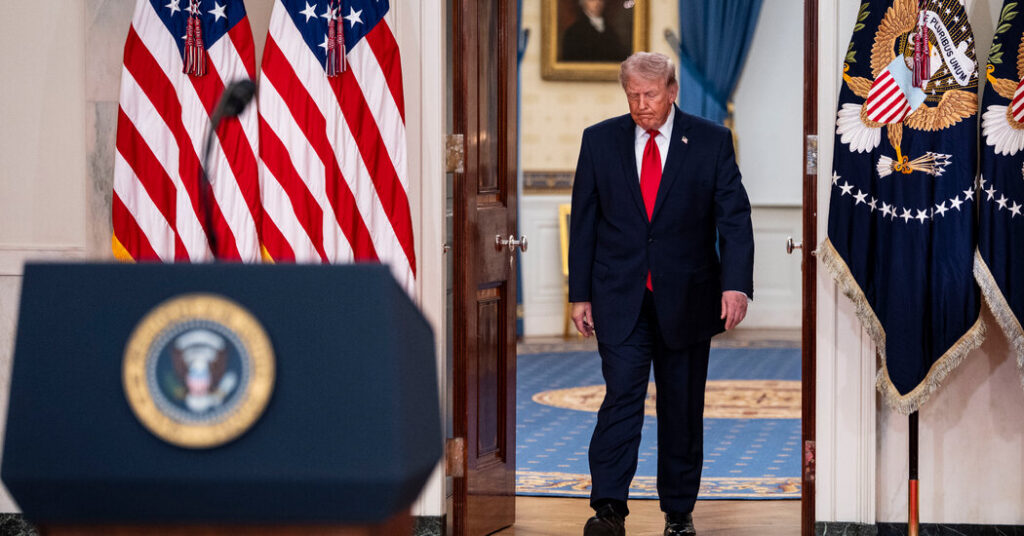
After celebrating the remarkable rescue of an injured American weapons officer from his mountain hide-out in Iran, President Trump might have taken the hair-raising episode as a warning about the risks of expanding the war, especially as he considers possible ground operations inside Iranian territory.
After all, had Iranian forces found the officer, an Air Force colonel, before the C.I.A. and American special operators located and extracted him, the president could have easily found himself in the kind of hostage situation that, he often notes, ended Jimmy Carter’s presidency.
But Mr. Trump appears emboldened by the rescue, as least based on the obscenity-laced message he sent on Sunday via social media to an Iranian leadership that has refused to negotiate on his terms. Angry and frustrated, he appears on the cusp of another escalation, this time to reopen the Strait of Hormuz, where ship traffic was flowing normally before the American and Israeli attack began. Iran has discovered that this is its most potent bargaining chip.
Mr. Trump has now renewed his threat to bomb the country, and its surviving leaders, into submission, even if that means taking out the bridges and power grids that ordinary Iranians — including the current government’s fiercest opponents — depend upon for everyday life. And even, it seems, if such attacks raise the question of whether the United States would be violating the Geneva Conventions’ prohibition on targeting civilian sites.
“Tuesday will be Power Plant Day, and Bridge Day, all wrapped up in one, in Iran,” the president wrote on Sunday morning, as much of the country was preparing for Easter celebrations. “Open the Fuckin’ Strait, you crazy bastards, or you’ll be living in Hell — JUST WATCH! Praise be to Allah.”
Mr. Trump has never shied away from threats and occasional vulgar language on social media, but this post would have stood out on any day, much less on what most Christians consider the holiest day of the year.
It was notable for not only its language, but also its somewhat desperate-sounding tone. Senator Chris Murphy, Democrat of Connecticut, said on social media that Mr. Trump’s comments were “completely, utterly unhinged.” “He’s already killed thousands,” Mr. Murphy wrote. “He’s going to kill thousands more.”
Representative Don Bacon, a Nebraska Republican who is retiring from Congress, said in a text message that “Americans don’t want their president to be profane and vulgar.” He added, “Part of leadership is self-control.”
Obscenities and ultimatums aside, this was only the most recent example of how Mr. Trump has swerved from braggadocio about the power of America’s military to force Iran into “unilateral surrender,” to threats about new strikes against civilian targets if they did not.
In early March, a little more than a week into the war, he said the unilateral surrender would come soon, either when “they cry uncle, or when they can’t fight any longer.” If Iran didn’t make the declaration, the White House press secretary said, he would do it for them.
On March 26, Mr. Trump told his cabinet, in a meeting that was streamed live, that Iranian leaders were “begging” for a deal — the first of his many suggestions that there was a secret, back-channel negotiation underway, facilitated by Pakistan or Turkey or, most recently, Egypt.
Last week, he insisted that Iran’s new leaders, presumably including its new supreme leader, were “much more reasonable” than their recently deceased predecessors. There was talk of a meeting, likely in Islamabad, Pakistan, between Vice President JD Vance and the speaker of the Iranian Parliament, Mohammad Bagher Ghalibaf, a former commander of the Islamic Revolutionary Guards Corps.
That meeting has yet to happen.
Perhaps it still will and Mr. Trump’s theory will prove correct: that Iran may hold fast to its reputation for resistance, but only until the pressure grows unbearable.
Some former American military officials say Mr. Trump’s approach may yet work.
“We know from history that leadership in Iran responds when existential pressure is applied to the regime,” Gen. Kenneth F. McKenzie Jr., the retired head of U.S. Central Command, which is leading the American war effort, said on CBS’s “Face the Nation” on Sunday. “Even if your ultimate aim is not regime change, getting the regime in Tehran to a place where they’ll make a deal that’s to our liking is going to be the inevitable byproduct of intolerable pressure.”
Of course, building that kind of pressure takes time — far more time than the two or three weeks of heavy attacks that Mr. Trump assured the nation on Wednesday night would hasten the war’s completion. And as Mr. Trump pushes out the deadline, he amasses more risk.
The Iranians know this, and they realize they do not need to win; they just need to survive and drag out the process.
While Mr. Trump still suggests that Iran is begging for a deal, intelligence analysis generated by the United States and some of its closest Western allies suggests the opposite, according to officials who have talked to The New York Times.
Although they differ on some details, most conclude that while Iran’s competing power centers are in disarray, its new supreme leader, Mojtaba Khamenei, is likely to take a harder line on negotiating with the United States than his father and predecessor, Ayatollah Ali Khamenei, did before he was killed in the first attack of the war.
They also assess that the Islamic Revolutionary Guards Corps is likely to gain authority in the face of an existential threat to the country — and may be more tempted than ever to race for a nuclear weapon, if it can.
The loss of at least four American aircraft in recent days — two shot down, two blown up by American forces when they got stuck in the sand during the rescue operation — is a reminder that once a battle begins inside enemy territory, Mr. Trump’s ability to control events melts away. Accidents happen. Machinery gets stuck. Aircrews eject.
With more time comes more risk. So far, Mr. Trump has not publicly reconciled his short deadlines for departure with the long timelines needed for success.
He may be able to open the Strait of Hormuz by force, but keeping it open would require a continuous presence of months or years, likely with regular raids on the Iranian side of the strait to wipe out drone and missile threats to the slow-moving tankers.
Mr. Trump has suggested that keeping the strait open will be the responsibility of an international force, with a bit of American support. But few other powers seem eager to join, even those, like China, that get a substantial share of their oil through the strait. The Europeans are enraged that Mr. Trump started the war without consulting them, and now demands their help. It was not by accident that when roughly 40 nations met last week in Paris to discuss how to reopen the strait, the United States was excluded.
Similar risks go with seizing Kharg Island, the hub of Iranian oil exports in the northern Persian Gulf. Taking it would be fairly easy, Mr. Trump said last week. Fox News reported that Mr. Trump told the network on Sunday, “If they don’t make a deal and fast, I’m considering blowing everything up and taking over the oil.”
Again, he has never explained how he would hold the island or the oil production facilities, which the Iranian military views as its lifeblood — and knows how to sabotage.
And then there is the riskiest operation of all: the seizure of 970 pounds of near-bomb-grade uranium from a deep underground storage site in Isfahan, not far from where the airman was rescued on Sunday. Military officials have said the risk of casualties in that operation is high.
Would Mr. Trump take that kind of risk? Not in his first term, say his former national security aides. But something has changed the second time around. After more than five years in the Oval Office, his confidence in his own judgment — “my gut,” as he likes to say — has built with time. He has assembled a team of close advisers who are far less likely to push back than those who counseled him the first time around.
And the success of Operation Midnight Hammer, the June 2025 bombing of three Iranian nuclear sites, and then the seizure of the Venezuelan president Nicolás Maduro from his well-protected bedroom in Caracas have given Mr. Trump a sense that the U.S. military can help him bend the world to his will. So much so that Mr. Trump, according to his special envoy Steve Witkoff, was “curious” back when the war started in February about why Iran had not just given in. “I don’t want to use the world ‘capitulated,’” he said, “but why they haven’t capitulated?”
Thirty-five days into the war, Mr. Trump’s outbursts suggest he is still asking the same question.
David E. Sanger covers the Trump administration and a range of national security issues. He has been a Times journalist for more than four decades and has written four books on foreign policy and national security challenges.
The post Trump’s Lesson From Risky Rescue: Threaten to Go Harder at Iran appeared first on New York Times.