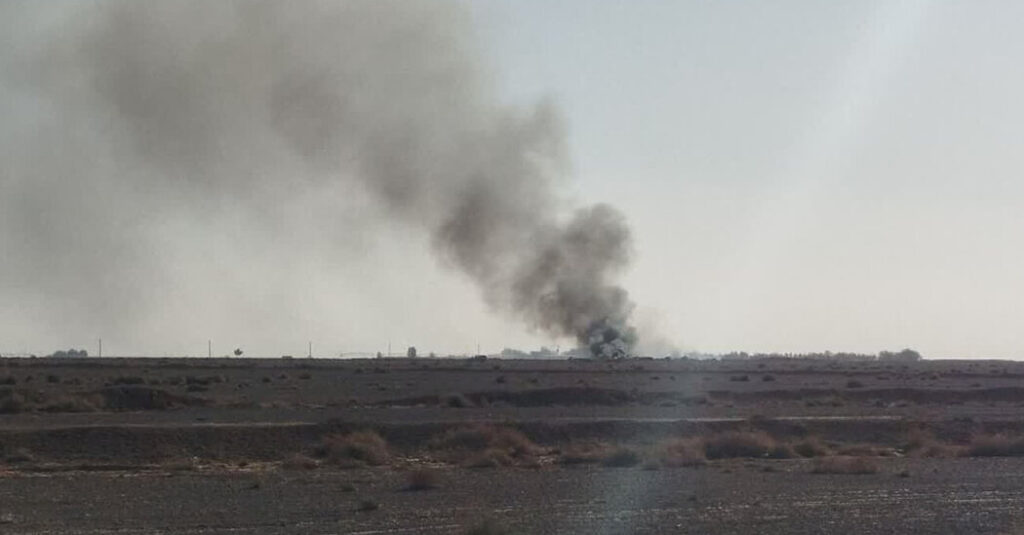
The two crew members ejected from their fighter jet just seconds after it was hit by Iranian fire. The F-15E Strike Eagle, the first fighter jet lost to enemy fire in the war, crashed violently to the ground.
The Air Force officers were deep in hostile territory on Friday morning, alone and armed only with pistols. The plane’s pilot was in “constant communication” with his unit and rescued about six hours later by a force that included attack planes and helicopters that came under heavy fire, military officials said.
But the aircraft’s weapons systems officer was missing. In the chaos of the ejection — a violent, lifesaving maneuver — he had become separated from the pilot, setting off a vast search that became the primary focus for the U.S. military troops and C.I.A. officers across the entire theater for two days.
This account of the weapons officer’s fight for survival and rescue is based on interviews with about a dozen current and former military and administration officials, who spoke on the condition of anonymity to discuss the sensitive operation.
Surveillance planes and drones combed the area near where the plane had crashed but could not find the weapons officer or any signs that he was alive, a military official briefed on the rescue said.
The military described him as “status unknown,” the official said.
On the ground in Iran, the downed officer’s mission boiled down to two words: evasion and survival. Surrounded by potential enemies, he hiked up a 7,000-foot ridgeline and wedged himself into a crevice where he hoped he would be safe until American forces found him, U.S. military officials said.
U.S. Central Command was preparing a statement that the plane had gone down and the pilot had been rescued.
But just as they were about to release the statement — about 14 hours after the fighter jet was hit — U.S. officials got a lock on the weapons officer’s location via a beacon he was carrying. Air Force fighter pilots and weapons officers are equipped with beacons and secure communications devices for coordinating with their rescuers. But they are trained not to signal their location constantly and to restrict use of the beacon, which can be spotted by the enemy, military officials said.
Central Command officials immediately scrapped the statement they were preparing to release. Defense Secretary Pete Hegseth called President Trump and told him that as long as there was a chance that they could find the weapons officer, they needed to keep information about the pilot’s rescue secret.
Iran had launched several search parties, one of which had assembled at the base of the mountain where the weapons officer was hiding. For the Iranians, the downed Air Force colonel was a powerful asset they could use as leverage in high-stakes negotiations with the United States.
For the U.S. military, which lives by the mantra of “no man left behind,” finding the downed officer was a moral imperative.
Battered by the force from his ejection, the weapons officer waited. He knew that both U.S. and Iranian forces were racing to find him.
A military official described the weapons officer’s signaling as intermittent. The first task for the military was making sure that the person signaling was the weapons officer and not someone in Iran who had found his equipment.
At its campus in Langley, Va., the C.I.A. was developing a deception plan to buy the U.S. military and the airman some time. They spread word in Iran that the airman had been found and was being moved out of the country in a ground convoy. The hope was that the Iranians would shift their search from the place where the airman was thought to be and focus instead on the roads out of the region.
The C.I.A. operation appeared to cause confusion among the Iranian forces hunting for the airman, according to a senior administration official.
The Iranians, however, intensified their search, calling on the public via the state’s primary broadcaster to capture the “enemy’s pilot or pilots” and turn them over alive to security forces for a reward.
On Saturday morning, Mr. Trump was escalating his threats against Iran, vowing to blow up the country’s electrical infrastructure unless its leaders opened the Strait of Hormuz to all traffic. “Time is running out — 48 hours before all Hell will reign down on them,” Mr. Trump wrote on social media.
At that moment, U.S. military officials were in the final stages of preparing a vast and complex rescue mission that involved about 100 Special Operations forces, led by elements of SEAL Team 6, with Delta Force commandos and Army Rangers on standby if needed. A far larger conventional force made up of helicopters, surveillance planes, fighters and aerial tankers was readied to provide support.
A U.S. military official said it took hours to get the weapons officer’s location and determine that it was him. Military officials were assisted by the C.I.A., which used a special piece of technology unique to the agency to locate the airman hiding in the mountain crevice and confirm his identity. U.S. and Israeli officials gathered intelligence to determine if the airman was alone, surrounded by Iranians or had been captured.
Once they determined the airman was alone, senior military officials waited until dark to launch a rescue mission. Special Operations helicopters, loaded with commandos, raced to the remote mountain site where he was waiting.
A senior U.S. official described the rescue mission as one of the most challenging and complex in the history of U.S. Special Operations. The commandos had to contend with the mountainous terrain, the Iranian forces that they assumed would rush to attack them and the injured airman’s health, which remained uncertain.
As they landed on the objective, the commandos fired their weapons ferociously to keep any Iranians in the area from advancing toward them. U.S. warplanes dropped bombs whose bright orange blasts lit up the silhouettes of the surrounding mountains.
But the commandos did not engage in a firefight with enemy forces. U.S. officials described the territory where the airman was hiding as strongly opposed to the Iranian regime and said it was unclear how close Iranian forces ever got to the site.
He was rushed to a helicopter that whisked him off to a sandy, austere airstrip inside Iran that Special Operations forces had previously developed for possible rescues or other contingencies.
The plan was to immediately load the airman and the rescue force onto two C-130 aircraft that were supposed to carry them out of danger to an airfield in Kuwait. But, in a final twist, the nose gear of at least one, and possibly both, of those planes got stuck in the sandy dirt at the airstrip, military officials said.
Hours passed. Efforts to free the stuck wheels failed, so the commandos called in three replacement aircraft.
Officials in the Pentagon and at Central Command waited anxiously. The success of a dangerous mission, which had seemed nearly complete, was suddenly once again uncertain.
Eventually the commandos and the injured weapons system operator were reloaded onto three newly arrived replacement aircraft. After the rescue team left, American warplanes bombed the two disabled planes rather than let them fall into Iranian hands.
As the sun was rising, the three planes launched in succession from the remote airstrip. The plane carrying the rescued airman went first followed by the others.
When word reached the White House that the aircraft had cleared Iranian airspace, Mr. Trump announced the mission’s success.
“WE GOT HIM!,” Mr. Trump exclaimed in a social media post a few minutes after midnight in Washington. “This brave Warrior was behind enemy lines in the treacherous mountains of Iran, being hunted down by our enemies, who were getting closer and closer by the hour.”
The rescued officer had “sustained injuries,” Mr. Trump wrote, but would be “just fine.”
All of the commandos were safe and accounted for. There were no U.S. casualties.
The moment of celebration seemed to pass quickly for Mr. Trump, who on Easter Sunday morning returned to the reality of an unpopular war for which he seemed to have no clear exit strategy. The airman was safe, but the Strait of Hormuz was still in Iranian control, imperiling as much as 20 percent of the world’s oil supply and the global economy.
Mr. Trump had tried bullying America’s allies in Europe and Asia to come to his aid, but his entreaties were ignored.
So he threatened Iran’s leaders in an angry and profane social media message.
“Tuesday will be Power Plant Day, and Bridge Day, all wrapped up in one, in Iran. There will be nothing like it!!!,” Mr. Trump wrote. “Open the Fuckin’ Strait, you crazy bastards, or you’ll be living in Hell – JUST WATCH! Praise be to Allah. President DONALD J. TRUMP.”
Ronen Bergman contributed reporting from Tel Aviv.
Greg Jaffe covers the Pentagon and the U.S. military for The Times.
The post A Harrowing Race Against Time to Find a Downed U.S. Airman in Iran appeared first on New York Times.