PHOENIX — If Dawn Staley and South Carolina beat UCLA in the national title game Sunday, she would become the fourth coach to win four championships.
UCLA coach Cori Close is looking for her first.
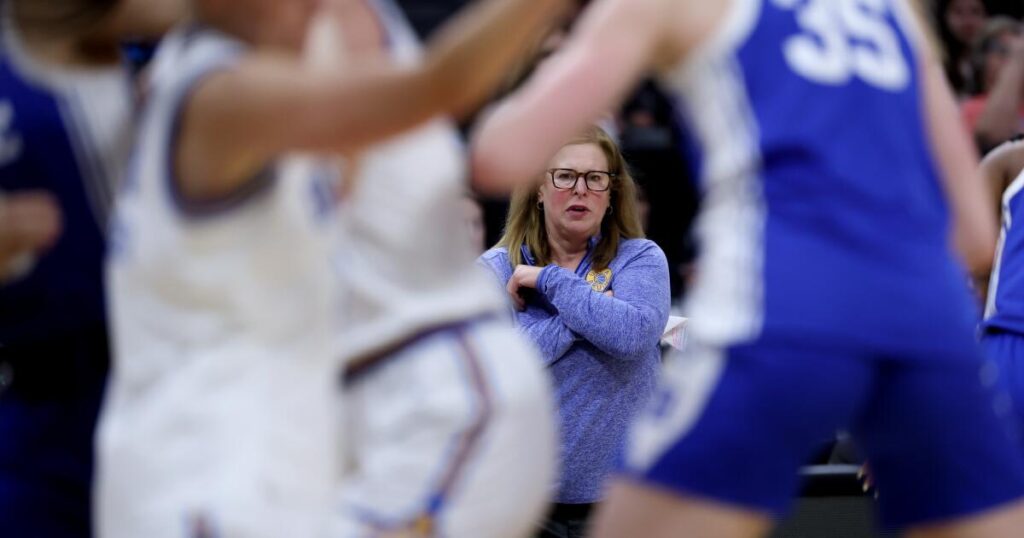
After 15 years of building the Bruins to a program that could get to the Final Four, and a year later, the NCAA championship game, the 52-year-old finds herself in the conversation with some of the game’s legends.
Staley is one of those who believes Close belongs.
“Cori is a connector,” Staley said Saturday. “She connects with her players, she connects with the community, she connects with powerful women that can help her as well as her players. She uses her voice. I think she’s very in tune with the state of our game. Very in tune. She doesn’t mind sharing. That’s the key. You’ve got to be able to share what you know in order for our game to grow.
“I do think she’s a spokesperson for our game and she’s one that really has used her voice for the advancement of our sport.”
At a Final Four with Staley, 12-time national champion Geno Auriemma of Connecticut and Vic Shaefer of Texas, who has been to four Final Fours, Close often was excluded from the conversation about the star coaches. For years she’s been labeled by critics as a better motivator than a tactical strategist you count in crunch time.
But here she is with the best UCLA team ever in the NCAA title game for the first time, going head-to-head with Staley.
After last year’s “embarrassment” in the Final Four, Close took an opportunity to learn from the mistakes that led to a blowout loss to UConn.
“Talking transparently, I did a crappy job as a leader,” Close said. “The moment we touched down, I was in the transfer portal. Not a great situation. One of my biggest regrets of last spring is that I didn’t celebrate them enough. I didn’t find ways to go, ‘This team was the most successful team since 1978-79.’ I let myself get wrapped up in everything that was transpiring in the portal. I don’t think I did a good enough job in that way.”
Going into Sunday’s championship game, Close has a veteran group, with no starter younger than 22 and a leadership group of six players slated to exhaust their eligibility and likely head to the WNBA.
All those players except Gianna Kneepkens were with the squad last season to see firsthand what went wrong. Charlisse Leger-Walker, a transfer from Washington State, spent the year on the sideline recovering from an anterior cruciate ligament injury.
Leger-Walker opened this season as the starting point guard and has seen a change in Close since last season’s Final Four run.
“Cori has built a lot of trust with this group, and it shows in the way that she stays so composed,” Leger-Walker said. “We’ve had a lot of conversations with her in the past that if she’s anxious and very high emotionally, then that transfers into us, and she is constantly seeking our feedback. What can she do to be better for us? And that’s something that you don’t always get in head coaches. So I’m really proud of her and her willingness to be open to us.”
In the locker room, players praised Close for opening up to the veteran group for input.
“I’ve seen her grow every single year, and I think that’s just a testament to her work and to us as well, just being able to have that open communication between a coach and players,” sixth-year forward Angela Dugalic said. “A lot of the time it’s just like, whatever the coach says, that’s what we do. Or sometimes players just do whatever they want. I think there’s a good balance of Cori listening to us and us listening to Cori.”
Senior Gabriela Jaquez, who has played all four of her college seasons at UCLA, shared a similar perspective about how Close has learned to lean on her players.
“She has improved every year and really listens to her players,” Jaquez said, which makes Close “really rare as a coach.”
Close said at the beginning of the tournament she had to apologize to a player because she “really screwed up.” She didn’t specify what mistake she made but said her apology was a key step in continuing to build trust with this team.
“That’s how you grow as a leader, how you earn credibility with your players, if you don’t think you have it all together all the time,” she said. “I think when you’re able to do that, you actually experience the most growth. So it’s never fun in the moment. It sure wasn’t fun to be exposed in some of the ways that we were exposed, and I’m ultimately responsible. But I am thankful for the growth that has stemmed from that.”
Close had to build her best UCLA team and pull off her greatest coaching performance to get to this point. Now she faces off with Staley, perhaps the best coach of this era who just walloped Auriemma and the Huskies on the national stage.
Once again, Close’s work is cut out for her. This time, those around her feel she is ready to leap into the top coaches conversation.
“I have a responsibility to make strategic changes that reflect that I really heard those things or saw those things,” she said. “There’s tactical things. There’s leadership things. There’s how we structured our practices, things that we needed to address. So I just hope that every year, we do that.”
The post UCLA’s Cori Close finally is ready for her national championship moment appeared first on Los Angeles Times.