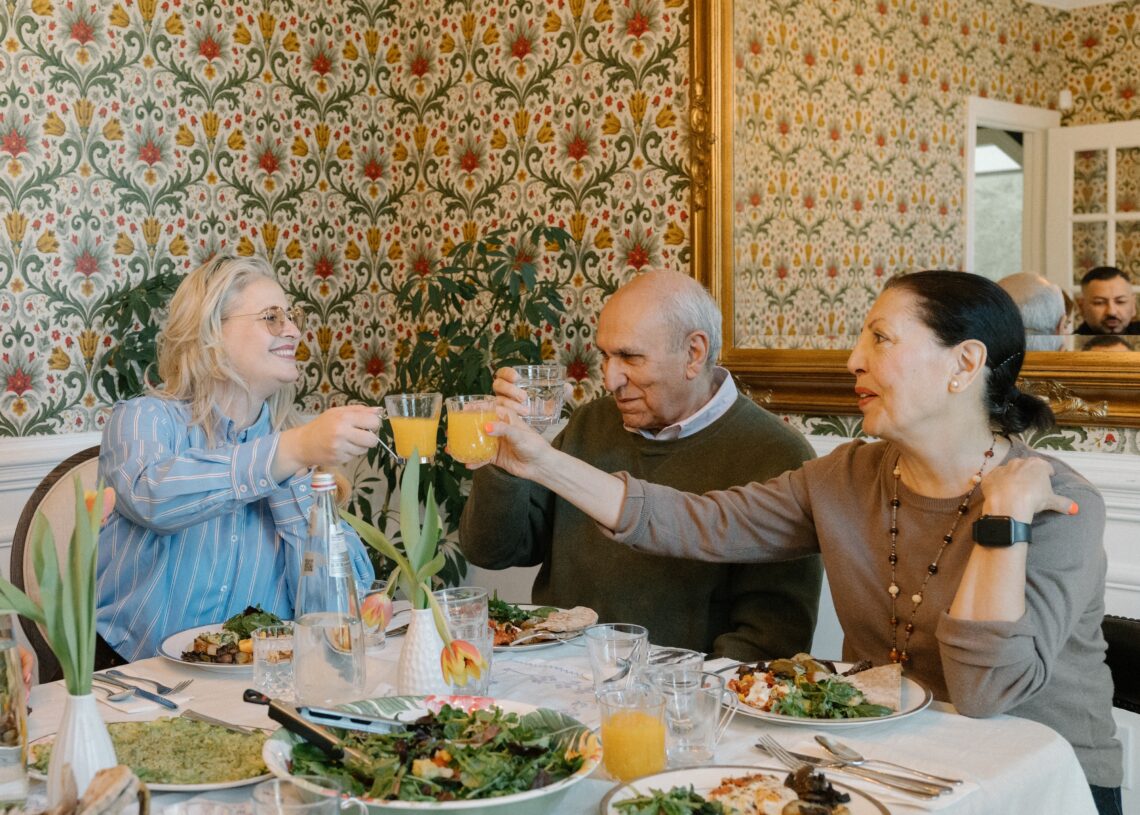
On a warm Sunday afternoon, Shamim Popal hovers in the kitchen of her Middleburg, Virginia, home, making brunch for her family. The tomatoes for the shakshouka have been stewing for hours. The zucchini frittata needs a few more minutes on the stove.
“I like everything to be perfect. I like everything to be the way I want it to be,” Shamim says.
Clad in a spotless apron with her black hair pulled back in a bun and fingernails painted coral, Shamim makes fun of her daughter, Fatima, for burning bread. “This kind of thing happens here a lot,” Shamim says. “Dad blames the toaster. ‘We need a new toaster.’ It’s not the toaster!”
The pair laugh as Fatima scrapes the burned bits into the sink. The smell of burned toast mixes with the scent of spices in the kitchen and flowers scattered throughout the house.
In the kitchen hangs a small painting of Cafe Bonaparte, the first restaurant that Shamim; her husband, Zubair; and their three children, Fatima, Omar and Mustafa, opened in 2003 in Georgetown. During the creperie’s early years, the family spent their Sundays serving brunch. But in the decades since, the Popals, who hail from Afghanistan, have established some of the most acclaimed restaurants in Washington.
Without any prior restaurateur experience, the Popal family is behind some of the most popular establishments in the nation’s capital — restaurants that top “best of” lists and win awards and are difficult to get into without reservations booked well in advance. The Popal restaurants have come to represent the international nature of Washington’s dining scene.
In Adams Morgan, the Popal Group’s award-winning fiefdom features the Afghan restaurant Lapis and its affiliated bar Lapop, plus the French restaurant Maison Bar à Vins and a private event space called 1819. The Berliner, a German beer hall, is set to reopen in the neighborhood this summer after closing in 2022. In Georgetown, the Popals run the modern French restaurant Lutèce, in the same 19th-century building where Cafe Bonaparte once was. The Mexican restaurant Pascual is in a Capitol Hill townhouse.
Even food critics are impressed. “I’m not a hype woman, but I will hype their restaurants,” says Jessica Sidman, Washingtonian magazine’s food editor. “They’re knocking it out of the park with every single thing that they open, just hit after hit, in a way that is so rare.”
About once every month, Shamim and Zubair’s children and grandchildren make a 45-mile pilgrimage from the Washington area to Middleburg, where the hills are dotted with vineyards and horses, to spend the weekend at their lush estate, which is complete with a pool and tennis court. Brunch is the main event.
On this March afternoon, as the Popals sip tea with cardamom after their meal, the conversation turns to giving birth. “You guys are all very, very lucky. If I tell my stories from back home, then you guys will run,” Shamim says. “During the war, after curfew, you’re not even allowed to go to the hospital.”
The Soviet-Afghan War began in 1979. By the time the conflict ended in 1989, the Popals had fled.
The family lived in Bahrain and Dubai, where Zubair worked for the hotel company that employed him in Kabul. But Zubair had always dreamed of living in the United States — “I was watching cowboy movies” — and in 1987, the family left Dubai for America. They settled in Northern Virginia and, given the situation in their home country, claimed political asylum.
The first few years were challenging. Lawyers took advantage of them, Shamim and Zubair say, and it was hard to find work. Zubair eventually got a job at a Honda dealership. “I was desperate,” he says. But he excelled at selling cars, and eventually a client connected him with a lawyer who got the family’s asylum claim approved.
When the Popals became U.S. citizens in 1991, Shamim felt like she could fly. “You have wings,” she says.
Shamim is the first to admit that she didn’t cook much when the family lived in Afghanistan. But in Virginia, food became one of the only ways to maintain a connection to her homeland. “I missed home so much. I wanted to have something to remind me of the good days,” she says one afternoon over a lunch of vegetable dumplings and eggplant in the Lapis basement.
In the years after moving to the U.S., during long meals at home, the Popals often talked about their hopes of opening a restaurant. “It was always something we just dreamed up over the breakfast table and Sunday brunches,” Fatima says. They hoped for an Afghan restaurant but worried that Washington wasn’t ready for one just a couple of years after 9/11. One day, Omar told the family that he had found a location in Georgetown. Cafe Bonaparte opened when Washington’s dining scene was largely composed of steakhouses.
Fatima, who was 23 at the time, quit her tech job and started managing the restaurant. “We opened with my mother and me in the kitchen,” she says. “We had one dish washer … no liquor license. I don’t even think our credit card machine was working.” (Zubair says purchasing a liquor license from the owner of the nearby Peacock Cafe for tens of thousands of dollars was pivotal to the restaurant staying afloat.)
Twenty years later, it’s still a family affair. Zubair, 75, is the CEO; Fatima, 46, is the chief financial officer; and Omar, 47, is the chief strategy officer. They avoided outside investors to keep the company family-owned.
Margins in the restaurant industry are notoriously thin, but Fatima says the company, which employs just under 200 people, is profitable. “I always had hope that something good would come out of this,” Zubair says, adding that he’s glad he trusted his children. “I am very proud of them. I don’t tell them, though.”
Still, they’ve made mistakes. French restaurant Malmaison opened in Georgetown in 2013, but the location was isolated, so the restaurant didn’t do well, according to Zubair. After a successful rebrand into the Berliner, a hotel company purchased the building, and the beer hall was forced to close. Now, the company’s strategy is purchasing their restaurant properties rather than renting; the family owns all except Lapis and Lutèce.
The family attributes some of their success to their clearly defined roles. Fatima is a numbers person; Omar is a designer. “We do not step over each other,” Fatima says. But working with family is not without its challenges. “You go through every emotion that you can possibly have. You go through them because it’s family. But it’s also one of the most amazing feelings,” she says.
That the company has stayed family-run is why some employees have stuck around. “Their priority is, and always has been, their family. That’s what makes them strong,” says Katya Klinkova, who has worked for the Popals for 19 years, first at Cafe Bonaparte and now at Lutèce.
That trust extends to the chefs, too, say Matt Conroy, executive chef at Maison, Lutèce and Pascual, and his wife, Isabel Coss, executive chef at Pascual and executive pastry chef at Lutèce. “They do a good job at letting people do their thing,” Conroy says.
Coss, who is from Mexico, says she identifies with the Popals as fellow immigrants. “You need to be a little fearless. You need to have dreams,” she says.
To Sidman, the Popal Group started making its mark on Washington dining when Lapis opened in 2015. “Lapis really put Afghan food on the map in D.C.,” she says.
When Shamim’s children first proposed that she should be the executive chef at Lapis, she balked at the idea, walked out of the restaurant and drove home. But she thought about it and agreed the next day. “I was thinking, ‘Shamim, if you do this, it’s something for your children, for your grandkids, something you leave behind, something for your country.’”
The Popals gave themselves just a few weeks to turn the former Napoleon Bistro into Lapis. Shamim spent that time writing down her recipes. “For the first time, I was measuring my food,” she says.
The 70-year-old worked full time as executive chef at Lapis until about four months ago, when she scaled back to a few days per week and hired a chef to lead daily operations. She held off because she worried a new chef would change her menu. “Lapis is my home,” she says. “Lapis is me. It’s my recipes. It’s the history of us and our family, and I want it to be this way.”
Memory is important to the Popals. In the Lapis basement, the black chairs are from Cafe Bonaparte, and the couches are from Napoleon. “We love to have our memories everywhere with us,” Shamim says.
To Lapis manager Fadel Kamal, Shamim is the heart of the restaurant. “We all call her Mom,” he says. When Kamal was sick recently, Shamim gave him recipes for ginger and cayenne pepper shots to make him feel better. He says they worked.
Shamim likes to remember the cosmopolitan Kabul she grew up in — one where she says women could wear mini skirts and go to college. Through Lapis, she wanted to challenge stereotypes about Afghans and create a memorial of sorts to a Kabul that no longer existed. One way the restaurant does that is through quips in the menu: It says vegetarian dishes are “our best kept secret because people think afghans are carnivores with large turbans (also true),” while “rice in Afghanistan is second only to turbans and tribal feuds.”
Lapis is perhaps the most personal of the Popal restaurants, but nostalgia and memory exist in all of them. The French restaurants are inspired by the Popals’ memories of cafe culture during their travels around Europe. The Berliner is an homage to their relatives in Germany. Coss returned to her Mexican roots at Pascual.
“There are certain memories that you want to experience over and over,” Omar says. “What we try to do is to relive those emotions for people. That’s contributed to our success.”
The list of accolades runs long. Just this week, Maison, which opened in a historic Adams Morgan townhouse in September, was named a finalist for a James Beard Award. The recognition is nice, Conroy says, but “you can’t cook for awards.” Perhaps a better marker of success is how difficult it can be to get a reservation at the restaurants.
Omar hopes to expand to other cities around the country. Once the Berliner reopens, which he expects to happen by June, he says his next concept will be a French seafood restaurant.
Sitting in Lutèce, where it all started, Zubair says he isn’t so sure. “God knows what happens after the Berliner,” he says. “We are pretty covered with what we have, but you never know. We always come up with some crazy plan.”
The post Meet Washington’s most powerful and mysterious restaurant family appeared first on Washington Post.