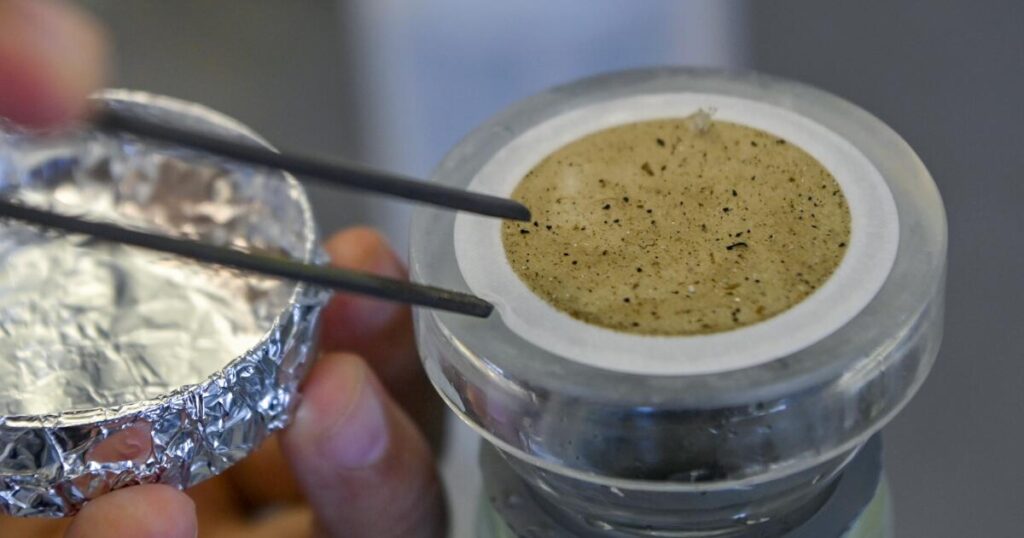
As the science of detecting microplastics matures, so too does consensus about their ubiquity. Everywhere researchers have looked to find them, there they’ve been: In human brains and lungs; in breast milk and semen; in alpine snow and deep-sea sediment; in corn plants and beer.
And that, say researchers, is the rub: Scientists are not just finding them in our livers, arteries and ovaries. They are also everywhere else: in research laboratories, pipettes, refrigerators, solvents, bottles, goggles and the very lab coats investigators are wearing to find them.
So how do we know if those particles seen under the lens of a microscope are inherent in the sample, or contamination from plastic fibers floating in the air? Or from tiny particles that sloughed off from the inside of a bottle of solvent?
Microplastics scientists are keenly aware of the problem and urgently studying it, because the credibility of the research is on the line.
Their research suddenly skyrocketed in importance with the federal government’s announcement Thursday that it will begin actively investigating the wayward, potentially toxic particles in people and drinking water.
“We cannot regulate what we don’t understand,” Robert F. Kennedy Jr., secretary of Health and Human Services, said at a news conference.
Nicolas Leeper, head of vascular medicine at Stanford University, said he is “absolutely” concerned that “at least some part of what has been reported [in the scientific literature] may be spurious or artifactual.”
For instance, a 2024 headline-stealing study showed a relationship between microplastics found in the arterial plaque of patients undergoing heart surgery, and a higher risk of heart attack and stroke. Several medical researchers, including Leeper, questioned the findings. They argued the authors hadn’t accounted for the introduction of microplastics during surgery.
Like most scientists in this new relatively new field, Leeper didn’t set out to study tiny, broken bits of plastic. But that study caught his attention.
“I take care of people that have atherosclerosis,” he said in an interview. “We’ve known for a while that genetics only explains about half of our lifetime risk.”
He now wonders if microplastics could be that X factor he’s been looking for, and is investigating the issue in his laboratory. But he’s aware the particles are everywhere.
“Think about it: Every time we work with a human bio specimen, we’re wearing plastic gloves and using plastic needles and plastic petri dishes,” he said.
Leeper is pretty sure microplastics can lead to ill health. He just wants his — and everyone’s — research to be beyond reproach.
“Given the potential public health impact of these ubiquitous … products, it is essential we know exactly what we are dealing with, how to quantify it, and how to be certain we aren’t chasing a signal that may be driven, in part, by contamination artifact,” he said.
It’s not a new concern. In fact, it’s a relatively old one.
Claire Gwinnett, a forensic scientist at the University of Staffordshire, in England, said she’s been fretting about microplastic contamination in her research for decades.
She’s spent most of her career inspecting dead bodies for signs of foul play. Her work requires painstaking quality control. When examining a cadaver for DNA, fibers or other chemicals and materials that could help identify a murderer, or information about a struggle, she needs complete confidence that the evidence she gathered came from the body, or perpetrator, and not from her own body, clothing or equipment.
“My entire career has been based around these teeny, tiny particulates you can’t see with the naked eye, but that I’m trying to confidently convince the courts were present on that victim in that crime scene, and not due to procedural contamination,” Gwinnett said.
About 10 years ago, she read a headline saying that researchers had found microplastic contamination in samples of deep ocean sediment — more than two miles below the surface.
“And the question for me was: Is that real? Were they actually using methods that would confidently allow them to say they actually found these microplastics at these depths, and that it wasn’t procedural contamination?”
She started working with environmental scientists at her university and then across the world to get them to start thinking like a forensic scientist: How can you reduce plastic in your lab or account for microplastics that are there? Are they using plastic when they could be using glass or metal? What are they wearing in the lab? Are they creating “blanks” — faux samples that go through the same preparation, in the same places, with the same researchers, using the same chemicals and materials — to account for microplastic background “noise”?
It was around this same time that Susanne Brander, director of scientific advancement efforts for the Pew Charitable Trust’s safer chemicals project, said she and other environmental scientists started asking similar questions, and establishing protocols to address contamination.
By the late 2010s, she and colleagues started replacing plastic with glass and metal, used HEPA filtration, and instituted special cleaning procedures for their equipment.
But, as often happens in science, knowledge in one research discipline doesn’t necessarily bleed into another.
There’s a silo effect, Brander said. So when people who study human health started asking questions about microplastics, they didn’t necessarily look to the water, fish and forensic folks for advice.
She doesn’t fault them for not reading her papers; “it’s a different research space,” she said. But it meant some of the early work on microplastics and human health didn’t use the quality controls that forensic and environmental scientists had adopted.
“Some of us have even talked about bringing these two research fields together, she said. “Maybe we should reconvene and talk about how we’ve already kind of done this.”
The human work is drawing a lot more scrutiny than the earlier work ever did.
It’s one thing to find microplastics in plants, snow and other animals. When we see it in our brains, placentas, testicles and blood — that’s different.
And as the federal government jumps into the fray, looking not only for the particles but also the potential effects on human health, the risk to the multibillion-dollar chemical and fossil fuel companies that manufacture and distribute these products grows.
So could scrutiny on the way we live: from food packaging, carpet manufacturing and water filtration, to medical supplies, car tires and clothing.
Plastic never goes away; it just breaks down into smaller and smaller pieces. According to the United Nations Environmental Programme, the world has produced more than 9.2 billion tons of plastic since 1950, with half of that amount produced in the last 13 years alone.
Matthew Campen, professor of pharmaceutical research at the University of New Mexico, has done some of the most well-known microplastic research on human tissue. He found it in placentas, livers, kidneys, lungs and brains.
He said the issue of contamination is real, but wonders if it’s over-hyped.
Campen was at the panel Thursday with Kennedy and Lee Zeldin, the administrator of the U.S. Environmental Protection Agency, as they announced their intention to make microplastics a research priority.
Although his work has also been challenged, he said that’s to be expected: The whole field of microplastic research is new, and there will be kinks that get ironed out as it matures.
“We knew that cigarettes caused cancer in the 1930s and the surgeon general didn’t say anything about it until 1966,” he said. “Ultimately, I think we’re going to move pretty fast. We’re going to invest in science in the coming years, and over the next five years, we’ll have much more confidence as to how this is getting into our bodies and what it could be doing.”
The post Microplastics are everywhere — even in the labs studying them. That’s a problem for research appeared first on Los Angeles Times.