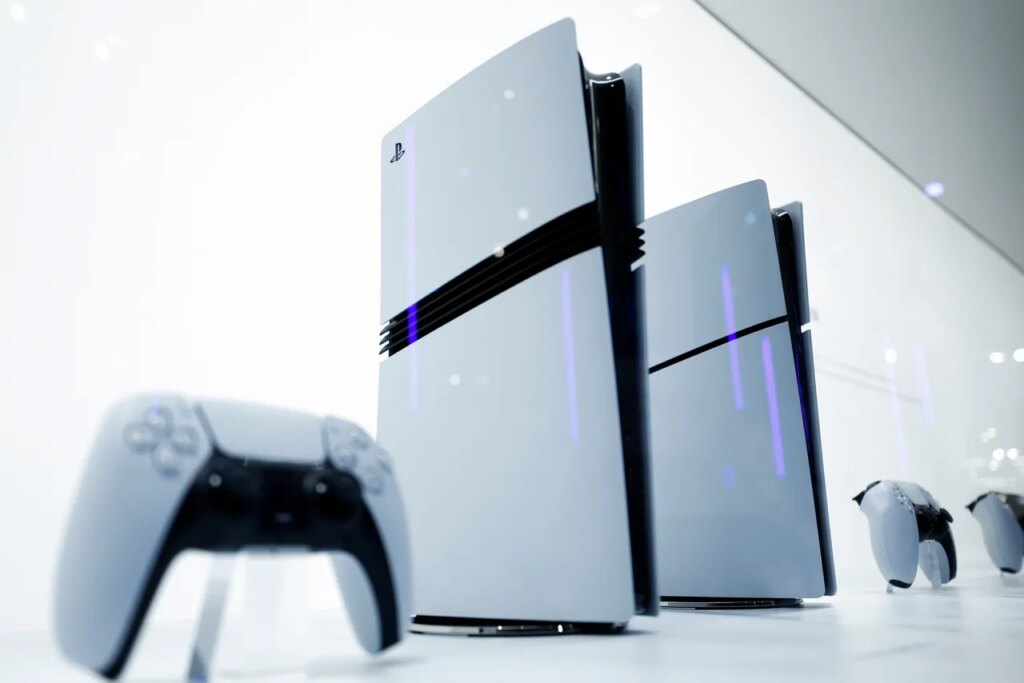
If you’ve been holding off on picking up a PlayStation 5 in hopes of a price cut, bad news: the cost of every model of Sony’s all-conquering console has instead just gone up considerably.
It’s a move that breaks with decades of tradition (or at least consumer expectations) and is undoubtedly a blow for anyone hoping for a discount, five years into the current console generation. However, it’s also a sign that the current generation is likely to stick around for a while yet—and that may be a good thing, for the industry and players alike.
Historically, at this point in a console generation, incumbent hardware sees steep discounts. For example, the PS4, which launched for $400 in 2013, was retailing for $300 by 2018, a 25 percent decrease. Even if hardware is loss-leading, it’s a pricing trajectory that’s usually win-win for manufacturers and customers alike. Production and component costs will typically have dropped over that half-decade, allowing companies to drop the retail price, often alongside slimmed-down hardware revisions. At the same time, players who weren’t won over at a console’s launch have a cheaper entry point and years of games to catch up on. But this generation has been anything but typical.
Generational Abnormalities
The AI bubble has seen RAM and SSD storage prices skyrocket in the last few months, impacting the entire global tech sector. Sony as a whole has been hit hard by this, with the recent announcement that it was suspending its memory card business, while the PlayStation corner of the fiefdom just confirmed long-standing rumors of price increases for its console family.
The new MSRPs went into effect on April 2, and there’s no sugarcoating that they mark significant increases. The “entry-level” digital edition PS5 console—the one without a disc drive—is the worst hit, leaping to $600. That’s $100 higher than its previous US retail price (which was already up following an earlier hike back in August 2025, driven by Trump’s tariffs) and a staggering 50 percent higher than its $400 launch price back in 2020.
The base PS5 with a disc drive is up 30 percent on its original $500 price, now costing $650, while the PS5 Pro “only” goes up around 29 percent from its $700 launch price, setting buyers back $900—though it also doesn’t come with a disc drive, so prepare to shell out another $80 to play physical games or Blu-ray movies. Elsewhere, the PlayStation Portal, Sony’s handheld that allows users to stream games from their PS5 or the cloud, has also increased by $50, from $200 to $250.
PlayStation is far from alone in increasing its prices. Xbox increased its hardware and GamePass subscription costs multiple times in 2025, eventually bringing the MSRP of the top-end 2-TB Xbox Series X to its current $800, and is rumored to be considering another hike. The Switch 2 dodged tariff-induced price hikes at launch but is also reportedly “contemplating raising the price of that device in 2026,” per Bloomberg—and the same report suggests Sony may be delaying the inevitable PlayStation 6 to as far off as 2029, all due to the AI-induced parts crisis.
Even Valve’s handheld Steam Deck isn’t immune—while prices have so far only risen in Japan, South Korea, and Taiwan, the manufacturer has announced that the original 256 GB, LCD-screen model (the cheapest) “is no longer in production, and once sold out will no longer be available” while the newer OLED models, available with either 512 GB or 1 TB of storage “may be out-of-stock intermittently in some regions due to memory and storage shortages.”
Further, its upcoming console-like Steam Machine, announced in November 2025, still has no confirmed release date or price. Valve says this is down to “memory and storage shortages,” with the “limited availability and growing prices of these critical components mean[ing] we must revisit our exact shipping schedule and pricing.”
Silver Linings
So, faced with increasing prices on current hardware and potential delays for the next generation, why is any of this potentially a good thing for the industry and gamers? In short: breathing room.
The present console generation has been atypical from the start. Both PS5 and Xbox Series X|S launched in November 2020, right in the middle of the Covid-19 pandemic, and the impact of global lockdowns on everything from manufacturing to distribution drove supply chains to a breaking point. Coupled with a rise in the number of people working from home, requiring more tech to do their jobs (and coinciding with a speculator boom surrounding cryptocurrencies and NFTs gobbling up consumer-grade graphics cards), we ended up with the last great chip shortage.
Like much of the pandemic years, it might seem like a distant memory now, but this all meant that at the start of the current generation, customers could barely get their hands on a new console, right as they most wanted one to stave off the boredom of extended quarantines. Even after stock levels improved, leading to reported lifetime sales of roughly 91 million PlayStation 5 models and around 34.5 million Xbox Series X|S units (and a respectable 17 million already for the latecomer Switch 2), there’s still a sizable cohort who haven’t leaped to a modern console yet. If successor hardware is held off until 2028 at the earliest, that’s more time for players to get stuck into what’s already available.
There’s also an argument to be had over whether we’re entering an era of diminishing returns for each new console generation. The leap in performance from the original PlayStation to PlayStation 2 was profound; the jump from PS4 to PS5 felt less so. The main gains this generation have been found in the shift to solid state storage, allowing much faster load times and true 4K output. Rumors abound on what the PS6 might offer, but most center on honing these areas—even faster loading and better ray tracing for more realistic visuals, brought on by a more efficient 2-nanometer process chipset, more memory, and a better GPU.
Similar rumors for Microsoft’s next Xbox, code-named Project Helix, indicate a comparable focus, albeit allegedly based on a 3-nm process. While all of those improvements will be nice to have and undoubtedly boost overall performance, it’s likely only the most hardcore, demanding players who’ll be genuinely excited by these leaps.
There’s a baked in cap on the visual front of the next generation, too—people’s displays. The PS5 Pro can already output an 8K image, thanks in part to its “PlayStation Spectral Super Resolution” upscaling tech, but practically no one’s seeing it—sales of 8K TVs have been so low that even Sony itself has pulled out of the market. There are a host of reasons for this, chiefly that nowhere near enough 8K-native content is being produced in the first place, an area that more advanced games could address, but for viewers to realistically notice the step up from 4K requires impractically gargantuan screen sizes.
In contrast, the 4K TV market is growing, with the 55 to 65 inch screen size category being the sweet spot for most consumers. Even if the next gaming generation is capable of pushing out native 8K graphics at 240 frames per second, is there really any rush to get them on the shelves if players literally won’t see the benefit? A few more years isn’t likely to see the 8K TV market rebound, but there might be a small increase.
Patience Pays Off
The biggest upside to any potential delay on future consoles brought about by the present parts crisis is that there’s more time for those component prices to—hopefully—come down again. Right now, the specs currently circulating for PS6 and Project Helix point at what could be ludicrous prices for them—some estimates put the latter as high as $1,200, with Microsoft potentially pitching its next Xbox as an alternative to a gaming PC.
While that might sound like a bargain compared to the price of a top-end Nvidia 5090 GPU alone—roughly $4,000—it’s still a ridiculous hypothetical price. Any company rushing to market with unaffordable new consoles, just because we’re approaching what’s historically been the gap between generational launches, would be making a huge mistake.
Thankfully, there are signs of component prices beginning to fall again, at least when it comes to RAM. At the end of March 2026, memory prices started decreasing, with Kotaku reporting the dip coincided with OpenAI appearing to back out of buying substantial amounts of DRAM. OpenAI also killed off AI video generator Sora, which also ended a billion-dollar partnership with Disney, and construction on half of all planned US data centers has stalled or been canceled. None of that means the AI bubble has popped just yet, but it may be deflating—and that can only be good news for end consumers and manufacturers wanting to build anything other than data center racks.
These moves might not result in meaningful cost savings soon enough to prevent sticker shock on the likes of the Steam Machine, if Valve does still intend to launch it this year. PC gamers also remain particularly exposed to high prices in the near term, with anyone needing to upgrade practically any component right now being short on luck. For the millions holding onto a Windows 10-based system, who’ll likely be forced to upgrade at the end of 2026 as Microsoft ends extended support for the operating system … well, thoughts and prayers.
However, things might be starting to move in the right direction again. If manufacturers are canny, they won’t rush to release with a new generation until production costs are a bit more sensible. While the latest PS5 price increases and any that may follow for Xbox and Switch 2 are undoubtedly painful, patient players should try not to panic and instead make the most of the current console generation—it may be here longer than anyone expects.
The post Sony’s PS5 Price Hikes Prove This Console Generation Is Far From Over. Good. appeared first on Wired.