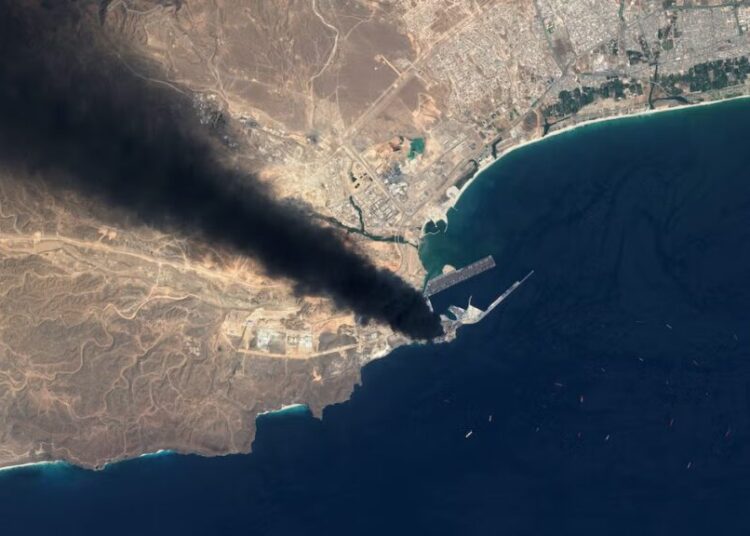
Since the start of the war in the Middle East, Iran has launched 23 cruise missiles, 498 ballistic missiles and a staggering 2,141 drones at the United Arab Emirates, according to the Emirati Ministry of Defense.
But the glittering towers of cities like Abu Dhabi, Dubai and Sharjah stand largely unharmed, and fatalities have been minimal. That is a testament to the effectiveness of modern military air-defense systems, which track and target missiles traveling faster than the speed of sound and shoot them out of the sky with another missile, saving many lives and sparing homes and property.
The wars in Ukraine and now the Persian Gulf have highlighted the crucial role interceptors play in protecting cities like Kyiv or Tel Aviv or Riyadh, not to mention American bases in Bahrain, Kuwait and other Gulf states. But the supply chain behind those interceptors has been strained for years, stressed by the war in Ukraine, past engagements with Houthi rebels along the Red Sea and last year’s 12-day war with Iran.
Missile defense experts are sounding increasingly dire warnings that if the war with Iran continues, stockpiles could become dangerously low, leaving allies around the world vulnerable to attacks.
“We started this conflict with a big hole,” said Tom Karako, the director of the Missile Defense Project at the Center for Strategic and International Studies in Washington. The center published a report on the depleting inventory of interceptors in December, before the current conflict even kicked off. “The hole got a lot bigger over the last month as we keep shooting these things off,” Mr. Karako said of the interceptors.
The dwindling supply of interceptors among the United States and its allies is in part attributable to Iran’s tenacious ability to go on the offensive — launching drones and missiles at Israel, American bases and civilian targets in the Gulf.
“Do not hope that you have destroyed our strategic missile production centers, long-range offensive drones” and modern air defense, a spokesman for the leadership of Iran’s Revolutionary Guards said in a video statement on Thursday.
Further, defense doctrine calls for two interceptors fired for each incoming missile, referred to as “shoot — shoot — look.” That means defensive stockpiles are depleted twice as fast as the offensive weapons they are shooting down.
In the current war, the U.S. military coordinates air-defense systems with Israel, Saudi Arabia, the Gulf states and others. They rely on a variety of launch systems — including Patriot and Terminal High Altitude Area Defense (THAAD) batteries, both fired from land, or Standard Missiles launched from Navy warships at sea.
An air-defense system is more than just a glorified quiver of missiles. A THAAD battery, for instance, includes 48 interceptors divided among six launchers mounted on trucks, a command-and-control platform and a radar. A Patriot battery also has a radar set and control station among its components.
In the opening days of the war, Iran conducted strikes aimed at communication and radar systems on at least seven U.S. military sites across the Middle East, trying to effectively blind the systems used to track incoming missiles. It is unclear how successful the strikes were.
The number of interceptors in a nation’s arsenal is a closely guarded secret. No country wants its enemy to know just when it might run out. But analysis of Gulf state defenses suggest the waves of missile and drone attacks by Iran have sorely depleted the interceptor inventories in countries like the United Arab Emirates, Kuwait and Bahrain.
For instance, a report by the Jewish Institute for National Security of America, or JINSA, a Washington research organization, estimated that the United Arab Emirates and Bahrain had expended more than three-quarters of their Patriot missile PAC-3 interceptor stockpiles, one of the main defensive missiles in their arsenals. The report relied on an analysis of each nation’s prewar stockpiles and its potential interceptor use since the start of the conflict.
The governments did not respond to a request for comment on the JINSA assessment.
Intercepting missiles has become a routine part of warfare for the United States and its allies, especially Israel, for whom it is a daily part of domestic defense. The interceptor systems provide a security blanket but are not foolproof. Israel’s vaunted, three-tier missile defense system came under growing scrutiny after two Iranian ballistic missiles evaded air defenses near Israel’s main nuclear research facility and reactor last month.
Even when missiles are intercepted, civilians and property are not necessarily out of harm’s way. Falling wreckage from the collision of two missiles can rain down on towns and cities; debris from an intercepted missile killed two people in Abu Dhabi last month.
The rise of cheap drones has complicated the math for militaries using expensive interceptors. An adversary can attack with one-way drones that cost tens of thousands of dollars, forcing its enemy to deploy multimillion-dollar air-defense systems to repel them. And the drones are much more easily and rapidly replaced.
A cease-fire with Iran would not completely solve the interceptor shortage, experts said.
Shortages in interceptor inventories are a global challenge. That was most acutely obvious in Ukraine after Russia invaded four years ago, launching large volleys of missiles, and later drones, at Ukrainian towns and cities, bombardments that continue to this day. In pleading for Western weaponry, Kyiv has regularly emphasized the urgent need for air-defense systems.
But it is not only Ukraine and Middle East countries that are counting on a steady supply of interceptor systems. Countries like Taiwan, South Korea and Japan are relying on missile batteries to deter potential aggression by North Korea or China, and with the nations of Western Europe getting serious about their defenses against Russia, the global nature of the challenge has become apparent.
President Trump has tried to goad the American defense industry into revving up the military supply chain. He signed an executive order in January limiting stock buybacks and dividends by defense contractors unless they sped up production and quality. In March, he hosted the chief executives of major contractors like Boeing, Raytheon and Lockheed Martin at the White House to discuss ramping up production.
Lockheed Martin announced plans in January to more than triple production of PAC-3 interceptors for Patriot batteries.
South Korean defense manufacturers have increasingly stepped in to try to fill the gap. The United Arab Emirates began using a Korean-made air-defense system last month that had never before been tested in combat but that reportedly shot down 29 of 30 of the missiles and drones it targeted, according to the South Korean news media and a government official.
But the complexity of the interceptor systems makes them hard to mass produce quickly, said Tal Inbar, an Israeli senior research fellow at the Missile Defense Advocacy Alliance, a nonprofit based in Virginia.
Mr. Inbar said that the kinds of interceptors used in THAAD or Arrow-3 systems require sub-components that are made to order, advanced electronics and a great deal of testing. “There are no stockpiles of those systems,” he said, “so again you are relying on other factories and in some cases other countries.”
“It’s not like a factory producing 9-millimeter pistol ammunition,” he said.
John Ismay contributed reporting.
Nicholas Kulish is a Times reporter who covers the changing nature of warfare in conflict areas around the world.
The post Interceptor Missiles Save Lives, but Stockpiles Are Dwindling appeared first on New York Times.