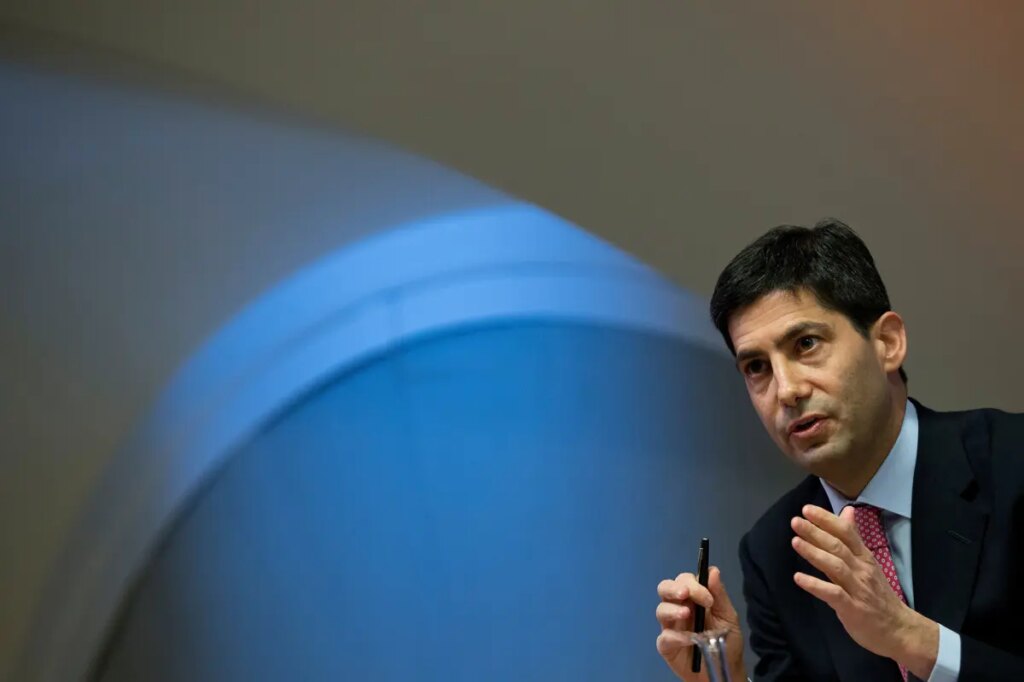

Kevin Warsh would like to start as Fed chairman yesterday, but his nomination as the head of the central bank remains in limbo.
The longer it does, the more the country’s economy is at risk.
With all that’s going on in the world, oil prices rising and inflation looming, it’s easy to forget that Warsh remains sidelined at a particularly vulnerable time for the US economy.
The current Fed chair, Jerome Powell, is of course a lame duck after butting heads with the president over interest rate policy, and President Trump has been doing all he can to remove Powell even before his term ends in May.
Trump’s moves to oust Powell — including a DOJ investigation into his testimony over the pricy rehab of the Fed’s headquarters in DC — isn’t sitting well with plenty of financial types and even GOPers, who worry it’s both overblown and an affront to the central bank’s long-held role as an independent agency that controls the money supply.
Sen. Thom Tillis, a ranking Republican from North Carolina on the Banking Committee, won’t vote to move Warsh’s nomination to a full Senate vote unless the Powell probe goes away.
A Tillis rep said there was no change to his position as this piece went to press.
So here we are at a stalemate with the prospect of Powell remaining in his chair for the foreseeable future.
He can wait for a replacement and lead the agency on a “pro tem” basis, while the future of monetary policy is mired in uncertainty.
The world isn’t binary, of course: you can dislike Trump’s methods to dump Powell and still see the need for him to go and get Warsh in that job the minute Powell’s term ends.
It goes beyond the economic issues that the conflict with Iran presents.
The central bank is an agency in need of reform, and if you do a little reporting on what Warsh intends to do when — or if — he gets in there, you will understand why we need him in the job ASAP.
‘Dual mandate’
The first reason is we need a Fed chair who understands the limits of the job, or at least why the agency was created in the first place back in 1913 with the Federal Reserve Act.
Congress and then-President Woodrow Wilson envisioned a central bank that helped control the country’s money supply, but with a narrow scope of duties primarily to protect the value of the dollar from the ravages of inflation and devaluation and be a lender of last resort during banking panics.
Years later, those duties were amended into something called the “dual mandate.”
The Fed on top of those duties was still required to maintain price stability (i.e., low inflation), but with an additional goal of “maximum employment.”
If you think these are competing goals, you wouldn’t be wrong.
Drawing the line between keeping inflation in check while not slowing the economy into recession isn’t easy.
It has bedeviled just about every Fed chair since the mandate was created in the late 1970s — including Powell, maybe most of all, because his mission appeared to creep well beyond the customary bounds.
To be sure, Powell has often been dealt a tough hand.
He was chair through COVID, when the economy was shut down and money printing was necessary to prevent its collapse.
He was appointed by the president during Trump’s first term and let’s just say the two never hit it off.
For years now, the president has believed that the Powell Fed has been reluctant to cut rates in ways that make him happy, and when Trump took over for Round 2, the battle heated up again.
But Powell’s mistakes were significant and, IMHO, self-inflicted, and I’m not talking about what he said or didn’t say during those Senate hearings over the new HQ.
He sharply cut interest rates in September 2024 just weeks before the presidential election that pitted Democrat Kamala Harris against Trump.
(Powell supporters would point out he also cut after Trump won the election).
Maybe the numbers — cooling inflation and slowing growth — were on Powell’s side, but let’s just say it didn’t sit well with the economic types Trump brought to the White House when he won and saw it as political.
Then there was the mission creep that went far beyond anything Congress envisioned when it created the Fed.
Warsh himself has raised this point about the Fed, and how under Powell it doubled down on its role as a policy-making arm of the government through the use of its massive balance sheet to control interest rates and economic growth that should come from elected officials in government.
But there’s more.
Powell has vocally supported Diversity, Equity and Inclusion, and Environmental Social Governance, with the Fed monitoring climate changes as risks for the economy.
That came to an end when Trump was elected and issued an executive order ending such practices in government.
But it’s hard to square Powell’s embrace of political hot potatoes (DEI has since been rendered constitutionally dubious by the Supreme Court) when he is supposed to be monitoring the money supply.
Warsh is promising to bring the Fed back to its basics.
Too bad he can’t get started like yesterday.
The post Kevin Warsh needs to be confirmed as Fed Chair in order to avoid an economic shutdown appeared first on New York Post.