The astronauts of Artemis II were 179,853 miles from Earth and at the time this article was published.
As Day 4 dawned on the Artemis II mission, the astronauts were closer to the moon than to Earth, after crossing the halfway point between the two bodies on Friday night.
Before Day 3 ended, the stark gray disk appeared in the crew’s view of the blackness of space from the window of their Orion spacecraft overnight. The crew has named the vehicle Integrity.
“It is a beautiful sight,” said Christina Koch, a mission specialist, while communicating with mission control on Earth. “We’re seeing more and more of the far side, and it’s just a thrill to be here.”
With their destination looming, Reid Wiseman, the mission commander, said in an update shared by NASA that the crew wasn’t sure what day it was on their home planet.
“We heard a rumor up here that it is actually Saturday back on Earth,” he said in a check-in with mission control after the crew started their day. “We have definitely lost track of the days.”
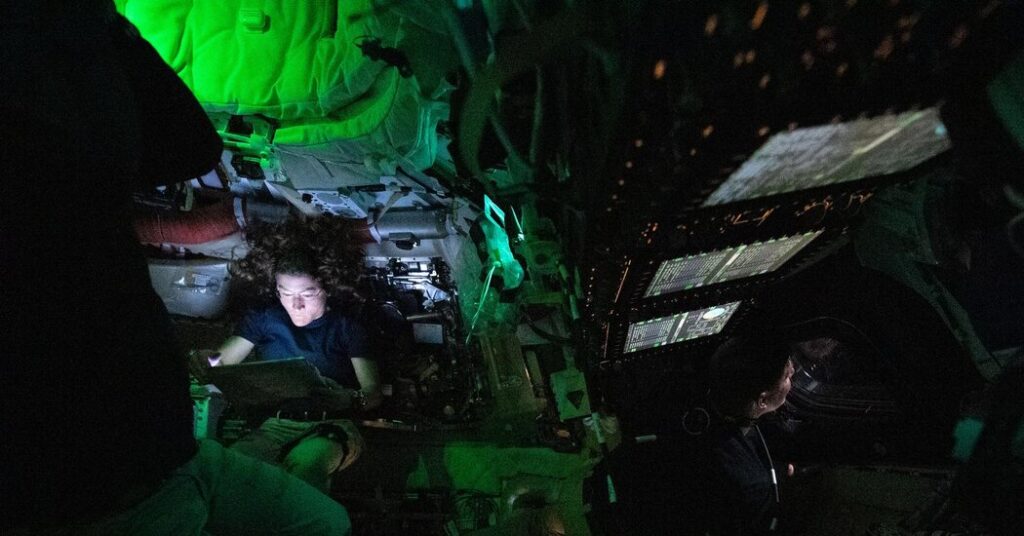
NASA shared more pictures taken from Integrity, including a view of what is mostly the lunar near side, the part that is visible from the ground and splotched with dark plains where lava once formed. Other images that NASA released show Ms. Koch and Mr. Wiseman gazing out of the window at Earth as it recedes into the distance.
Using a camera on one of its solar arrays, Orion also snapped a picture of the retro NASA “worm” logo on its side. The agency brought the worm out of retirement in 2020.
After a busy first two days of the mission, the Artemis II crew transitioned to more routine tasks on their third day of flight, including exercising and medical check-ins. They also began deploying cameras and other equipment that will be used during the lunar flyby.
Mission control woke the astronauts on Saturday around 12:35 p.m. Eastern time and began troubleshooting the toilet drain. On Friday night, a routine wastewater dump to funnel urine out of the capsule and into space failed, most likely because of ice on the drain nozzle.
From Houston, flight controllers positioned Integrity to orient the nozzle of the drain line toward the sun in hopes of thawing any ice. In the meantime, the crew will use backup waste collection bags, like the Apollo astronauts in the 1960s and 70s.
“We are no-go for toilet,” Ms. Koch said as flight controllers attempted another wastewater dump.
Tonight, Victor Glover, the Artemis II pilot, will perform a second test drive of Integrity’s manual handling, this time in deep space, to demonstrate how the Orion spacecraft can be controlled while maneuvering the spacecraft in different modes.
After that, the crew will begin to review a list of lunar-surface features they will analyze and photograph on Monday, while looping around the side of the moon we never see from Earth.
Down in Houston on Saturday, a couple dozen flight officers appeared calm in mission control at Johnson Space Center as Orion zoomed toward its target.
Judd Frieling, the Artemis II flight director, spoke to members of the media during a tour of mission control. He said his team was not anxious about losing contact with the astronauts as they sojourn behind our closest celestial neighbor.
“We absolutely know physics is going to take them back to us,” Mr. Frieling said. “We’ll take a break, a breather,” he added, “and we’ll meet them on the other side.”
Katrina Miller is a science reporter for The Times based in Chicago. She earned a Ph.D. in physics from the University of Chicago.
The post NASA Astronauts Are Closer to Moon Than Earth on Artemis II Day 4 appeared first on New York Times.