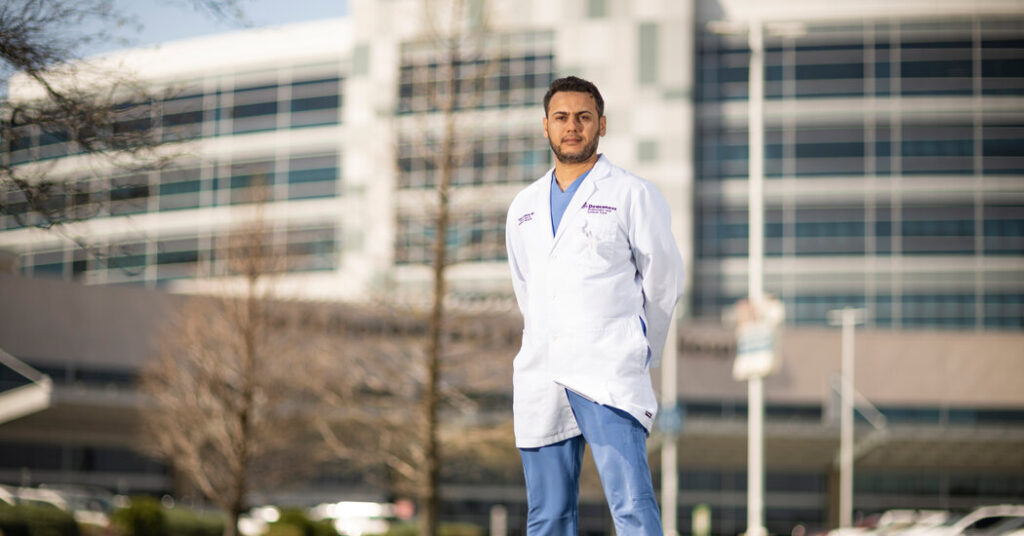
One Nigerian doctor performed knee and hip replacement surgeries at a New York teaching hospital. A Venezuelan physician treated people with diabetes and hypertension in rural Texas. A U.S.-trained ophthalmologist from Iran can no longer perform eye surgeries in Arkansas.
All three physicians have been forced to stop seeing patients after they were pushed out of their jobs because of a Trump administration policy that took effect in January and froze visa extensions, work permits and green cards for citizens of 39 countries as well as people with Palestinian Authority travel documents.
The fallout of the move, which stemmed from a December travel ban, is expected to be most pronounced in rural areas that have long had a dearth of doctors, and in communities with large populations of older Americans coping with chronic conditions. The disruption comes amid a broader immigration crackdown as the Trump administration has detained undocumented people, reduced refugee admissions and tightened visa scrutiny, among other measures.
“This was a big swipe at immigration without regard for particular categories of immigrants, like physicians, who are desperately needed,” said Andrew Wizner, a lawyer who represents medical institutions that hire foreign doctors.
In response to questions, the Homeland Security Department said in a statement that decisions on cases involving immigrants from “high-risk countries” had been placed on hold “to ensure they are vetted and screened to the maximum degree possible.”
The U.S. currently faces a shortage of about 65,000 physicians, according to the Association of American Medical Colleges. That deficit is expected to balloon over the next decade as Americans live longer and more physicians retire.
Foreign doctors currently comprise 25 percent of all doctors practicing in the country, and many have become citizens.
The Times reviewed a list of more than 100 physicians affected by the new policy, including doctors already on administrative leave and others who could be forced out when their work permits and visas expire.The list was created by the doctor’s themselves. Some agreed to be interviewed on the condition they not be identified, citing fear of retribution.
The Nigerian surgeon, who was performing knee and hip operations at a New York hospital as part of a fellowship, was pulled off the job in February after the government failed to renew his work permit.
The doctor, who has published dozens of peer-reviewed articles, has been offered a position at a university hospital in an underserved area starting July 1. That job treating patients and teaching residents is now in jeopardy.
The office of Senator Kirsten Gillibrand contacted U.S. Citizenship and Immigration Services to expedite the doctor’s case but was told he was ineligible because he is from a country subject to the processing freeze. Colleagues and hospital leaders said his removal harmed patient care, lowered morale and strained an already short-staffed team.
“We’ve doing this for decades, and there has always been a pathway forward for foreign physicians,” said Mr. Wizner. “Now it’s just a dead end for those affected by this adjudication pause.”
The affected doctors come from countries included in the ban, mostly from Africa and the Middle East, and are unable to work because they had immigration cases pending when the policy was announced.
Hundreds of foreign physicians affected by the pause have formed an informal professional network to exchange information. About 200 attended a recent online presentation by Curtis Morrison, a lawyer who has filed 13 lawsuits in federal court to compel the government to process the applications of particular individuals .
In a Feb. 27 letter to the secretaries of Homeland Security and State, chief executive of the American Medical Association, John Whyte, called for an exemption from the policy for physicians, citing national interest and harm to patients.
“It is important to support and expand pathways for these physicians to be able to enter and remain in the U.S. to care for our U.S. patients,” wrote Dr. Whyte, who noted that 900 patients were left without adequate care in a rural area after a physician was removed.
Ezequiel Veliz, a family physician from Venezuela who was named resident of the year in 2025 at UT Health, Rio Grande Valley, has been unable to work for months.
“I am stuck in processing purgatory,” said Dr. Veliz, 32. “The saddest part is that my patients are being affected.”
In a letter to U.S. Citizenship and Immigration Services, his former supervisor, Jose Cano, said that, “Dr. Veliz delivers outstanding, compassionate care to the patients of the Rio Grande Valley.”
Dr. Veliz’s patients adhered to treatment plans and consistently attended appointments, said Dr. Cano, who added that Dr. Veliz had served on the committee reviewing resident applicants and was among 20 young doctors chosen for a state leadership program.
American medical schools do not produce enough doctors. For residency positions starting this July, there were 41,000 residency positions available, according to official data, but only 32,000 applicants from U.S. medical schools.
Some 7,000 foreign doctors were selected to fill the gap, after rigorous exams and background checks. Once they complete training, many take jobs in federally designated underserved areas.
More than 60 percent of the foreign physicians practice primary care, including family medicine, internal medicine and pediatrics, fields that Americans often shun because of punishing workloads and lower pay compared to other specialties
“International medical graduates fulfill a critical need for our country,” said Dr. Rebecca Andrews, chair of the Board of Regents for the American College of Physicians, which represents internists, primary care doctors who treat adults.
“Bottlenecking the influx of these physicians will leave our health care system in a tenuous state,” said Dr. Andrews.
At Family Health Centers of Southwest Florida, which provide primary care to about 100,000 patients annually, half of the physicians are foreign born, including some from banned countries, said David Koester, vice president of the network.
“We would be hamstrung if they were not able to work or we were not able to recruit new ones,” he said. “A lot of these patients would overrun ERs and place a burden on hospitals.”
Physicians from the banned countries whose visas will expire soon are bracing for what is to come.
Among them is Kasra Moein, an Iranian physician on a small team conducting National Institutes of Health-funded research on heart disease and aging at the University of Oklahoma.
Dr. Andrew Gardner, who leads the study, said Dr. Moein has made significant contributions to the project.
Another doctor, Faysal Alghoula, of Libya, provides care to 960 patients, including military veterans, at two hospitals in rural Indiana.
He arrived in the U.S. in 2016. After rising to chief resident at Creighton University’s hospital in Nebraska, he went on to the Mayo Clinic in Rochester, Minn., where he completed three years of training in pulmonology and critical care.
In Indiana, Dr. Alghoula assesses patients referred to him from across the region with suspicious spots on their lungs and determines the appropriate treatment, surgery, chemotherapy or monitoring. In the ICU, he cares for patients on ventilators and suffering from heart failure.
But his O-1 visa, which is issued to people with extraordinary ability, will expire on Sept. 6. Although he has a green card application pending, he will have to stop working when the visa lapses. He has sued to compel the government to act.
“My life is suspended,” said Dr. Alghoula, a father of two U.S.-born girls, 3 and 4. “Should I renew my lease or not? Should I take a job in another country or not?”
He has received offers from Canada, but said that he preferred to stay in a place where there is a physician shortage.
“I’ve been screened and heavily vetted,” he said. “Now they say I’m high risk because I was born in Libya.”
Kirsten Noyes contributed research.
Miriam Jordan reports from a grass roots perspective on immigrants and their impact on the demographics, society and economy of the United States.
The post Trump’s Immigration Policy Sidelines Foreign Doctors Amid Shortage appeared first on New York Times.